News · Defence & Security
Yemen conflict escalates as Houthis hit Aden airport, target Riyadh
The reported attacks showed a rapid exchange between Yemen and Saudi Arabia. Houthi missiles and drones threatened Aden, while Saudi Arabia reported intercepting missiles aimed at its territory. The competing claims made it important to separate confirmed events from unverified statements. At Aden International Airport, Yemen’s Transport Ministry said one missile landed near the runway before a Cairo flight arrived. The flight diverted to Jeddah, and two planes on the ground were moved. Saudi Arabia said it destroyed a ballistic missile north of Riyadh and another near Khamis Mushait. Houthi spokesperson Yahya Saree claimed attacks on King Khalid airport, Abha airport, and a Khamis Mushait airbase. Saudi Arabia did not immediately confirm the airport attacks claimed by the Houthis. The article also says it was unclear whether the Khamis Mushait claim involved the intercepted missile. The uncertainty reflects the fog of wartime reporting and suggests further strikes could disrupt civilian travel and raise regional tensions.
Based on reporting by Daily Sabah Turkey
What attacks were reported in Yemen and Saudi Arabia, and which of them were confirmed or claimed by the opposing sides?
The reported attacks showed a rapid exchange between Yemen and Saudi Arabia. Houthi missiles and drones threatened Aden, while Saudi Arabia reported intercepting missiles aimed at its territory. The competing claims made it important to separate confirmed events from unverified statements.
At Aden International Airport, Yemen’s Transport Ministry said one missile landed near the runway before a Cairo flight arrived. The flight diverted to Jeddah, and two planes on the ground were moved. Saudi Arabia said it destroyed a ballistic missile north of Riyadh and another near Khamis Mushait. Houthi spokesperson Yahya Saree claimed attacks on King Khalid airport, Abha airport, and a Khamis Mushait airbase.
Saudi Arabia did not immediately confirm the airport attacks claimed by the Houthis. The article also says it was unclear whether the Khamis Mushait claim involved the intercepted missile. The uncertainty reflects the fog of wartime reporting and suggests further strikes could disrupt civilian travel and raise regional tensions.
What are ballistic missiles and explosive drones, and why are they difficult to defend against?
A ballistic missile is launched by a rocket and then travels along a high, fast arc toward its target. An explosive drone is an unmanned aircraft designed to carry and detonate explosives. The article identifies both as weapons used by the Houthis, but it does not explain their mechanics. These definitions use established military knowledge.
Defense is difficult for different reasons. Ballistic missiles can cover long distances quickly and may descend at very high speed. Defenders need early warning, tracking systems, and interceptors positioned along the missile’s path. Drones are often slower, but they can fly close to the ground, change direction, and appear alongside other drones or missiles.
The article describes Houthi weapons as a regional threat and reports interceptions near Riyadh and Khamis Mushait. Interception can prevent destruction, but it does not eliminate danger. Launch sites, warning networks, and civilian airports remain exposed, especially when attackers use several methods at once.
What happens to air travel and civilian safety when an airport such as Aden International is targeted?
When an airport is targeted, normal aviation procedures immediately give way to safety measures. Flights may be cancelled, diverted, or delayed. Aircraft on the ground may be moved, and runways may close for inspections. Passengers can be stranded, while airport workers and nearby residents face the danger of additional strikes.
Aden provided a clear example. Yemen’s Transport Ministry said a missile landed near the runway minutes before a flight from Cairo was expected. Authorities cancelled the landing and diverted the aircraft to Jeddah. They also moved two planes away because they feared further attacks. Even without reported casualties, the strike disrupted an essential civilian service.
Aden is the main international gateway for areas outside Houthi control. Repeated attacks could isolate those areas, interrupt aid and commercial travel, and increase insurance and security costs. They also show how fighting can affect civilians far from front lines. Airport authorities must balance keeping routes open with protecting lives.
How large and geographically widespread is the conflict, given that the Houthis control much of northern Yemen, have targeted Saudi cities, and threaten the Bab el-Mandeb area?
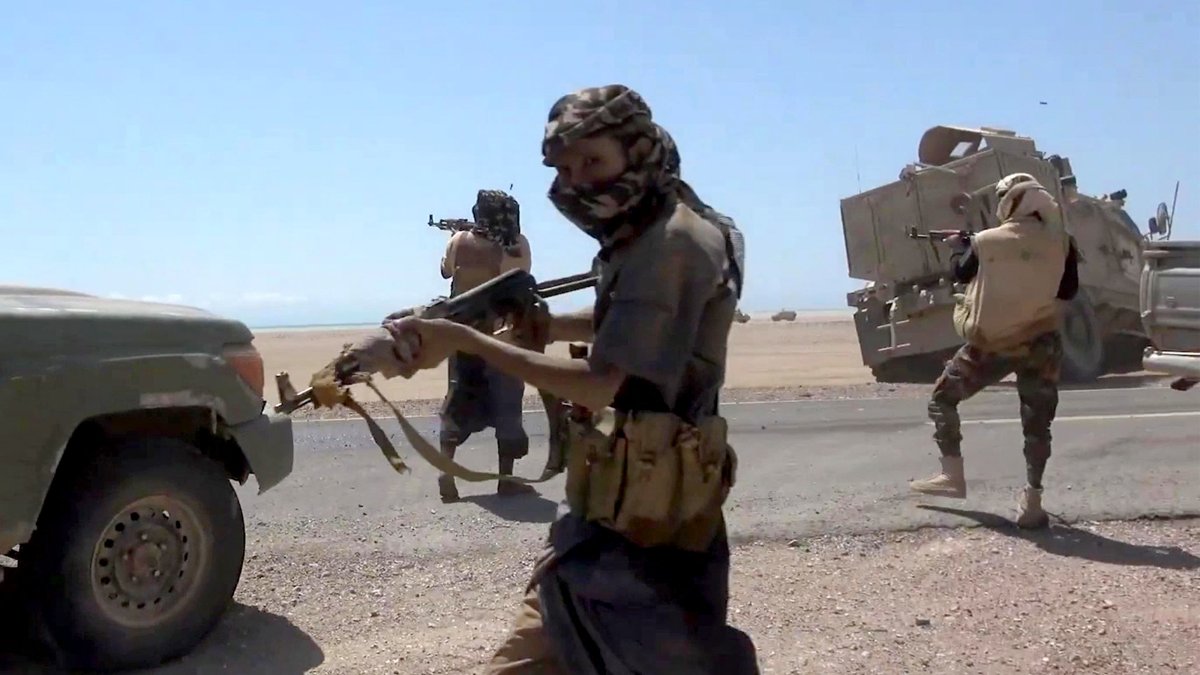
The conflict is geographically broad because the Houthis hold much of northern Yemen while fighting also reaches southern and western areas. Government forces and Saudi-backed fighters launched an offensive along the Red Sea coast near Bab el-Mandeb and Mokha. Houthi attacks also extended across the border into Saudi Arabia, showing the war’s regional reach.
The article names several locations. Houthi-held Sanaa is linked to a missile launch platform. Aden, outside Houthi control, came under attack. Saudi reports mentioned Riyadh and Khamis Mushait, while the Houthis claimed attacks involving Abha and King Khalid airports. These places span Yemen’s capital, southern gateway, western coast, and Saudi population centers.
This spread raises risks beyond battlefield losses. Fighting near Bab el-Mandeb could threaten shipping, while attacks on airports endanger civilians and disrupt transport. Saudi defenses may intercept missiles, but each launch can trigger retaliation. The wider the conflict becomes, the harder a local ceasefire will be to sustain.
Who are the Houthis, Yemen's internationally recognized government, the Saudi-led coalition, and Iran, and what role does each play in the war?
The Houthis are an armed Yemeni movement that seized Sanaa in 2014 and now controls much of northern Yemen. They possess missiles and drones and describe themselves as an independent force. Yemen’s internationally recognized government is the opposing national authority, supported by forces trying to recover territory taken by the Houthis.
Saudi Arabia leads the coalition backing that government. The coalition provides military support, including air power, and says it is defending Saudi security and opposing Iranian influence. Iran is not described as openly fighting in the article. Instead, the coalition accuses Tehran of arming, training, and funding the Houthis. Iran rejects those accusations, and the Houthis deny being an Iranian proxy.
These roles make the war both domestic and regional. Yemeni forces fight over territory and political authority, while Saudi Arabia responds to cross-border threats. Iran’s alleged involvement adds a wider rivalry. Because each actor has different goals, battlefield gains do not automatically produce a lasting political settlement.
How did the Houthis' seizure of Sanaa in 2014, Saudi intervention, and the 2022 truce lead to the renewed fighting?
The modern escalation began when the Houthis seized Yemen’s capital, Sanaa, in 2014. That takeover threatened the internationally recognized government and increased Saudi fears that Iran would gain influence next door. Saudi Arabia therefore led a military coalition into the war. The intervention turned a Yemeni power struggle into a larger regional conflict.
A United Nations-brokered truce in 2022 largely stopped heavy fighting. However, it did not create a lasting political settlement. The Houthis retained major territory, including much of northern Yemen, while the government and its allies continued opposing them. The article says a spillover from the Iran conflict later triggered the latest fighting, followed by a government counteroffensive.
The renewed battles show why a pause is not the same as peace. Without agreement over power, territory, security, and outside support, combat can restart quickly. The current offensive around the Red Sea coast may change front lines, but it could also widen the war and make another durable settlement more difficult.
What is the Bab el-Mandeb Strait, and why does control of its surrounding coast matter for international shipping and regional power?
Bab el-Mandeb is a narrow maritime passage at the southern entrance to the Red Sea. The article calls it a strategic shipping route and describes fighting near its surrounding coast. In geographic terms, it connects Red Sea traffic with the Gulf of Aden, making it a gateway between major sea routes.
Its nearby coastline matters because forces there can monitor, threaten, or protect ships moving through the passage. The Yemeni government’s counteroffensive aimed to capture Red Sea territory around Bab el-Mandeb and the city of Mokha. Those operations were therefore about more than local towns. They also concerned access, security, and influence over international maritime movement.
If fighting remains close to the strait, shipping companies may face greater danger, delays, or higher security costs. Control of the coast could give either side political and military leverage. The article does not report a closure, but continued attacks could turn a Yemeni battlefield into a wider regional shipping crisis.
Key Facts:
📌 A missile landed near Aden airport’s runway before a Cairo flight was due.
📌 Saudi Arabia reported intercepting missiles near Riyadh and Khamis Mushait.
📌 The Houthis claimed airport attacks Saudi authorities had not immediately confirmed.
📌 Ballistic missiles use rocket launches and follow high-speed trajectories.
📌 Explosive drones are unmanned aircraft carrying warheads.
📌 Low flight, speed, maneuvering, and multiple attacks complicate defense.
📌 A Cairo flight was diverted from Aden to Jeddah.