News · Defence & Security
At Least 8 Killed in Overnight Russian Strikes on Ukraine
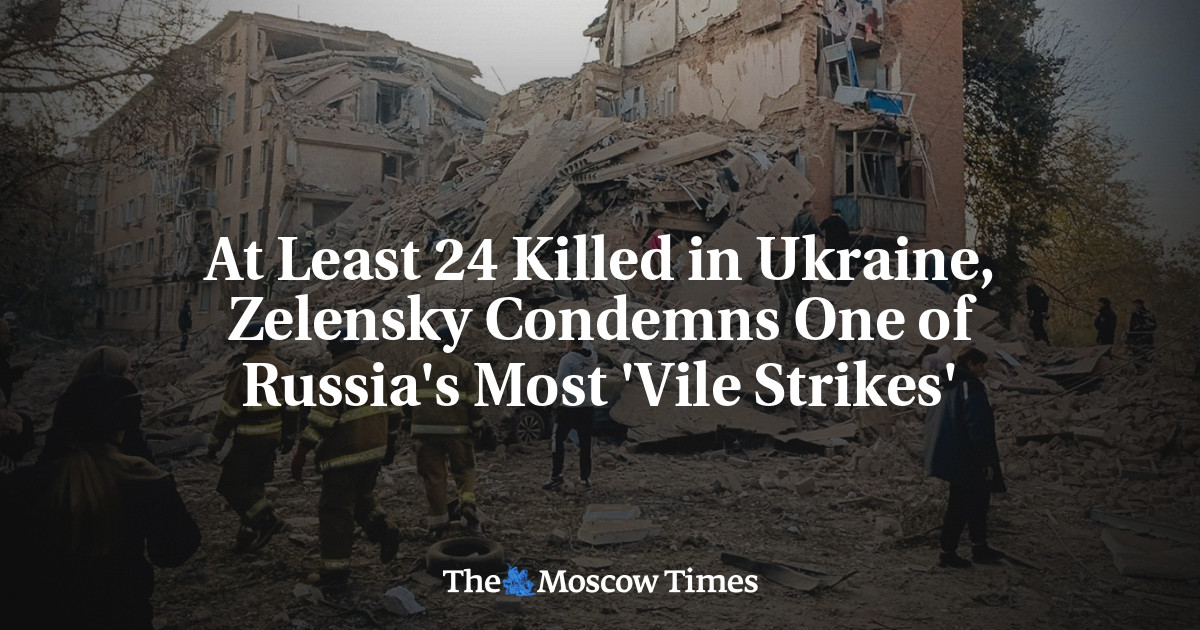
Russia launched a large overnight attack across Ukraine, killing at least eight people and damaging homes, industrial sites, and infrastructure. The barrage included drones, cruise missiles, and ballistic missiles. Ukrainian officials described another night of widespread strikes and civilian danger. The capital Kyiv was attacked, and residents sheltered in metro stations. A missile hit a five-storey apartment building in Pryluki, in the Chernihiv region, killing at least four people and wounding 20. Two people died in Kyiv, while two others were killed in Poltava region. The Ukrainian air force also reported attacks on Poltava, Dnipropetrovsk, and Kharkiv. Officials reported damage to an industrial facility in Dnipro, transport infrastructure in Zaporizhzhia, and apartment buildings in Kremenchuk. The spread of locations shows how overnight strikes can affect both major cities and regional infrastructure.
Based on reporting by Moscow Times
What happened in the overnight attacks, and which Ukrainian cities and regions were hit?
Russia launched a large overnight attack across Ukraine, killing at least eight people and damaging homes, industrial sites, and infrastructure. The barrage included drones, cruise missiles, and ballistic missiles. Ukrainian officials described another night of widespread strikes and civilian danger.
The capital Kyiv was attacked, and residents sheltered in metro stations. A missile hit a five-storey apartment building in Pryluki, in the Chernihiv region, killing at least four people and wounding 20. Two people died in Kyiv, while two others were killed in Poltava region.
The Ukrainian air force also reported attacks on Poltava, Dnipropetrovsk, and Kharkiv. Officials reported damage to an industrial facility in Dnipro, transport infrastructure in Zaporizhzhia, and apartment buildings in Kremenchuk. The spread of locations shows how overnight strikes can affect both major cities and regional infrastructure.
How many drones and missiles did Russia launch, and how many targets did Ukraine say its air defenses destroyed?
The scale was substantial: Ukraine’s air force said Russia launched 130 drones, 48 cruise missiles, and ballistic missiles during the overnight attack. The statement did not give a number for the ballistic missiles. This combination can challenge defenses because different weapons may approach at different speeds and along different flight paths.
Ukraine said its air-defense units downed 161 targets. That figure refers to targets intercepted or destroyed, not necessarily to every weapon launched. The reported totals therefore should not be treated as a complete missile count, because the number of ballistic missiles was not specified.
Even after many interceptions, deadly damage occurred. A missile hit an apartment building in Pryluki, while strikes also damaged facilities in Dnipro, Zaporizhzhia, and Kremenchuk. The figures show both the reach of the barrage and the importance of layered air defenses.
What are drones, cruise missiles, and ballistic missiles, and how do they differ in speed, flight path, and purpose?
The article names all three weapon types but does not define them; these distinctions come from established military knowledge. A drone is an unmanned aircraft that can observe, carry explosives, or strike a target. It is often slower and reusable or relatively inexpensive. A cruise missile is a powered, guided weapon that flies most of the way through the atmosphere, often at low altitude, toward a selected target.
A ballistic missile usually accelerates rapidly, then follows a high, arcing trajectory before descending at great speed. Unlike many drones, it is built mainly for a one-way strike. Cruise missiles can maneuver during flight, while ballistic missiles rely more on speed and trajectory. Drones can loiter or arrive in large numbers.
These differences matter because defenses must detect and respond to varied threats. In the article, Russia used drones, cruise missiles, and ballistic missiles in one barrage. Their mixed profiles can complicate warning, interception, and protection of cities.
Why can residential buildings and civilians still be hit even when air defenses intercept many incoming weapons?
Intercepting many incoming weapons reduces danger, but it cannot guarantee complete protection. Air-defense systems have limited ammunition, coverage areas, reaction time, and ability to track every target. A large barrage can force defenders to make rapid choices about which threats to engage and where to concentrate protection.
The article illustrates this gap clearly. Ukraine said it downed 161 targets, yet a missile struck a five-storey residential building in Pryluki. At least four people died there and 20 were wounded. Kyiv residents also sheltered underground while ballistic missiles and drones targeted the capital.
Threats can also arrive on different paths and at different speeds. A weapon that evades interception can hit directly, while fragments from an interception may fall over populated areas. Damage can therefore continue even when defenses perform many successful interceptions. Ukraine’s reported air-defense shortage made this vulnerability more serious.
What military-industrial facilities did Russia say it was targeting, and why would a missile-and-drone manufacturer such as Fire Point matter in the war?
Russia’s Defense Ministry said its “massive strike” targeted military-industrial facilities in Kyiv and several Ukrainian regions. It specifically named sites where Ukrainian defense company Fire Point allegedly manufactures and stores Flamingo cruise missiles and medium- and long-range drones. Russia also listed regions including Kyiv, Chernihiv, Kirovohrad, Dnipropetrovsk, Poltava, and Kharkiv.
The article does not independently confirm those targeting claims. Fire Point matters because a producer of missiles and drones can expand Ukraine’s ability to attack, surveil, and defend over long distances. Last week, President Volodymyr Zelensky said Ukraine had used its first domestically made ballistic missile in combat.
Domestic production can reduce reliance on foreign deliveries and help sustain operations during a prolonged war. Zelensky said Fire Point expected a longer-range FP-9 missile by autumn. The company has said it could reach Moscow, making its development strategically significant, though that future capability was not yet confirmed in the article.
What happens to a country’s cities, infrastructure, and military operations when it has a critical shortage of air-defense systems?
Air-defense systems protect people and essential facilities by detecting, tracking, and intercepting incoming weapons. When a country lacks enough systems, it cannot cover every city, industrial site, power link, or transport route. Leaders must choose which places receive the strongest protection, leaving other areas more vulnerable.
The article says Ukraine faced a critical shortage of air defenses for months. During this attack, residential buildings in Pryluki and Kremenchuk were damaged, an industrial facility in Dnipro was hit, and transport infrastructure in Zaporizhzhia was damaged. Kyiv residents sought shelter in metro stations as missiles approached.
The effects extend beyond immediate destruction. Repeated strikes can disrupt transport, industry, civilian routines, and military logistics. They also force officials to plead for additional supplies, as Zelensky and others repeatedly did. Until more protection is available, large barrages can keep threatening both population centers and the country’s ability to operate during war.
How do long-range missiles and drones change modern warfare by allowing a country to strike targets far behind the front line?
Long-range missiles and drones extend combat beyond the immediate front line. They allow a country to attack military facilities, production sites, transport networks, and urban areas hundreds of kilometers away, depending on the weapon. This can disrupt supplies and daily life while forcing defenders to protect a much larger area.
The article shows this depth directly. Russia attacked Kyiv, while also striking or damaging sites in Chernihiv, Poltava, Dnipropetrovsk, Kharkiv, Zaporizhzhia, and Kremenchuk. Russia said it was targeting Fire Point facilities connected to missile and drone production. Ukraine, meanwhile, has developed domestic long-range weapons, including the Flamingo program described in the article.
The result is a contest of reach, production, and defense. Longer-range weapons can pressure governments and industries far from the battlefield, but they also require intelligence, manufacturing, and reliable guidance. As both sides expand these capabilities, air defenses must cover more territory and protect more kinds of targets.
Key Facts:
📌 At least eight people were killed in the overnight attacks.
📌 Pryluki apartment strike killed four people and wounded 20.
📌 Kyiv, Poltava, Dnipropetrovsk, and Kharkiv faced attacks.
📌 Russia launched 130 drones and 48 cruise missiles.
📌 The attack also included an unspecified number of ballistic missiles.
📌 Ukraine said air defenses downed 161 targets.
📌 Drones are unmanned aircraft with varied surveillance and strike roles.