News · International Relations
EU Approves Record Sanctions Expansion Targeting 1.6K Russian Citizens and Entities
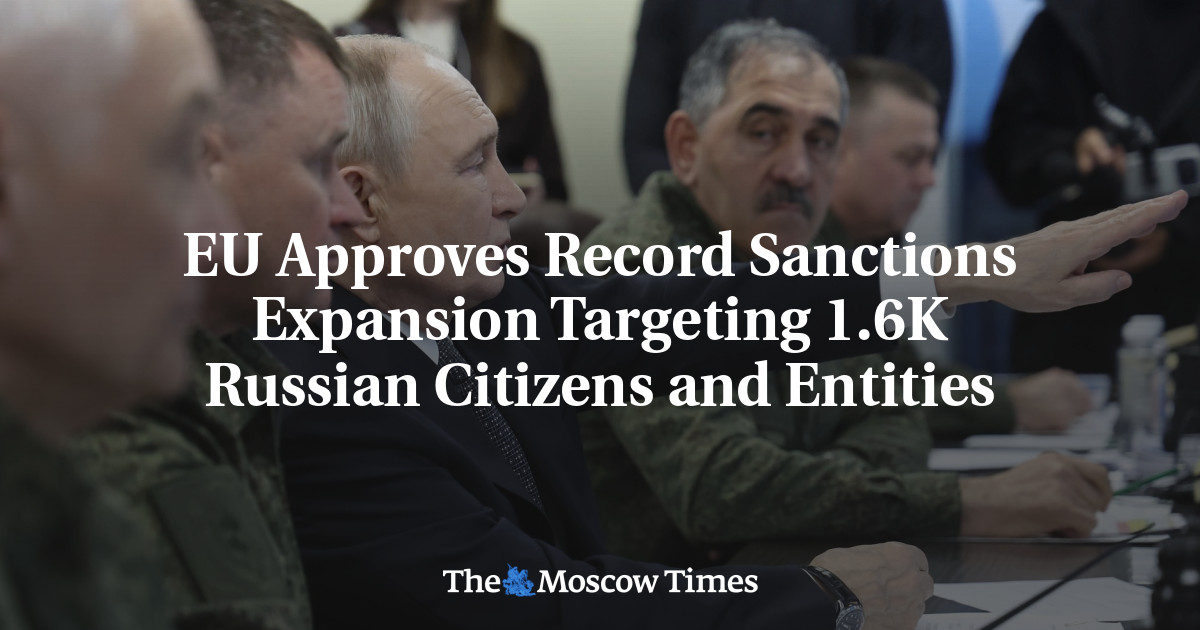
The 22nd sanctions package expands the EU’s restrictions connected to Russia’s war against Ukraine. It adds more than 1,600 people and entities, making it the largest expansion since the full-scale invasion began in 2022. Sanctions aim to restrict resources, access, and influence linked to the war. The package includes 743 individuals and 826 entities, primarily tied to Russia’s defense industry. More than half of the listings focus on missile production. It also includes 77 political figures and election officials connected to parliamentary elections held in Russian-occupied Ukrainian areas. The agreement is political approval in principle, not yet the final formal act. EU foreign ministers are scheduled to approve the expanded list in Luxembourg on Monday, according to the article. Once adopted, the package would raise the total number of people and entities under EU war-related sanctions to nearly 4,650.
Based on reporting by Moscow Times
What has the EU agreed to do in this 22nd sanctions package, and when will the decision become formally approved?
The 22nd sanctions package expands the EU’s restrictions connected to Russia’s war against Ukraine. It adds more than 1,600 people and entities, making it the largest expansion since the full-scale invasion began in 2022. Sanctions aim to restrict resources, access, and influence linked to the war.
The package includes 743 individuals and 826 entities, primarily tied to Russia’s defense industry. More than half of the listings focus on missile production. It also includes 77 political figures and election officials connected to parliamentary elections held in Russian-occupied Ukrainian areas.
The agreement is political approval in principle, not yet the final formal act. EU foreign ministers are scheduled to approve the expanded list in Luxembourg on Monday, according to the article. Once adopted, the package would raise the total number of people and entities under EU war-related sanctions to nearly 4,650.
What are sanctions, and what do travel bans, asset freezes, and bans on receiving EU funding mean in practice?
Sanctions are legal restrictions imposed by governments or international bodies to create pressure. They can punish conduct, limit resources, or signal opposition without using military force. In this case, the EU uses sanctions against people and entities connected to Russia’s war and related activities.
A travel ban prevents a listed person from entering or passing through EU countries, subject to limited exceptions. An asset freeze blocks access to money or property within the relevant jurisdiction. Ownership or control can also make company funds difficult to use. A ban on receiving EU funding prevents listed targets from benefiting from EU grants, contracts, or other financial support.
These measures do not automatically seize every asset worldwide or imprison someone. Their reach depends on EU law, location, ownership, and enforcement. The article says the new listings carry travel bans, asset freezes, and prohibitions on receiving EU funding.
How large is this expansion, and how does it compare with the EU’s total of nearly 4,650 sanctioned people and entities connected to the war?
The package is exceptionally large because it adds more than 1,600 people and entities in one expansion. The article identifies 743 individuals and 826 entities in the main group, or 1,569 combined. It also mentions several related listings under the EU’s separate North Korea sanctions framework, helping explain the broader figure.
The new additions include defense-linked companies, individuals, political figures, and election officials. The EU’s stated restrictions include travel bans, asset freezes, and bans on receiving EU funding. These tools apply to the newly listed targets and add to earlier measures.
The agreement would bring the total number of people and entities sanctioned over the war to nearly 4,650. Comparing more than 1,600 additions with nearly 4,650 total means the expansion is approximately one-third of the entire list. The scale signals a major effort to widen pressure across military, political, and economic networks.
Who is being targeted, and why are Russia’s defense industry, missile production, political figures, and election officials included?
The main targets are people and entities connected to Russia’s defense industry. More than half of the new listings reportedly concern missile production. The package also names 77 political figures and election officials tied to parliamentary elections held last month in Russian-occupied parts of Ukraine.
Defense-industry targets are included because they are linked to producing or supporting military equipment. Missile production is especially prominent in the reported list. Political figures and election officials are included because of their connection to the contested elections in territory internationally recognized as Ukrainian. The article describes these links but does not provide each target’s specific role.
The targeting therefore combines military and political pressure. Restrictions can limit listed actors’ access to EU travel, assets, and funding. The package also includes several Russia-related listings under the EU’s separate North Korea sanctions framework. Together, the categories show an effort to address both battlefield supply networks and political administration in occupied areas.
What practical effects could these sanctions have on the targeted people, companies, Russia’s military supply chains, and EU-related financial activity?
The practical effect is to make sanctioned people and entities less able to use EU-linked resources. Individuals may be denied entry or transit, while their covered assets can be frozen. Listed organizations can also be excluded from EU funding. These restrictions raise the cost of operating through European financial and institutional networks.
For defense companies, the impact could extend beyond frozen accounts. Banks, suppliers, contractors, and other businesses must avoid prohibited dealings, increasing compliance checks and transaction risks. If missile-related firms depend on EU-linked finance, equipment, or services, sanctions could make procurement and payments harder. The article does not measure any actual disruption yet.
The effect on Russia’s military supply chains would depend on enforcement and on whether targets can find substitutes, intermediaries, or non-EU suppliers. Sanctions are not an automatic shutdown. They create legal and financial barriers. EU-related financial activity involving listed targets must be screened and stopped where prohibited, while enforcement determines how much pressure results.
Why can a single EU member currently block or threaten sanctions decisions, and how would qualified majority voting change that process?
EU sanctions decisions in foreign policy generally depend on unanimity. This means every member state must agree. A single government can therefore block a new package or threaten to withhold consent, creating pressure for concessions. The article says officials are considering a change after recent disputes over listings.
Under qualified majority voting, a proposal would pass when it reaches the treaty-defined majority rather than unanimous approval. In the EU’s standard system, that usually means at least 55% of member states representing at least 65% of the EU population. The exact legal route for sanctions would matter, because foreign-policy rules have special procedures.
Such a change could make sanctions faster and less vulnerable to one-country vetoes. It could also make compromise inside the majority more important and raise concerns for states losing a veto over sensitive foreign policy. The article presents the shift as under consideration, not as an adopted rule.
How do international sanctions create pressure on a country, and what determines whether they actually change its behavior?
International sanctions work by limiting a government’s access to resources and relationships. They can restrict finance, trade, technology, travel, and foreign assets. The goal is to make a policy costly or difficult while avoiding direct military action. Their effect is usually gradual rather than immediate.
For example, an asset freeze can stop a listed entity from using covered funds, while export or financial restrictions can complicate military procurement. Banks and companies then avoid risky transactions because violations can bring penalties. Pressure spreads through compliance decisions, supply chains, and access to international markets. The article’s EU measures use several of these channels.
Success depends on enforcement, international cooperation, the target’s economic resilience, and access to alternative suppliers or financial routes. Sanctions may be weakened by evasion, intermediaries, or support from countries outside the sanctioning coalition. They can still signal political isolation and raise long-term costs, but the article does not claim that this package alone will change Russia’s behavior.
Key Facts:
📌 - The 22nd package targets more than 1,600 people and entities.
📌 - It is the EU’s largest Russia-sanctions expansion since the 2022 invasion.
📌 - EU foreign ministers are expected to approve it Monday in Luxembourg.
📌 - Travel bans restrict entry into or transit through EU countries.
📌 - Asset freezes block access to covered money and property.
📌 - EU funding bans prevent listed targets from receiving EU financial support.
📌 - The main listed groups total 1,569 individuals and entities.