News · Social Issues
France suspends use of stun grenades against protesters
Stun grenades are police crowd-control devices intended to disorient people with a loud blast, flash, or other sudden effect. Their use matters because these weapons can cause severe injuries if they explode close to someone or are handled incorrectly. The article focuses on their safety during protests. A sting-ball grenade is a specific type of stun grenade. Unlike an ordinary tear-gas canister, whose main purpose is to spread a chemical irritant, a sting-ball device can propel small projectiles or rubber balls while producing a startling blast. The article says a 15-year-old picked one up after it was used, and it detonated before he could throw it back. The article does not provide a complete technical description of either device. It does show the danger clearly: the teenager lost his hand, and another student was struck in the jaw by a fired tear-gas canister. Those injuries prompted France to suspend stun-grenade use at high-school protests while officials clarify what happened.
Based on reporting by DW News
What are stun grenades, and how do sting-ball grenades differ from ordinary tear-gas canisters?
Stun grenades are police crowd-control devices intended to disorient people with a loud blast, flash, or other sudden effect. Their use matters because these weapons can cause severe injuries if they explode close to someone or are handled incorrectly. The article focuses on their safety during protests.
A sting-ball grenade is a specific type of stun grenade. Unlike an ordinary tear-gas canister, whose main purpose is to spread a chemical irritant, a sting-ball device can propel small projectiles or rubber balls while producing a startling blast. The article says a 15-year-old picked one up after it was used, and it detonated before he could throw it back.
The article does not provide a complete technical description of either device. It does show the danger clearly: the teenager lost his hand, and another student was struck in the jaw by a fired tear-gas canister. Those injuries prompted France to suspend stun-grenade use at high-school protests while officials clarify what happened.
What exactly has France suspended, and which protesters does the suspension apply to?
France suspended the use of stun grenades during protests led by high-school students. This is a limited pause, not a nationwide ban on every crowd-control weapon or every protest. Interior Minister Laurent Nunez stressed that the measure applied only to high-school student protests.
The decision followed reports of serious injuries involving teenage protesters. On Monday, a 15-year-old lost his hand after a sting-ball grenade detonated while he was picking it up. The previous week, a 14-year-old was hit in the jaw by a tear-gas canister. An officer was charged in that case on Tuesday.
Nunez said the suspension would last only long enough to understand what happened. That means the government presented it as a temporary safety measure while facts are examined. Its narrow scope also leaves open the question of whether the policy will expand, end, or change after investigations and public debate.
How large are the protests, and how many protesters, police officers, students, and teachers have reportedly been injured or arrested?
France’s student protests have become a national movement rather than a small Paris gathering. The Interior Ministry said nearly 256,000 people joined demonstrations nationwide on Tuesday. Protests spread from the Paris region to smaller towns, and trade unions joined students on Tuesday.
The reported injury figures show that the unrest has affected several groups. Interior Minister Nunez said 761 police officers or gendarmes were wounded during roughly three weeks of protests. He also reported injuries to 215 students and 89 teaching staff. The article links particular public anger to serious injuries involving teenagers.
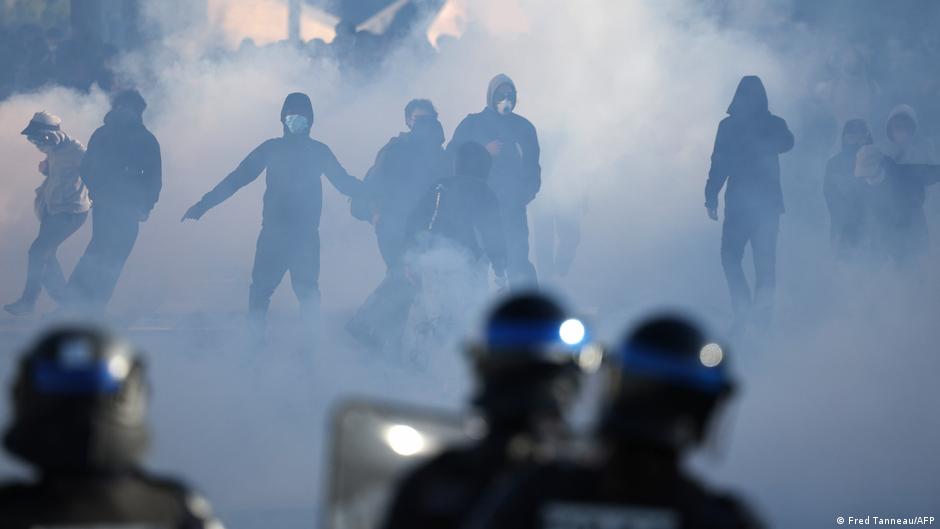
Arrests have also been extensive. More than 6,500 people were arrested during the previous two weeks, most of them minors. The article says clashes turned violent in Paris, where small groups confronted riot officers. These figures indicate a broad and tense crisis, while the government says its first response decisions will come at the end of October.
What consequences can follow when police crowd-control weapons seriously injure protesters?
When crowd-control weapons seriously injure protesters, the consequences can extend far beyond the original confrontation. People may lose trust in police, question whether force was necessary, and demand investigations or policy changes. Injuries can also intensify protests, especially when those hurt are teenagers.
The article gives two concrete examples. A 15-year-old lost his hand when a sting-ball grenade detonated as he picked it up. A 14-year-old was hit in the jaw by a tear-gas canister, and an officer was charged on Tuesday. These events helped drive public anger and led France to suspend stun grenades at high-school protests.
The wider consequences include political pressure and possible further clashes. Prime Minister Sebastien Lecornu said young people’s anger did not come from nowhere and promised concrete, funded responses. At the same time, officials must separate verified evidence from AI-generated misinformation, which the article says amplified tensions and could lead to prosecution.
Why are French students protesting, and how are concerns about unequal education connected to the wider unrest?
French students are protesting what they see as unequal conditions in the education system. They say teaching, facilities, and opportunities for advancement are worse in disadvantaged neighborhoods. This directly challenges France’s ideal of “Liberty, Equality, Fraternity,” because students do not experience equal chances in practice.
The protests began in the Paris region in mid-September and then spread nationwide, including to smaller towns. Trade unions joined on Tuesday, showing that the concerns reach beyond pupils alone. The article says students’ anger did not come from nowhere, reflecting frustration with promises that were not kept.
That education dispute has become part of a wider political crisis. Demonstrations have produced clashes, injuries, and thousands of arrests while France faces pressure to reduce debt and increase public-service spending. The government must now address both immediate safety concerns and the underlying inequality. Lecornu promised concrete, quick, and fully funded decisions by the end of October.
What other methods can police use to manage violent crowds when a particular weapon is suspended?
The article does not list alternative crowd-management methods. In general, police can begin with dialogue, warnings, liaison officers, and negotiated routes for peaceful demonstrators. Barriers, managed access points, and separating rival groups can also reduce danger without immediately using force.
If violence continues, officers may issue clear dispersal orders and create safe exit routes. They can make targeted arrests of people suspected of specific crimes rather than treating an entire crowd as a threat. Police may also use protective shields and other equipment, but every method carries risks and must be used under clear rules. Less-lethal does not mean harmless.
The best approach depends on the situation and local law. France’s current crisis shows why alternatives matter: 215 students and 89 teaching staff were reportedly injured, while 761 police or gendarmes were wounded. Authorities should explain tactics, record incidents, provide medical help, and review any force that causes serious injury.
What legal limits and responsibilities should govern the use of force by police during public protests in a democracy?
The article does not set out France’s full legal rules, but democratic policing rests on several established principles. Officers may protect people and property, yet force must have a lawful purpose and be necessary for the danger faced. It should be proportionate, meaning no more force than needed, and should distinguish violent individuals from peaceful protesters.
Police should give clear warnings when practical, allow safe routes away, and provide prompt medical assistance. Commanders should train and supervise officers, document weapons and decisions, and preserve evidence. Crowd-control tools should never be treated as harmless simply because they are labeled less-lethal. Independent review is especially important after severe injuries, such as the teenager’s lost hand.
Accountability protects both protesters and officers. Complaints should be investigated promptly, and credible evidence of unlawful force should lead to appropriate disciplinary or criminal proceedings. Officials must also communicate verified facts, because the article says AI-generated videos and disputed claims intensified tensions. Public safety and the right to protest must be protected together.
Key Facts:
📌 Stun grenades are intended to disorient crowds.
📌 Sting-ball grenades can propel projectiles as well as create a blast.
📌 A 15-year-old lost his hand when one detonated.
📌 The suspension covers stun grenades at high-school student protests.
📌 It does not apply to every French demonstration.
📌 Officials will review the incidents before deciding what happens next.
📌 Nearly 256,000 people protested nationwide on Tuesday.