News · Politics & Governance
Watch: Rahul Gandhi, Priyanka hauled away again after lie-in on Delhi road
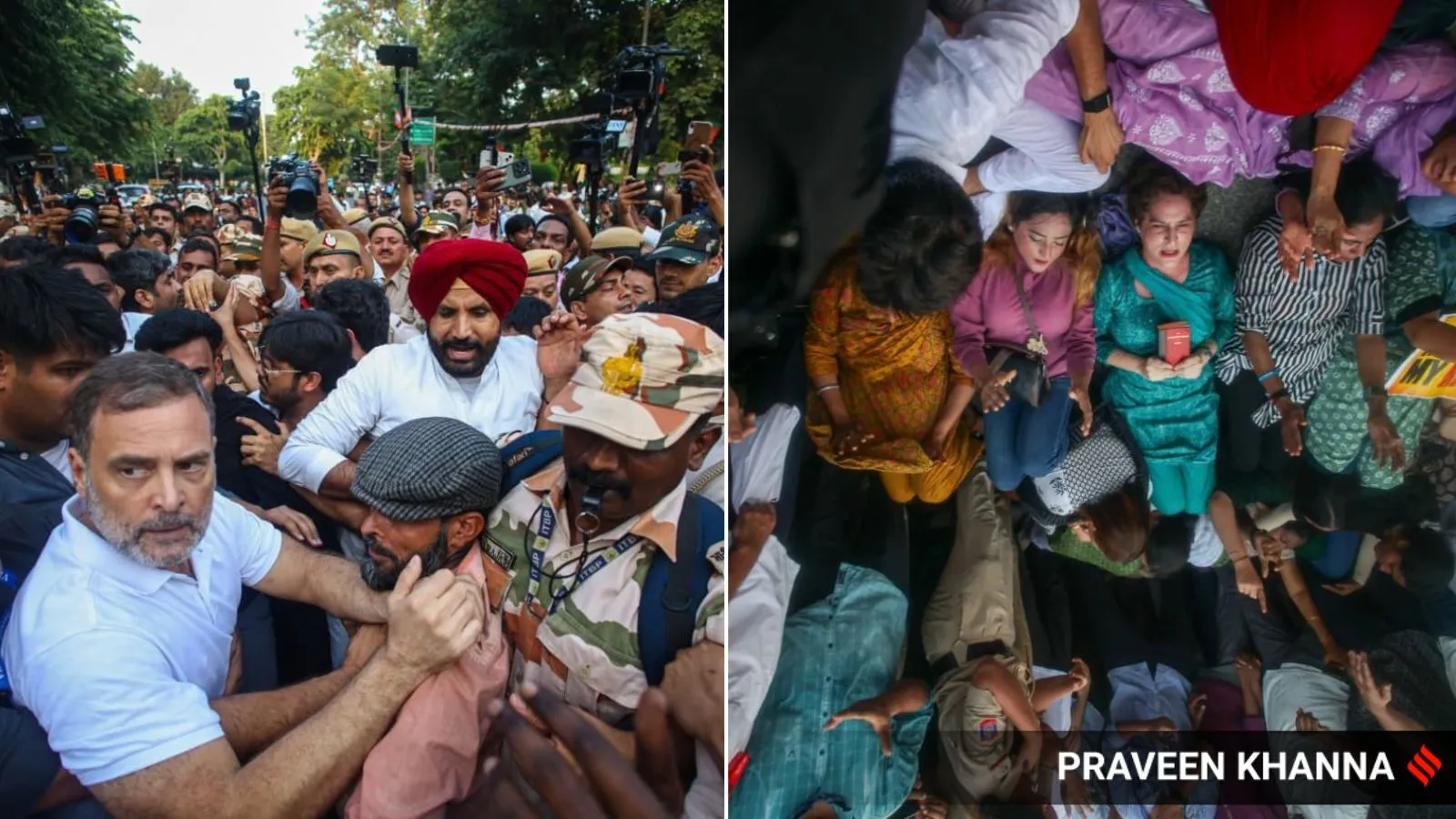
Rahul Gandhi and Priyanka Gandhi were detained during a confrontation near Windsor Place, about 900 metres from Jantar Mantar. Rahul was reportedly manhandled and forced into a police bus. Priyanka lay on the road with her arms crossed before officers took her away. She held a copy of the Constitution outside the moving vehicle. The leaders had joined an INDIA bloc procession after a Congress lunch meeting. Three buses carried MPs toward Jantar Mantar, but police stopped them at Windsor Place. Protesters then held an impromptu sit-in near the Shangri-La hotel. Rahul resisted being put into a police van, while other leaders jostled with security personnel. The article says police moved to detain protesters and clear the area. The report does not describe a court order or specify every legal basis for the detention. It does show that the action followed a road-blocking protest in a high-security area. Rahul was taken to Barakhamba police station, and other leaders were taken to a central Delhi police station. The confrontation became another visible escalation in the dispute over Chief Election Commissioner Gyanesh Kumar.
Based on reporting by Indian Express
What happened to Rahul Gandhi and Priyanka Gandhi during the protest, and why were they taken away by the police?
Rahul Gandhi and Priyanka Gandhi were detained during a confrontation near Windsor Place, about 900 metres from Jantar Mantar. Rahul was reportedly manhandled and forced into a police bus. Priyanka lay on the road with her arms crossed before officers took her away. She held a copy of the Constitution outside the moving vehicle.
The leaders had joined an INDIA bloc procession after a Congress lunch meeting. Three buses carried MPs toward Jantar Mantar, but police stopped them at Windsor Place. Protesters then held an impromptu sit-in near the Shangri-La hotel. Rahul resisted being put into a police van, while other leaders jostled with security personnel. The article says police moved to detain protesters and clear the area.
The report does not describe a court order or specify every legal basis for the detention. It does show that the action followed a road-blocking protest in a high-security area. Rahul was taken to Barakhamba police station, and other leaders were taken to a central Delhi police station. The confrontation became another visible escalation in the dispute over Chief Election Commissioner Gyanesh Kumar.
What is a designated protest site, and why did the police stop the leaders before they reached Jantar Mantar?
A designated protest site is a place identified by authorities for demonstrations. It helps balance the right to protest with public safety, traffic movement, and security. Jantar Mantar is described in the article as such a site. Protesting there normally gives officials a clearer way to manage crowds, routes, vehicles, and emergency access.
The Congress leaders said they wanted to protest at Jantar Mantar. After lunch, however, police stopped their buses at Windsor Place, roughly 900 metres away. Rahul Gandhi said officials had told them they could not protest at Jantar Mantar, even though it was a designated site. The buses and vehicles then crowded the roundabout near the Shangri-La hotel, where protesters staged an impromptu sit-in.
The article does not give a formal written reason for the stop. It records heavy police presence, a jammed high-security area, and police efforts to clear it. Thus, the immediate issue was not simply reaching the protest site. It was also the procession’s route, the blocked road, and the authorities’ attempt to control the gathering before it reached Jantar Mantar.
How large was the protest effort, and how many MPs did Rahul Gandhi say wanted to meet the Election Commissioners?
The protest effort was substantial but the article does not provide a complete headcount. After a lunch meeting hosted by Congress president Mallikarjun Kharge, MPs left in three buses for Jantar Mantar. Several leaders climbed onto one bus roof and waved the national flag. The procession then halted traffic around Windsor Place for the second day.
Rahul Gandhi said around 300 Lok Sabha and Rajya Sabha MPs wanted to meet the Election Commissioners. He also said 45 FIRs had been lodged against him and joked that he wanted 100, calling the cases “medals.” Most INDIA bloc parties attended the lunch meeting. The Samajwadi Party did not, because most of its MPs had reportedly left Delhi.
These figures describe the political scale claimed by Congress, not necessarily the number physically present at the protest. The article does not independently verify the 300-MP figure or provide a total crowd count. Still, multiple buses, senior leaders, and a large police response show that the action was designed as a major political confrontation. Further protests were expected over demands involving Gyanesh Kumar.
What is the Election Commission of India, and what authority does the Chief Election Commissioner have?
The Election Commission of India is an independent constitutional authority responsible for supervising elections to Parliament, state legislatures, and the offices of President and Vice-President. Its work includes preparing electoral rolls, setting election schedules, enforcing election rules, and overseeing polling and counting. This role makes it central to representative government.
The Chief Election Commissioner, or CEC, heads the Commission and has constitutional authority within its election-supervision mandate. The CEC helps direct administration, coordinates with election officials, and acts as the Commission’s principal public figure. The Commission can issue instructions and take steps needed to conduct elections fairly. Under India’s constitutional framework, decisions are not simply the CEC’s personal orders; the Commission functions as a constitutional body.
In this article, Congress leaders demanded Gyanesh Kumar’s resignation and questioned his legitimacy. Their criticism concerned the Special Intensive Revision process and alleged differences among election commissioners. The report does not detail the CEC’s specific decision-making role in those allegations. Any challenge to the Commission therefore matters because it can affect confidence in electoral administration, even before a court or formal inquiry settles the claims.
What is the Special Intensive Revision, or SIR, of electoral rolls, and why would alleged irregularities in it matter?
Special Intensive Revision, or SIR, is a thorough process for checking and updating electoral rolls. Election officials may verify voter information, add eligible citizens, correct records, and remove entries that no longer qualify under election rules. The aim is to keep voter lists accurate. The article refers to SIR but does not explain its detailed procedures.
The concern in this report comes from a September 25 Indian Express report. It allegedly found irregularities in the SIR process and differences among the election commissioners. Congress leaders used those reported concerns to demand Chief Election Commissioner Gyanesh Kumar’s resignation. They said the issue required political protest and sought a meeting with the Election Commissioners.
If electoral-roll revision is inaccurate or poorly explained, eligible voters could face difficulty voting, while incorrect entries could remain. Either outcome can damage confidence in election results. The article reports allegations, not a final finding that irregularities occurred. Their implications therefore depend on evidence, official responses, and any independent review. The dispute shows why transparent roll revision and clear explanations matter before future elections.
What can happen when protesters block roads or disobey police directions, and how is preventive detention different from arrest?
When protesters block roads or ignore police directions, authorities may order them to disperse, restrict movement, remove them, or detain them. Traffic can be halted, especially in a high-security area. Police may also register cases, including FIRs, if they believe laws were broken. The article describes buses, cars, and Congress workers jamming Windsor Place, followed by police efforts to clear the area.
Rahul Gandhi resisted being placed in a van, and other INDIA bloc leaders jostled with security personnel. Police detained protesters and took leaders to police stations. These actions show the immediate consequence of refusing to leave or continuing a road sit-in. However, the report does not identify the exact legal sections used against each person.
Preventive detention generally means holding someone to prevent anticipated harmful conduct, under applicable law; it is not automatically a punishment for a proven offence. Arrest usually means taking a person into custody in connection with a suspected offence and requires specified procedures and safeguards. The article uses “detained,” but does not establish that every leader faced preventive detention in the technical legal sense.
Why does the independence of election officials matter for public trust in elections and the peaceful transfer of political power?
Election officials must be trusted to apply rules fairly. Their independence helps protect voter registration, polling, counting, and results from partisan pressure. When citizens believe the process is neutral, candidates are more likely to accept defeat and transfer power peacefully. This makes election administration a foundation of democratic stability, not merely a technical task.
The article shows why this matters. Congress leaders said about 300 MPs wanted to meet the Election Commissioners, but were not received. They rejected Gyanesh Kumar as a legitimate Election Commissioner and demanded his resignation. Their protest followed a report alleging irregularities in SIR and differences among the commissioners. These are political allegations, not findings established by the article.
If concerns are ignored, distrust can spread among voters, parties, and civil society. Transparent procedures, accessible explanations, and credible review can reduce that risk. The continuing protests suggest the dispute was unresolved when the report was published. Going forward, confidence will depend on how election authorities answer the allegations and demonstrate that electoral decisions are made independently and lawfully.
Key Facts:
📌 Rahul Gandhi was bundled into a police bus during the protest.
📌 Priyanka Gandhi lay on the road holding a copy of the Constitution.
📌 Police detained leaders after the Windsor Place sit-in.
📌 Jantar Mantar was identified as a designated protest site.
📌 Police stopped the buses at Windsor Place, 900 metres away.
📌 The procession jammed a high-security roundabout near the Shangri-La hotel.
📌 Three buses carried MPs toward Jantar Mantar.