News · Defence & Security
Building security in Caucasus: Türkiye-Azerbaijan-Georgia axis
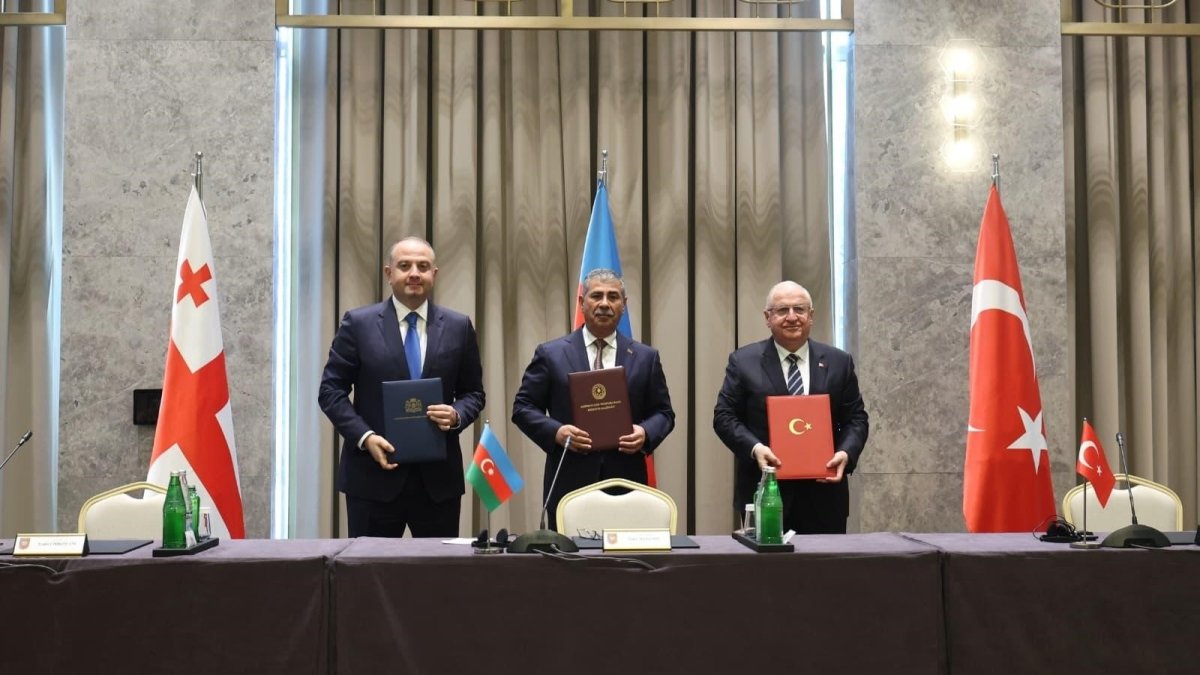
The Türkiye-Azerbaijan-Georgia trilateral security mechanism is a regular forum where the three defense ministries coordinate on regional security. It matters because the countries increasingly view Caucasus security as inseparable from their own security, prosperity and stability. At the Shusha meeting on Oct. 2, the ministers signed a protocol and discussed expanding cooperation. They focused on joint exercises, training, military-technical cooperation, defense education and medical support. They also highlighted the need to protect shared energy, transport and communications projects. The meeting did not create one dramatic new alliance. Instead, it strengthened an existing mechanism with repeated meetings, established procedures and a growing agenda. Exercises such as Eternity and Caucasus Eagle will remain practical tools for exchanging experience and improving defense capabilities. The ministers also reaffirmed support for Georgia’s and Azerbaijan’s independence and territorial integrity, while linking cooperation to peace and stability.
Based on reporting by Daily Sabah Turkey
What is the Türkiye-Azerbaijan-Georgia trilateral security mechanism, and what did the ministers agree to do at its 13th meeting?
The Türkiye-Azerbaijan-Georgia trilateral security mechanism is a regular forum where the three defense ministries coordinate on regional security. It matters because the countries increasingly view Caucasus security as inseparable from their own security, prosperity and stability.
At the Shusha meeting on Oct. 2, the ministers signed a protocol and discussed expanding cooperation. They focused on joint exercises, training, military-technical cooperation, defense education and medical support. They also highlighted the need to protect shared energy, transport and communications projects.
The meeting did not create one dramatic new alliance. Instead, it strengthened an existing mechanism with repeated meetings, established procedures and a growing agenda. Exercises such as Eternity and Caucasus Eagle will remain practical tools for exchanging experience and improving defense capabilities. The ministers also reaffirmed support for Georgia’s and Azerbaijan’s independence and territorial integrity, while linking cooperation to peace and stability.
How large and established is this cooperation format—how many countries participate, how often has it met, and what kinds of activities does it include?
The format includes exactly three countries: Türkiye, Azerbaijan and Georgia. Its 13th meeting shows that cooperation has moved beyond occasional diplomacy. The meetings rotate among the three countries, giving the mechanism continuity, shared ownership and institutional memory.
The article notes meetings in Türkiye the previous year and Georgia the year before, after the Shusha session. That sequence indicates a recurring, likely annual pattern, although the article does not state a fixed timetable. The agenda is broad rather than limited to military talks.
Activities include trilateral exercises such as Eternity and Caucasus Eagle, joint training and exchanges of experience. Ministers also discuss military-technical cooperation, defense education, medical support, regional security and military-political developments. They are examining ways to expand the framework while strengthening existing bilateral ties. Thus, the format combines practical defense work with wider political coordination on regional stability and connectivity.
Who are the three countries, and what strategic interests bring Türkiye, Azerbaijan and Georgia together in the South Caucasus?
The three countries are Türkiye, Azerbaijan and Georgia. They describe their relationship through shared geography, history, mutual trust and strong ties of friendship. Their cooperation matters because instability in one part of the South Caucasus can affect the others, especially along transport, energy and communications routes.
Their practical interests meet around connectivity. Energy and transportation projects cross or link their territories, while communications networks support economic activity and strategic access. The ministers therefore treat protecting these projects as a common responsibility. Joint exercises and training help turn political solidarity into operational cooperation.
They also share an interest in regional peace and national sovereignty. Türkiye and Georgia support the independence and territorial integrity of Georgia and Azerbaijan, while the three countries welcome movement toward peace between Azerbaijan and Armenia. The trilateral format helps coordinate responses to regional challenges without replacing the countries’ separate bilateral relationships or broader diplomacy.
Why are pipelines, railways, roads and communications links treated as security issues rather than only economic projects?
Pipelines, railways, roads and communications links are security issues because they connect national economies and influence regional access. If they work reliably, they support trade, energy delivery, communication and political cooperation. Their importance reaches beyond commercial profit.
The article gives a direct example. Türkiye, Azerbaijan and Georgia have built energy, transportation and communications projects whose security, according to Turkish Defense Minister Yaşar Güler, is the countries’ common responsibility. Joint exercises, training and experience-sharing provide the practical response. Defense cooperation supports the infrastructure on which wider connectivity depends.
This approach also reflects the region’s strategic transformation. The countries are coordinating as global tensions, new challenges and economic uncertainty grow. The article does not identify a specific threat to any project. It shows instead that infrastructure has become part of regional security planning. Protecting these links can help preserve stability, prosperity and the benefits of cooperation across the South Caucasus.
What could happen to regional trade, energy supplies and political stability if these shared infrastructure projects were disrupted?
If shared infrastructure were disrupted, the immediate effects could include delayed trade, interrupted energy flows and unreliable communications. Roads and railways could carry less cargo, while pipelines might deliver less energy. Businesses and governments would face higher uncertainty about regional connectivity.
The article does not describe a specific disruption or calculate its economic cost. It does establish why the risk matters: Türkiye, Azerbaijan and Georgia depend on shared energy, transportation and communications projects for development and security. Their ministers therefore connect infrastructure protection with joint exercises, training and defense coordination.
Politically, repeated disruption could reduce trust and make cooperation harder. It could also weaken the South Caucasus’s role as a dependable connection between markets and energy producers. Conversely, protecting these links could reinforce trade, energy reliability and stability. The ministers’ decision to deepen coordination suggests they see secure infrastructure as a foundation for lasting peace and regional prosperity.
How does this trilateral format differ from a formal military alliance, and how does it complement the countries’ existing bilateral relationships?
The trilateral format is a flexible cooperation mechanism among three defense ministries. The article describes meetings, protocols, exercises, training and consultations, but it does not announce a treaty requiring automatic military assistance. That makes it different from a formal military alliance as presented in the source.
Its main mechanism is coordination. The ministers review regional developments, expand joint activities and exchange military experience. Exercises such as Eternity and Caucasus Eagle strengthen practical cooperation. Discussions also cover defense technology, education and medical support. These activities build readiness and trust without erasing national decision-making.
The format complements bilateral relationships rather than replacing them. Turkish Defense Minister Yaşar Güler explicitly addressed regional security in separate meetings with Azerbaijan’s Zakir Hasanov and Georgia’s Irakli Chikovani. The trilateral channel gives shared issues a three-country setting, while bilateral ties handle country-specific needs. Together, the layers create a broader network for peace, security, stability and prosperity in the Caucasus.
Why does geography make the South Caucasus important for routes connecting Europe and Asia, and how can control of corridors shape regional power?
Geography makes the South Caucasus important because it lies between Europe and Asia, near routes linking the Caspian region, the Black Sea and Türkiye. The article itself emphasizes the countries’ shared geography and their energy, transport and communications projects. That location gives corridors economic and strategic value.
A railway, road, pipeline or communications line can connect producers, consumers and markets across borders. The country that hosts, protects or regulates a corridor can gain influence over access, investment and regional partnerships. Secure routes can attract trade and strengthen cooperation; contested or unreliable routes can increase dependence and political pressure.
The ministers’ position reflects this reality. They say protecting shared projects is a common responsibility and connect connectivity with regional security. The article does not map specific corridors or rank their geopolitical importance. More broadly, however, cooperation among Türkiye, Azerbaijan and Georgia helps keep these routes reliable and gives the three countries a stronger collective voice in shaping the Caucasus’s future.
Key Facts:
📌 The Shusha meeting was the mechanism’s 13th session.
📌 Ministers signed a protocol and planned deeper defense cooperation.
📌 Joint exercises include Eternity and Caucasus Eagle.
📌 Three countries participate: Türkiye, Azerbaijan and Georgia.
📌 The mechanism has reached its 13th meeting.
📌 Activities include exercises, training, education and medical support.
📌 The participants are Türkiye, Azerbaijan and Georgia.