News · Economy & Business
Rosatom Takes Full Control of Transport Conglomerate Delo Group in $900M Buyout
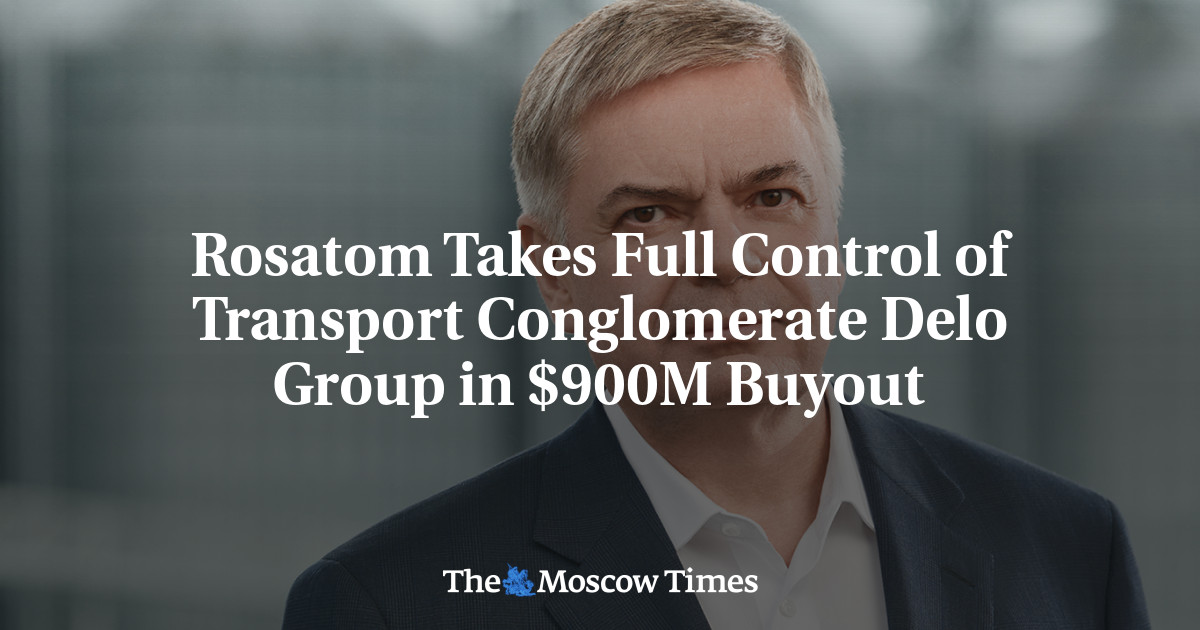
Acquiring the remaining 51% means Rosatom moved from being a partial owner to owning 100% of Delo. It no longer needs another shareholder’s approval for major decisions. This completes Rosatom’s control of the transport conglomerate and supports its plan to combine logistics assets under one organization. The key example is the ownership change announced Wednesday. Rosatom previously bought a stake in Delo in 2019, then purchased Shishkarev’s remaining share seven years later. The parties did not reveal the price, although Shishkarev valued his stake at 77 billion rubles. The deal could make Delo a central part of Rosatom’s national logistics strategy. Rosatom says it wants stronger transport sovereignty, reliable international routes, and development of the Northern Sea Route. Shishkarev cited “insurmountable disagreements” and plans to remain in logistics independently.
Based on reporting by Moscow Times
What does it mean for Rosatom to acquire Delo’s remaining 51% stake and take full control of the company?
Acquiring the remaining 51% means Rosatom moved from being a partial owner to owning 100% of Delo. It no longer needs another shareholder’s approval for major decisions. This completes Rosatom’s control of the transport conglomerate and supports its plan to combine logistics assets under one organization.
The key example is the ownership change announced Wednesday. Rosatom previously bought a stake in Delo in 2019, then purchased Shishkarev’s remaining share seven years later. The parties did not reveal the price, although Shishkarev valued his stake at 77 billion rubles.
The deal could make Delo a central part of Rosatom’s national logistics strategy. Rosatom says it wants stronger transport sovereignty, reliable international routes, and development of the Northern Sea Route. Shishkarev cited “insurmountable disagreements” and plans to remain in logistics independently.
Who are Rosatom and Delo, and what does each company do in Russia’s transport system?
Rosatom is Russia’s state nuclear corporation, but it also operates a growing logistics business. Its transport arm handles containers, rail movements, ports, and other infrastructure. The article says Rosatom’s logistics assets operate across all Russian maritime basins and support major national transport goals.
Delo is a transport conglomerate founded by Sergei Shishkarev 33 years ago. Its businesses are connected with container handling, rail container transport, port facilities, and container fleets. Rosatom first bought a stake in Delo in 2019, before acquiring Shishkarev’s remaining 51%.
Their roles now overlap inside one ownership structure. Rosatom says the combination will create Russia’s largest national logistics company. It also connects Delo’s transport assets with Rosatom’s plans for international routes and the Northern Sea Route. The article does not provide a complete list of every subsidiary.
How large is Rosatom’s resulting position in Russia’s logistics market, and what do the figures of 50% of container handling and 44% of rail container transport mean?
The figures show a very large position in two important logistics activities. A 50% share of container handling means Rosatom’s logistics businesses process about half of the containers handled in Russia’s market. A 44% share of rail container transport means they account for nearly half of container movements carried by rail.
These percentages are market-share measures, not necessarily ownership of half of every port or railway. For example, Rosatom says its logistics arm owns the country’s largest container fleet and port facilities in major cities. It also says the business operates in all Russian maritime basins. The article does not explain the calculation method.
The resulting scale strengthens Rosatom’s influence over the movement of imported and exported goods. It may also support national transport planning and Northern Sea Route development. However, the article does not report how the deal will change prices, service quality, or competitors’ market shares.
Why did Rosatom first buy a stake in Delo in 2019, and how does that investment connect to Arctic shipping?
Rosatom bought its first stake in Delo in 2019 as part of plans to capitalize on Arctic shipping routes. The basic idea was to combine logistics capabilities with a route that could become increasingly important for cargo moving between Europe and Asia. This gave Rosatom a transport role beyond its nuclear business.
The connection is practical. Arctic shipping needs more than ships. It also requires containers, ports, rail links, terminals, storage, and coordinated cargo handling. Delo’s transport assets could help support those parts of the network. The article does not specify the original percentage Rosatom acquired or name particular projects from 2019.
Seven years later, Rosatom completed its purchase of the remaining 51%. Its CEO says the company now aims to develop the Northern Sea Route and a wider Trans-Arctic transport corridor. The route’s future depends on infrastructure, safe operations, commercial demand, and navigational conditions.
What could happen to competition, prices, and control of transport infrastructure when one state-controlled company holds such a large share of the market?
When one company controls a large share of container handling and rail container transport, it may gain influence over access, contracts, investment, and service priorities. Competitors could find it harder to match the company’s network of ports, terminals, trains, and containers. Rosatom is a Russian state corporation, making the concentration significant for national infrastructure.
For example, a shipper may depend on terminals connected to Rosatom’s logistics arm. If alternative operators are limited, Rosatom could have greater bargaining power over service terms or capacity. A large integrated network can also reduce costs through coordination. The article gives no evidence that prices have risen or that competitors have been excluded.
The likely outcome depends on regulation, transparent access, and genuine competition. Strong oversight could limit unfair treatment and protect customers. Without it, market concentration could reduce choice or increase dependence on one provider. Rosatom’s stated priorities suggest greater state direction of transport, especially around strategic Arctic routes.
What alternative routes connect Europe and Asia, and why does Russia see the Northern Sea Route and a Trans-Arctic corridor as strategically valuable?
Europe and Asia are connected by several established routes. Ships can use the Suez Canal and Mediterranean, travel around Africa’s Cape of Good Hope, or move by rail across Eurasia. Air freight is another option for urgent, high-value goods. Each route differs in distance, cost, capacity, weather exposure, and political risk.
The Northern Sea Route runs along Russia’s Arctic coast between the Atlantic and Pacific approaches. In principle, it can offer a shorter sea connection than the Suez route for some Europe–Asia journeys. It needs ports, icebreakers, navigation systems, rescue services, and reliable cargo handling. A Trans-Arctic corridor would link maritime and land transport across a wider network.
Rosatom says these routes could strengthen Russia’s transport sovereignty and support sustainable international transport. They could also increase Russia’s influence over infrastructure and Arctic trade. However, the article does not claim the route has already replaced traditional corridors. Its commercial success depends on demand, safety, ice conditions, and investment.
How do containers, ports, railways, and ships work together to move goods through a modern logistics network?
A container is a standardized box that holds cargo securely during transport. Ships carry large numbers of containers between maritime ports. Ports use cranes and terminals to unload ships, store boxes briefly, and transfer them to trains, trucks, or other vessels. Standard sizes let different transport modes connect efficiently.
For example, a container arriving by ship can be lifted from the vessel onto a railcar. A train then carries it inland, where a terminal may transfer it to a truck for final delivery. The cargo usually stays sealed inside the container. Coordinated schedules, tracking systems, customs processes, and shared handling equipment make this chain work.
Rosatom’s reported logistics position covers several links in this system. It says the company owns a large container fleet, port facilities, and operations in all Russian maritime basins. Full ownership of Delo could help coordinate these assets. It also gives Rosatom a stronger base for international routes and Northern Sea Route development.
Key Facts:
📌 Rosatom acquired Shishkarev’s remaining 51% stake in Delo.
📌 The purchase gives Rosatom full ownership of Delo.
📌 The deal price was not disclosed.
📌 Rosatom is Russia’s state nuclear corporation with a logistics arm.
📌 Delo is a transport conglomerate founded by Sergei Shishkarev.
📌 Their businesses include containers, ports, rail, and shipping logistics.
📌 Rosatom reports 50% of Russia’s container handling market.