News · International Relations
Kremlin Says France's Test Nuclear Launch Is Part of 'Dead End' Anti-Russia Strategy
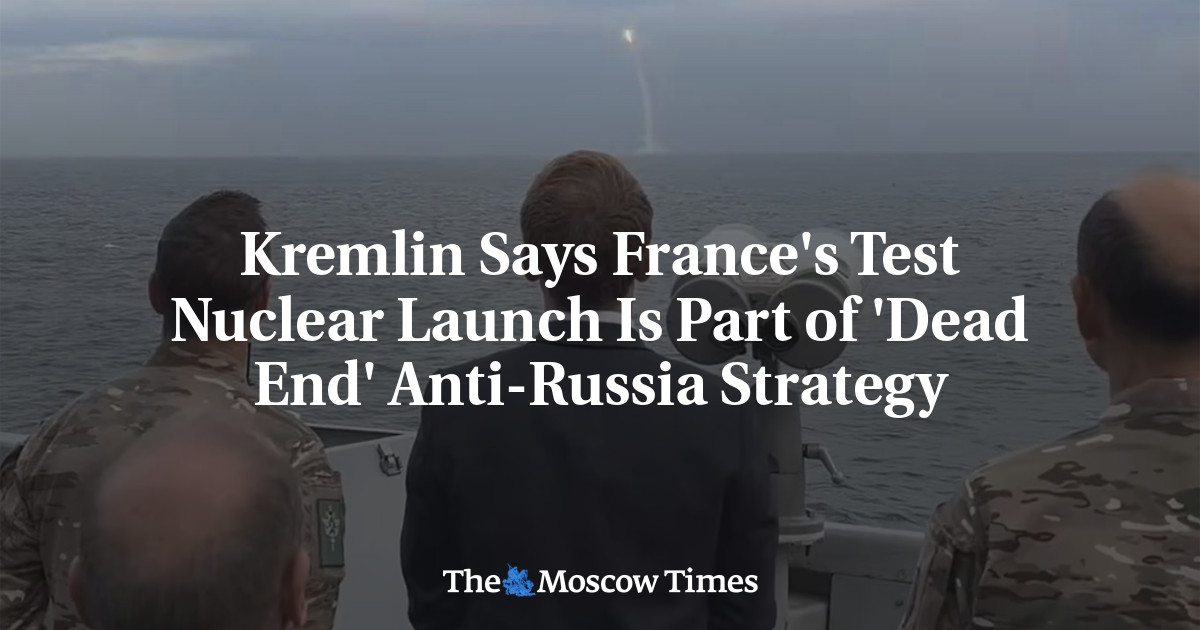
France tested a submarine-launched ballistic missile, or SLBM, from a vessel operating off the coast of Brittany. The weapon is designed to carry nuclear warheads, although the article does not say that a nuclear warhead was used. The test mattered because it demonstrated France’s ability to deliver its nuclear force from the sea. President Emmanuel Macron described the launch as a message “sent loud and clear for wherever it must be received.” He did not mention Russia directly. The timing connected the test to tensions over Ukraine, European security, and nuclear deterrence. The Kremlin said it had received France’s message. Spokesman Dmitry Peskov called the launch part of Europe’s militarization and said building defense around confrontation with Russia was a “dead end.” France presented the test as deterrence; Russia viewed it as confrontational signaling.
Based on reporting by Moscow Times
What exactly did France test, where was it launched, and what message did President Macron say the launch sent?
France tested a submarine-launched ballistic missile, or SLBM, from a vessel operating off the coast of Brittany. The weapon is designed to carry nuclear warheads, although the article does not say that a nuclear warhead was used. The test mattered because it demonstrated France’s ability to deliver its nuclear force from the sea.
President Emmanuel Macron described the launch as a message “sent loud and clear for wherever it must be received.” He did not mention Russia directly. The timing connected the test to tensions over Ukraine, European security, and nuclear deterrence.
The Kremlin said it had received France’s message. Spokesman Dmitry Peskov called the launch part of Europe’s militarization and said building defense around confrontation with Russia was a “dead end.” France presented the test as deterrence; Russia viewed it as confrontational signaling.
What is a submarine-launched ballistic missile, and why can it carry nuclear weapons?
A submarine-launched ballistic missile is fired from a submerged submarine and travels toward its target through a high, arcing ballistic trajectory. “Ballistic” describes the missile’s flight after its powered launch phase. These weapons can travel thousands of kilometers and carry powerful payloads.
They can carry nuclear weapons because ballistic missiles are built to lift and deliver substantial warheads over long distances. Nuclear warheads are compact compared with the missile’s overall payload capacity. The submarine provides an important advantage: it can hide beneath the ocean, making the launch platform harder to detect and destroy.
That survivability supports a second-strike capability. Even if an enemy attacked land-based forces, a concealed submarine might remain able to retaliate. The article identifies France’s tested missile as nuclear-capable, but it does not say that this particular launch carried a nuclear warhead. Such tests demonstrate delivery capability, not necessarily wartime use.
Why is France able to conduct an independent nuclear deterrence policy, rather than relying entirely on another country's weapons?
France can pursue an independent nuclear deterrence policy because it developed and maintains its own nuclear weapons, delivery platforms, and decision-making system. France is one of the nuclear-weapon states recognized under the Nuclear Non-Proliferation Treaty. Its force is nationally controlled rather than wholly dependent on another country’s nuclear guarantee.
France’s deterrent includes ballistic-missile submarines and aircraft capable of delivering nuclear weapons. Submarines provide a concealed retaliatory force. Aircraft provide a separate, visible, and potentially flexible option. The president holds authority over the use of France’s nuclear weapons. France remains a NATO member, but it does not participate in NATO’s nuclear-sharing arrangement in the same way as some other allies.
This independence gives Paris strategic autonomy and a national voice in deterrence decisions. It also explains why the missile test carried political weight. The article says Europe is debating its security identity, while France is demonstrating that its own nuclear defense capability remains operational.
How many countries possess nuclear weapons, and how does France's nuclear arsenal compare with those of the United States and Russia?
Nine countries are generally considered nuclear-armed: the United States, Russia, Britain, France, China, India, Pakistan, Israel, and North Korea. This count comes from established international assessments, not from the article itself. Exact totals are uncertain because governments keep many details secret and estimates change over time.
Public estimates commonly place France’s nuclear stockpile at roughly 290 warheads. The United States and Russia each have several thousand warheads. Recent Federation of American Scientists estimates put their total inventories at approximately 5,000 or more each, with Russia and the United States holding by far the largest arsenals. These figures include weapons in different conditions, not only deployed systems.
France’s arsenal is therefore much smaller but still strategically significant. It is designed to threaten unacceptable damage, not to match Russian or American numbers. The submarine missile test demonstrated that France retains a credible delivery system. That capability can influence European security debates even without numerical parity.
What happens to European and Russian security calculations when either side publicly demonstrates a nuclear-capable delivery system?
When either side publicly demonstrates a nuclear-capable delivery system, it tries to show that its deterrent is credible. Allies may feel reassured, while opponents must consider the possibility that an attack could bring devastating retaliation. The signal therefore changes military planning and political calculations without requiring a nuclear weapon to be used.
France’s launch illustrates this mechanism. Macron called it a message “sent loud and clear.” The Kremlin said it had received the message but described Europe’s approach as militarization and confrontation. Russia may respond by increasing readiness, exercises, deployments, or warnings. European governments may then strengthen defenses and rely more visibly on nuclear deterrence.
The result can be both stability and danger. Clear capabilities may discourage direct war, but ambiguous intentions can produce worst-case assumptions. The article says Russia remains on alert while remaining open to dialogue. Future security may depend on combining credible deterrence with communication, restraint, and measures that reduce accidental escalation.
How did the Cold War idea of nuclear deterrence shape today's belief that the threat of retaliation can prevent war?
During the Cold War, the United States and Soviet Union built nuclear forces capable of surviving an initial attack and striking back. This became known as mutual assured destruction, or MAD. The logic was not that nuclear war would be winnable. It was that the expected cost of starting one would be unbearable.
Submarines were central to this idea because they could remain hidden and preserve a second-strike option. A leader could not confidently destroy every opposing weapon in one attack. That uncertainty made a first strike extraordinarily dangerous. Deterrence therefore depended on capability, survivability, and the belief that leaders would retaliate if attacked.
This Cold War experience shaped today’s belief that retaliation can prevent war. It also created continuing fears about accidents, false alarms, and miscalculation. The article’s focus on France’s submarine missile reflects that legacy. Nuclear signaling may discourage attacks, but it can also intensify confrontation when opponents doubt each other’s intentions.
Why can actions taken for defense by one side make the other side feel less safe and lead to an escalating security dilemma?
A security dilemma occurs when one side’s defensive actions make another side feel threatened. Weapons usually reveal capability more clearly than intention. A government may say a missile protects its territory, while an opponent sees the same missile as a possible tool for attack or coercion.
The French test shows the problem. Paris presented the nuclear-capable launch as a deterrent message amid tensions over Ukraine and European security. Moscow interpreted it as evidence that Europe was building its defense identity through confrontation with Russia. Russia’s response could then lead European states to increase military readiness, producing another Russian reaction.
This cycle can grow even without either side seeking war. More weapons, exercises, and public warnings create pressure to act quickly during a crisis. They also increase chances of misunderstanding. Dialogue, transparency, and communication can reduce the dilemma, but the article shows the disagreement clearly: France emphasized deterrence, while the Kremlin called the strategy a dead end.
Key Facts:
📌 France tested a submarine-launched ballistic missile.
📌 The launch occurred off Brittany’s coast.
📌 Macron called its message “sent loud and clear.”
📌 SLBMs launch from submerged submarines.
📌 Their flight follows a ballistic trajectory.
📌 Submarines make nuclear forces harder to destroy.
📌 France possesses its own nuclear arsenal.