News · Defence & Security
Death toll from Russian strike on two buses in Kramatorsk rises to 33, 18 injured
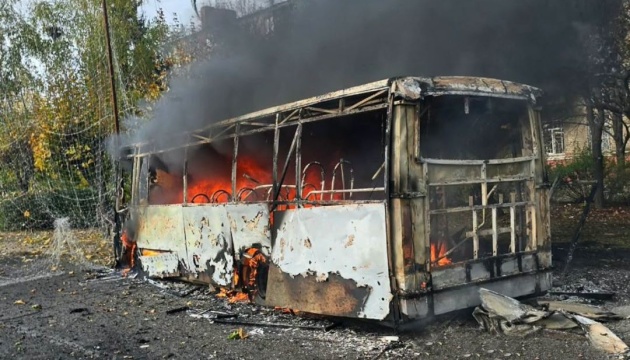
The attack hit two passenger buses while they were traveling along a street in Kramatorsk. Both buses caught fire, turning ordinary public transport into the immediate site of a mass-casualty emergency. An open area nearby also burned. The strike affected homes as well as vehicles. In Bilenke, part of the Kramatorsk urban community, three people were killed. Rescuers recovered one victim from the rubble of a private house, showing that blast damage extended beyond the road and buses. The article does not describe the full condition of every nearby home. It does establish that at least one private house collapsed or was heavily damaged, and that rescuers searched its rubble. Fires, debris, and victims in both transport and residential areas made the response especially difficult.
Based on reporting by Ukrinform English
What happened to the two passenger buses and the nearby homes in Kramatorsk?
The attack hit two passenger buses while they were traveling along a street in Kramatorsk. Both buses caught fire, turning ordinary public transport into the immediate site of a mass-casualty emergency. An open area nearby also burned.
The strike affected homes as well as vehicles. In Bilenke, part of the Kramatorsk urban community, three people were killed. Rescuers recovered one victim from the rubble of a private house, showing that blast damage extended beyond the road and buses.
The article does not describe the full condition of every nearby home. It does establish that at least one private house collapsed or was heavily damaged, and that rescuers searched its rubble. Fires, debris, and victims in both transport and residential areas made the response especially difficult.
How many people were killed or injured, and how did the reported death toll change as rescuers searched the area?
The reported death toll increased as emergency workers assessed the attack scene and searched damaged areas. Ukraine's State Emergency Service ultimately reported 33 people killed and 18 injured. Those figures show that the first count was incomplete, not that the attack happened in several separate waves.
At first, 12 people were reported killed and 14 injured after the bomb struck the street. Later, the Donetsk Regional Prosecutor's Office reported 30 deaths and 18 injuries as of 12:36 Kyiv time. The State Emergency Service then issued the higher total of 33 deaths.
The changes reflect the difficulty of counting casualties amid fires, wreckage, and collapsed structures. The article specifically notes that rescuers recovered one victim from a private home's rubble in Bilenke. Continued searches can locate victims and confirm injuries after an initial emergency estimate.
What is a UMPB D-30 SN guided bomb, and how is it used to strike a target?
A UMPB D-30 SN is a Russian guided aerial munition. The article names it as the weapon used, but does not explain its design. In general, guided bombs use onboard navigation and control systems to steer toward planned coordinates more accurately than unguided bombs.
The basic mechanism is target guidance after release. An aircraft releases the munition, and its control surfaces and navigation system adjust its path toward the selected point. Guidance can improve accuracy, but it does not make an attack automatically lawful or prevent harm when people are present near the target.
At about 10:00 on October 8, Russian forces struck Kramatorsk with this munition. It hit a street as two passenger buses traveled there. The immediate result was fires, deaths, injuries, and damage extending into Bilenke, according to the article.
Why can a strike on a road carrying passenger buses cause many casualties in a short time?
Roads carrying passenger buses concentrate many people in a small, predictable space. A strike there can injure or kill several passengers at once, especially when vehicles are close together and cannot move away immediately. Burning fuel, smoke, broken glass, and damaged road surfaces can add danger after the impact.
This attack illustrates that mechanism directly. A guided bomb hit the street while two buses were traveling. The buses caught fire, and an open area also burned. The strike also damaged a private house in Bilenke, where rescuers recovered one victim from rubble.
The casualty count rose as responders searched and assessed the scene. Initial reports listed 12 dead and 14 injured. Later figures reached 30 dead and 18 injured, followed by the State Emergency Service report of 33 dead. The event shows why transport routes require urgent emergency access after attacks.
What did rescuers do after the strike, and why are firefighting, medical aid, and rubble searches urgent after an attack?
Emergency work after a strike has three immediate aims: save survivors, stop secondary dangers, and find people who may be trapped. Medical aid can prevent injuries from becoming fatal. Firefighting protects people and nearby structures. Rubble searches can locate victims who are hidden from view.
At the Kramatorsk scene, rescuers assisted the injured and extinguished fires in two buses and an open area. They also recovered one victim from the rubble of a private house in Bilenke. These tasks happened while authorities were still revising the casualty figures.
Speed matters because flames spread, smoke limits breathing, and damaged structures can collapse further. Early searches also improve the accuracy of casualty counts. In this case, the reported toll rose from 12 deaths to 30 and then 33 as responders worked through the aftermath.
What is Kramatorsk's location and role in Ukraine's Donetsk region during the war?
Kramatorsk is a city in eastern Ukraine's Donetsk Oblast, commonly called the Donetsk region. During the full-scale war, it has served as an important Ukrainian-held administrative and logistical center in the region. Its location has made it significant to civilian life and wartime operations.
The article places the main strike in Kramatorsk and identifies Bilenke as part of the Kramatorsk urban community. At about 10:00 on October 8, a guided bomb hit a street where two passenger buses were traveling. Three people were killed in Bilenke, including one victim found in a private home's rubble.
The article does not give a broader history of Kramatorsk or describe its current military status in detail. It does show that the city's roads, buses, homes, and emergency services were directly affected. That makes attacks there consequential for both residents and regional movement.
What rules does international humanitarian law establish for protecting civilians and civilian transport during armed conflict?
International humanitarian law protects civilians and civilian objects during armed conflict. Parties must distinguish military objectives from people and property that are civilian. They may not deliberately attack civilians or civilian objects, and they must not launch attacks expected to cause excessive civilian harm compared with the anticipated military advantage.
Passenger buses are normally civilian objects, unless facts show they are being used for military purposes. An attack on a road must therefore consider who is using it, what the intended target is, and whether civilians can be avoided. Parties must take feasible precautions, such as choosing safer timing or methods and giving effective warnings when circumstances permit.
The article reports a guided bomb striking a street with two passenger buses, killing 33 people and injuring 18. It does not provide enough information to make a legal finding about the attack. Any assessment would require facts about the intended target, military necessity, precautions, and expected civilian harm.
Key Facts:
📌 Two passenger buses caught fire after the strike.
📌 An open area also caught fire.
📌 Three people were killed in Bilenke.
📌 The final reported toll was 33 killed and 18 injured.
📌 The initial report listed 12 killed and 14 injured.
📌 The prosecutor's office later reported 30 deaths.
📌 Russian forces used a UMPB D-30 SN guided bomb.