News · Politics & Governance
Former President Bhandari returns to UML under ex-PM Oli
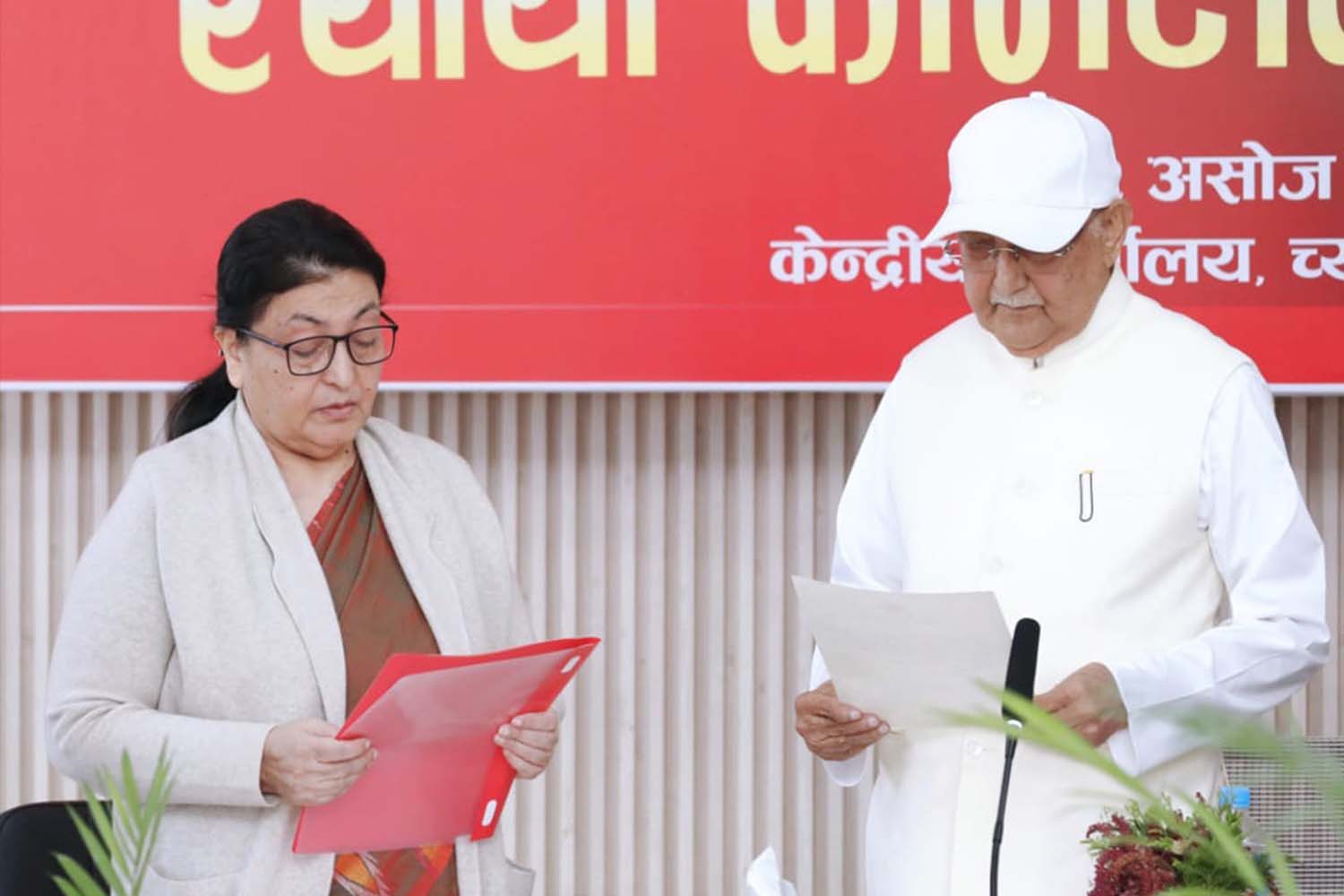
Bidya Devi Bhandari officially returned to active politics in the CPN-UML on Thursday. She had left party responsibilities 11 years earlier after becoming Nepal’s President. The move restored her place inside the party and immediately affected its leadership balance. The UML central committee nominated her as a senior leader, placing her directly after party chair KP Sharma Oli. At the Standing Committee meeting, Oli administered her oath. Bhandari sat to Oli’s right, while vice-chair Ram Bahadur Thapa sat on his left. The party had also decided to grant her membership at a May meeting held at Oli’s residence. Her return matters because the UML is already divided over leadership and restructuring. Bhandari says she has no personal ambition, but she has called for a review of the leadership, party working style, and communist movement. Analysts also worry that her active party role could reopen partisan arguments about decisions made while she was President.
Based on reporting by Kathmandu Post Nepal
What exactly happened when former President Bidya Devi Bhandari returned to the CPN-UML?
Bidya Devi Bhandari officially returned to active politics in the CPN-UML on Thursday. She had left party responsibilities 11 years earlier after becoming Nepal’s President. The move restored her place inside the party and immediately affected its leadership balance.
The UML central committee nominated her as a senior leader, placing her directly after party chair KP Sharma Oli. At the Standing Committee meeting, Oli administered her oath. Bhandari sat to Oli’s right, while vice-chair Ram Bahadur Thapa sat on his left. The party had also decided to grant her membership at a May meeting held at Oli’s residence.
Her return matters because the UML is already divided over leadership and restructuring. Bhandari says she has no personal ambition, but she has called for a review of the leadership, party working style, and communist movement. Analysts also worry that her active party role could reopen partisan arguments about decisions made while she was President.
What is the CPN-UML, and what do the leadership positions held by KP Sharma Oli and Bhandari mean inside the party?
The CPN-UML is the Communist Party of Nepal (Unified Marxist-Leninist), a major communist political party in Nepal. In this article, its leadership structure is central because the party is debating whether its leadership and working style need restructuring. The positions held by Oli and Bhandari show their current standing within that internal hierarchy.
KP Sharma Oli is the UML’s party chair and a former prime minister. He therefore leads the party and has authority over its formal political direction. Bhandari is now designated a senior leader and ranks second after Oli. The central committee created that placement even though the existing statute does not list a senior-leader post.
This arrangement has both practical and political meaning. It gives Bhandari a prominent platform while preserving Oli’s top position. It may also signal that Oli is strengthening his position against leaders who demanded restructuring. Bhandari’s calls for a candid review could nevertheless keep pressure on the chair and the party leadership.
How was Bhandari placed second in the party even though the UML's existing statute does not formally recognize a senior-leader post?
Bhandari was placed second through a procedural workaround rather than an existing office. The UML central committee nominated her as a senior leader and ranked her immediately after KP Sharma Oli. This gave her a formal place near the top of the party at a time of intense internal debate.
The party invoked a statutory provision for removing obstacles. The article does not describe this as a regular senior-leader appointment under the existing structure. In fact, the UML’s current statute does not recognise a senior leader post. The provision allowed the central committee to address what it treated as an organisational gap and create the position.
The decision matters because it changes the party’s power map without the article reporting a formal statutory amendment. Bhandari now has institutional standing, while Oli remains first. The arrangement may help Oli send a message to leaders calling for restructuring, but it also gives Bhandari a platform to press for leadership and party reform.
How much has the UML's parliamentary strength changed, from 78 seats in the previous lower house to 25 seats after the March 5 election?
The UML’s parliamentary strength declined sharply. It held 78 seats in the previous lower house but won only 25 seats after the March 5 parliamentary election. That is a net loss of 53 seats, leaving the party with less than one-third of its earlier representation.
The 25-seat result came from seven first-past-the-post seats and 18 proportional-representation seats. Compared with 78 seats, the new total represents about 32 percent of the party’s previous strength. Put another way, the UML lost roughly 68 percent of its earlier lower-house representation. The figures show the scale of the electoral setback described in the article.
This loss intensified questions about Oli’s leadership. The article says he faced pressure to reconsider his position after the poor result. It also describes leaders such as Bishnu Paudel, Shankar Pokharel, Gokarna Bista, and Raghu Panta calling for leadership restructuring. Bhandari returned during this dispute, making her appointment part of the party’s broader power struggle.
What consequences has Bhandari's return had for the UML's internal leadership struggle and its debate over restructuring?
Bhandari’s return has intensified the UML’s internal leadership struggle. She came back when Oli was under pressure after the party’s poor election showing. Several leaders were calling for changes to the leadership and party structure, so placing Bhandari second immediately altered the balance at the top.
One party leader said Oli may have brought Bhandari forward to send a message to Bishnu Paudel, Shankar Pokharel, Gokarna Bista, and Raghu Panta. The same leader suggested Oli might eventually project her for future UML leadership. Pokharel’s distance from Oli had also grown after he prepared a report advocating party and leadership restructuring. Seating changes at the meeting further reflected these tensions.
Bhandari says she returned without personal ambition. Yet she has begun calling for a candid review of the leadership, working style, and communist movement. Her position could therefore serve Oli’s immediate power strategy while also giving reform arguments a prominent voice. The struggle may continue around whether she supports, challenges, or eventually succeeds the current leadership.
What was Bhandari's constitutional role before this return, and how many consecutive terms did she serve as Nepal's president?
Before this return, Bidya Devi Bhandari served as Nepal’s President, the country’s highest constitutional post and a symbol of the republic. She entered that office after previously serving as a UML vice-chair. Becoming President required her to leave party responsibilities, which she did for 11 years.
Bhandari served two consecutive terms. Her first ran from October 2015 to March 2018, and her second ran from March 2018 to March 2023. After leaving office, she remained active through the Madan Bhandari Foundation, established in memory of her late husband. She later accepted repeated requests from party leaders to take responsibility again.
Her return creates a direct link between a former head of state and active party politics. Bhandari says she has no desire for another position or personal interest. However, analysts warn that decisions made during her presidency could be judged differently once she becomes a partisan figure. That concern drives the article’s ethical debate over former presidents rejoining parties.
Why is a former head of state generally expected to remain politically impartial, and how can returning to party politics affect the perceived neutrality of the presidency?
A former head of state is generally expected to remain impartial because the office represents the country rather than one political organisation. Political scientist Hari Sharma described Nepal’s presidency as an impartial institution, the highest institution created by the constitution, and a symbol of the republic. That status is meant to keep the office above political merits and demerits.
Active party politics can change how people interpret the former president’s record. Sharma warned that decisions made while a person was President could be judged differently after that person became an active partisan. Actions once viewed as constitutional or institutional might instead be linked to a party’s interests. The concern is about public trust and the meaning of the office, not only about whether the constitution permits the return.
The article says Nepal’s constitution does not expressly prohibit a former President from joining active politics. Still, Sharma argues that former office-holders should remain outside parties. Bhandari’s return has therefore revived a broader debate about whether legal permission should be separated from the ethical expectations attached to the presidency.
Key Facts:
📌 Bhandari returned to active UML politics after 11 years away from party responsibilities.
📌 She was placed directly after party chair KP Sharma Oli.
📌 Oli administered Bhandari’s oath at the Standing Committee meeting.
📌 CPN-UML means Communist Party of Nepal (Unified Marxist-Leninist).
📌 KP Sharma Oli is the UML’s party chair and a former prime minister.
📌 Bhandari is positioned as the party’s senior leader after Oli.
📌 The central committee nominated Bhandari as a senior leader.