News · Space
Crew-12 Returns to Earth
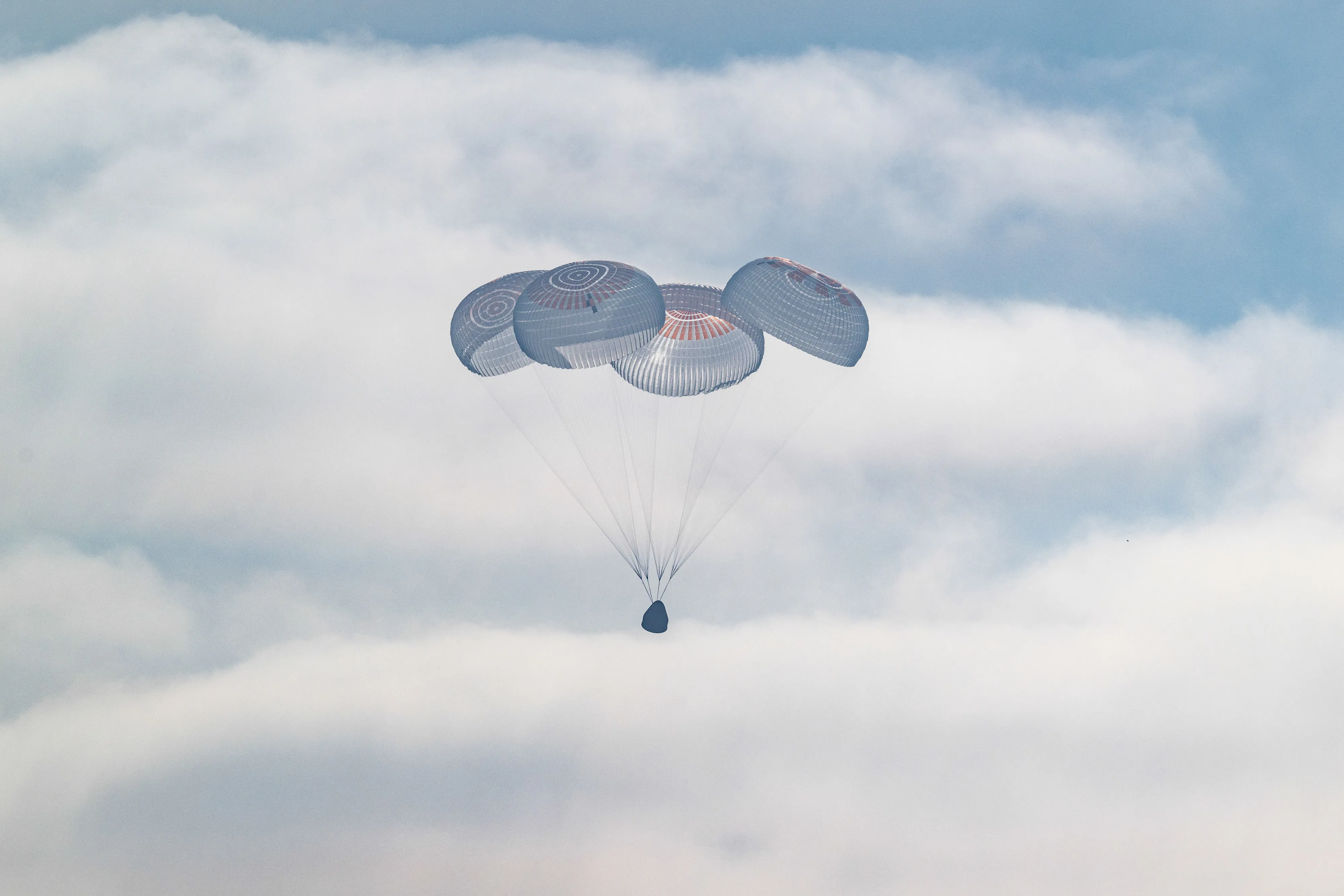
Crew Dragon Freedom was returning from space when it approached a planned splashdown in the Pacific Ocean. Splashdown means a spacecraft lands on water rather than on a runway or solid ground. The event marked the return phase for the Crew-12 crew. The photograph was taken on October 8, 2026, moments before the spacecraft touched down off the coast of California. Its passengers were NASA astronauts Jessica Meir and Jack Hathaway, ESA astronaut Sophie Adenot, and Roscosmos cosmonaut Andrey Fedyaev. Their presence made the return an international spaceflight event. The supplied article does not describe the touchdown itself, recovery operations, or the crew’s condition afterward. It establishes that Freedom was seen just before splashing down and identifies everyone aboard. Those details connect the spacecraft, the Pacific landing site, and the Crew-12 return in one image.
Based on reporting by NASA Breaking News
What happened when the Crew Dragon Freedom spacecraft splashed down in the Pacific Ocean?
Crew Dragon Freedom was returning from space when it approached a planned splashdown in the Pacific Ocean. Splashdown means a spacecraft lands on water rather than on a runway or solid ground. The event marked the return phase for the Crew-12 crew.
The photograph was taken on October 8, 2026, moments before the spacecraft touched down off the coast of California. Its passengers were NASA astronauts Jessica Meir and Jack Hathaway, ESA astronaut Sophie Adenot, and Roscosmos cosmonaut Andrey Fedyaev. Their presence made the return an international spaceflight event.
The supplied article does not describe the touchdown itself, recovery operations, or the crew’s condition afterward. It establishes that Freedom was seen just before splashing down and identifies everyone aboard. Those details connect the spacecraft, the Pacific landing site, and the Crew-12 return in one image.
What is a Crew Dragon spacecraft, and what is a splashdown?
A Crew Dragon spacecraft is a crewed vehicle built to transport astronauts and cosmonauts between Earth and space. It provides the enclosed cabin needed during launch, orbital flight, and return. The supplied article identifies Freedom as a Crew Dragon spacecraft but does not explain its systems or design.
A splashdown is the final landing of a returning spacecraft in water. Instead of touching down on a runway, the vehicle descends toward the ocean and lands on its surface. In this case, Crew Dragon Freedom was photographed moments before splashing down in the Pacific Ocean off California.
These terms describe different parts of the same journey. Crew Dragon names the vehicle, while splashdown names the landing method. The article connects both with NASA’s SpaceX Crew-12 members: Jessica Meir, Jack Hathaway, Sophie Adenot, and Andrey Fedyaev. Details about Freedom’s exact equipment come from general spaceflight knowledge, not the article.
How many astronauts and cosmonauts were aboard, and which space agencies did they represent?
The spacecraft carried four Crew-12 members. NASA astronauts Jessica Meir and Jack Hathaway represented NASA, the United States space agency. Sophie Adenot represented ESA, the European Space Agency. Andrey Fedyaev represented Roscosmos, Russia’s space agency.
The crew therefore combined astronauts and a cosmonaut from three agencies. The article specifically names each person and gives each agency affiliation. Two people held NASA astronaut titles, one held the ESA astronaut title, and one held the Roscosmos cosmonaut title. Together, they formed the international group aboard Freedom.
This multinational crew shows how one spacecraft can carry people connected with different space programs. The article does not provide their nationalities, individual responsibilities, or the length of their flight. It does establish the total by listing four people, along with the agency each represented during the Crew-12 return.
What mission had Crew-12 been carrying out in space before returning to Earth?
The supplied text gives only a limited answer about Crew-12’s work in space. It identifies the four people aboard as NASA’s SpaceX Crew-12 members and shows their spacecraft returning to Earth. It does not state what experiments, maintenance, research, or other tasks they carried out.
The concrete details are the crew names and the return scene. Jessica Meir and Jack Hathaway were NASA astronauts, Sophie Adenot was an ESA astronaut, and Andrey Fedyaev was a Roscosmos cosmonaut. Their spacecraft, Crew Dragon Freedom, was seen moments before a Pacific Ocean splashdown off California.
Therefore, the mission’s specific activities cannot be established from this article alone. In general, crewed space missions may include research and station operations, but attributing any particular task to Crew-12 here would go beyond the supplied facts. The article’s clear focus is their spacecraft and return, not their work in orbit.
What happens to the crew and spacecraft after they splash down in the ocean?
After a crewed spacecraft splashes down, recovery teams typically locate it, secure it, and approach by boat or aircraft. They help the crew leave the cabin and transfer them to safety. Medical personnel usually assess returning space travelers before they continue with postflight procedures. These are standard recovery steps, not details stated in the article.
The spacecraft is also recovered and inspected. Teams check its structure, cabin, heat shield, parachutes, and other systems for evidence of the flight’s effects. Engineers can use those findings to evaluate the vehicle and support future missions. The exact process depends on the spacecraft and recovery plan.
For Freedom, the supplied text provides only the scene before landing. It says the vehicle was seen moments before splashing down in the Pacific Ocean off California, with four Crew-12 members aboard. It does not state whether recovery occurred, how the crew felt, or what happened to the spacecraft afterward.
Why do spacecraft returning from orbit need a heat shield, parachutes, and a carefully chosen landing area?
A spacecraft returning from orbit enters Earth’s atmosphere at very high speed. Air compresses and heats around it, creating intense temperatures that could damage an unprotected vehicle. A heat shield absorbs, reflects, or carries away that energy, protecting the cabin and its occupants.
Parachutes then reduce the spacecraft’s speed for the final descent. They do not handle atmospheric heating; they control the slower approach near the landing stage. A carefully chosen landing area adds another layer of safety. It should provide room for recovery teams and avoid hazards such as heavy traffic, obstacles, or dangerous weather.
Crew Dragon Freedom’s planned Pacific splashdown illustrates why these systems work together. The spacecraft needs thermal protection during atmospheric entry, parachutes for descent, and a suitable ocean area for landing and recovery. The article names Freedom, its Pacific destination, and its crew, but does not describe the vehicle’s heat shield or parachutes.
How do rockets place spacecraft into orbit, and how can a spacecraft later leave orbit and return safely to Earth?
Rockets place spacecraft into orbit by producing thrust and accelerating upward and sideways. That sideways speed is crucial. It lets the spacecraft continually fall toward Earth while the planet’s surface curves away beneath it. When speed, direction, and altitude are suitable, the vehicle follows an orbital path instead of immediately falling back.
To return, the spacecraft performs a planned braking maneuver that lowers its orbit and sends it into the atmosphere. Atmospheric drag removes more speed, while the heat shield protects the vehicle from intense heating. Parachutes then slow the spacecraft further for its final descent. Crew Dragon Freedom was photographed just before the last stage of such a return, its Pacific splashdown.
Safe recovery requires accurate navigation and a selected landing area. The spacecraft must enter at the right angle and time, then descend where recovery teams can reach it. The article confirms Freedom’s Pacific destination and crew, but does not describe its rocket launch or return maneuvers.
Key Facts:
📌 Crew Dragon Freedom approached a Pacific Ocean splashdown off California.
📌 The photograph was taken on October 8, 2026.
📌 Four Crew-12 members were aboard the spacecraft.
📌 Crew Dragon is a crewed spacecraft.
📌 A splashdown is a spacecraft landing on water.
📌 Freedom approached the Pacific Ocean off California.
📌 Four Crew-12 members were aboard.