News · Defence & Security
Watch: At least one plane severely damaged as Houthis claim third Riyadh airport attack
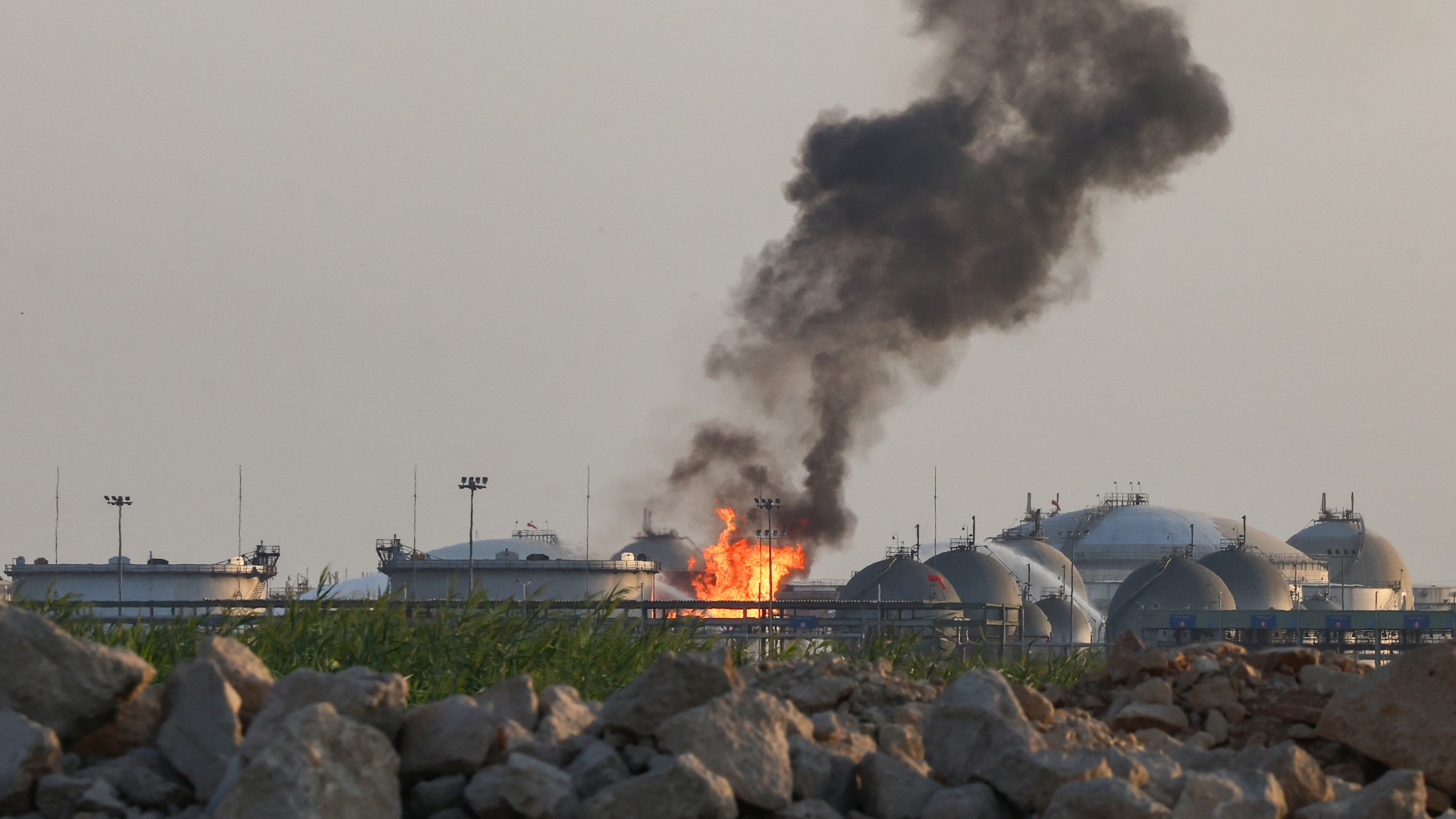
At least one plane was severely damaged at Riyadh airport on Thursday. The Houthis, also called Ansar Allah, claimed this was their third attack targeting the airport. The incident matters because an airport is a major civilian and military transport hub, so an attack can threaten aircraft, passengers, and wider air operations. Ansar Allah spokesperson Yahya Saree said the group launched two missiles at Riyadh airport. He also claimed one missile was aimed at an airport in Najran and another at an airbase in Khamis Mushait. Earlier, the Saudi-led coalition said it had intercepted missiles fired in an attack. The article does not identify what damaged the plane or confirm the full extent of the attack. It reports the aircraft damage through AFP, citing two informed sources. The competing claims show that the incident was still developing, while the airport remained the focus of a wider confrontation.
Based on reporting by Middle East Eye
What happened at Riyadh airport, and what attack did the Houthis claim to have carried out?
At least one plane was severely damaged at Riyadh airport on Thursday. The Houthis, also called Ansar Allah, claimed this was their third attack targeting the airport. The incident matters because an airport is a major civilian and military transport hub, so an attack can threaten aircraft, passengers, and wider air operations.
Ansar Allah spokesperson Yahya Saree said the group launched two missiles at Riyadh airport. He also claimed one missile was aimed at an airport in Najran and another at an airbase in Khamis Mushait. Earlier, the Saudi-led coalition said it had intercepted missiles fired in an attack.
The article does not identify what damaged the plane or confirm the full extent of the attack. It reports the aircraft damage through AFP, citing two informed sources. The competing claims show that the incident was still developing, while the airport remained the focus of a wider confrontation.
Who are the Houthis, also known as Ansar Allah, and where are they based?
The Houthis, also known as Ansar Allah, are a Yemeni armed and political movement. They are based primarily in northern Yemen and have controlled substantial territory there, including the capital, Sanaa, for much of the recent conflict. Their name comes from the Houthi family and movement founder Hussein Badreddin al-Houthi.
The movement grew from religious, political, and social opposition in Yemen’s Zaydi Shia community. It later became a powerful military organization. In 2014, Houthi forces seized Sanaa and expanded their control, prompting a regional intervention led by Saudi Arabia in 2015.
The supplied article identifies Ansar Allah’s spokesperson, Yahya Saree, and links the group to missile claims against Saudi targets. It does not describe the movement’s origins or territorial control, so that background comes from established historical knowledge. The group’s capabilities make Yemen’s conflict a regional security issue.
How many missiles and targets did the Houthis claim were involved, and where are Riyadh, Najran, and Khamis Mushait?
Yahya Saree claimed four missiles were launched in total. Two were aimed at Riyadh airport, one at an airport in Najran, and another at an airbase in Khamis Mushait. That means three named target locations, with Riyadh receiving two of the claimed missiles.
Riyadh is Saudi Arabia’s capital and lies in the country’s interior. Najran is a city in southwestern Saudi Arabia, near the Yemen border. Khamis Mushait is also in the southwest, in the Asir region, and hosts an important Saudi military airbase. The article does not give distances or missile trajectories.
The claimed spread matters because the targets were not confined to one site. They included a major civilian airport, another airport, and a military airbase. The coalition had earlier reported intercepting missiles, but the article does not independently verify the number launched or whether every claimed target was hit.
What does it mean for the Saudi-led coalition to intercept a missile, and why might an aircraft still be damaged?
When the Saudi-led coalition says it intercepted a missile, it means a defensive system detected the incoming weapon and attempted to destroy, deflect, or disable it. The purpose is to prevent the warhead from reaching its intended target. Interception is not the same as proving that every threat was stopped.
An aircraft might still be damaged by a separate missile, fragments from a destroyed interceptor or incoming weapon, a nearby explosion, or debris falling across the airport. Damage could also result if an interception happened late or only partly disrupted the missile. These are general possibilities, not confirmed explanations for this incident.
The article reports both the coalition’s interception claim and AFP’s report that at least one plane was severely damaged. It does not establish how the aircraft was hit or whether the damage came from a missile, debris, or blast. Further investigation would be needed to connect the two events.
What immediate consequences can an attack on an airport have for planes, passengers, and air travel?
An attack on an airport can create immediate danger for aircraft on the ground or in the air. Explosions, missiles, debris, or fires may damage planes and airport equipment. Passengers, crews, and workers can be exposed to blast effects or falling fragments. Even a reported threat can force authorities to pause operations.
For example, the article reports that at least one plane was severely damaged at Riyadh airport. An airport may then inspect runways, terminals, aircraft, and navigation systems. Airlines could delay departures, divert incoming flights, cancel services, or move passengers to safer areas. Air defenses may also remain active around the site.
The article does not state whether flights were suspended, passengers were injured, or the airport closed. It only confirms severe damage to at least one plane and reports the claimed missile attacks. The immediate effect on air travel therefore remains unclear, but safety checks and disruption are likely concerns after such an incident.
Why are the Houthis and the Saudi-led coalition involved in a war connected to Yemen?
The Houthis and the Saudi-led coalition are connected through Yemen’s long-running civil war. The Houthis, an armed Yemeni movement, challenged the government and captured Sanaa in 2014. Their expansion prompted Saudi Arabia and regional partners to intervene militarily in 2015 on behalf of Yemen’s internationally recognized government.
The war has since involved fighting inside Yemen and cross-border attacks. Houthi forces have used missiles and drones against Saudi and other regional targets, while the coalition has carried out air operations in Yemen. The conflict has also involved local Yemeni factions and outside support, making it more than a simple two-sided war.
The supplied article gives no historical background beyond identifying the Saudi-led coalition and the Houthi claims. The wider conflict explains why missiles launched from Yemen toward Saudi airports and airbases carry regional significance. The latest reported strike shows that the confrontation remains capable of threatening important sites beyond Yemen’s borders.
How do missiles and air-defense systems change the balance of power between states and armed groups in modern warfare?
Missiles can extend an armed group’s reach without requiring it to control the airspace or cross a border with ground forces. They can threaten airports, military bases, energy facilities, and cities from far away. This creates pressure on a stronger state and can impose security and economic costs even when damage is limited.
Air-defense systems change that equation by detecting incoming weapons and attempting to destroy them before impact. In this case, the Saudi-led coalition said it had intercepted missiles, while the Houthis claimed launches against Riyadh airport, Najran airport, and Khamis Mushait airbase. The reported aircraft damage shows that defenses do not necessarily prevent all harm.
Modern warfare therefore becomes a contest between offensive missiles and defensive networks. Outcomes depend on warning time, attack size, missile design, interception reliability, and the protection around each target. The article confirms competing claims and aircraft damage, but does not provide enough evidence to judge the systems’ overall effectiveness.
Key Facts:
📌 At least one plane was severely damaged at Riyadh airport.
📌 The Houthis claimed their third attack on Riyadh airport.
📌 They said two missiles targeted Riyadh airport.
📌 The Houthis are also known as Ansar Allah.
📌 They are a Yemeni armed and political movement.
📌 The movement is based mainly in northern Yemen.
📌 The Houthis claimed two missiles targeted Riyadh airport.