News · Politics & Governance
DAY 3: INDIA bloc protest reaches Rajghat; next stop — Rashtrapati Bhavan
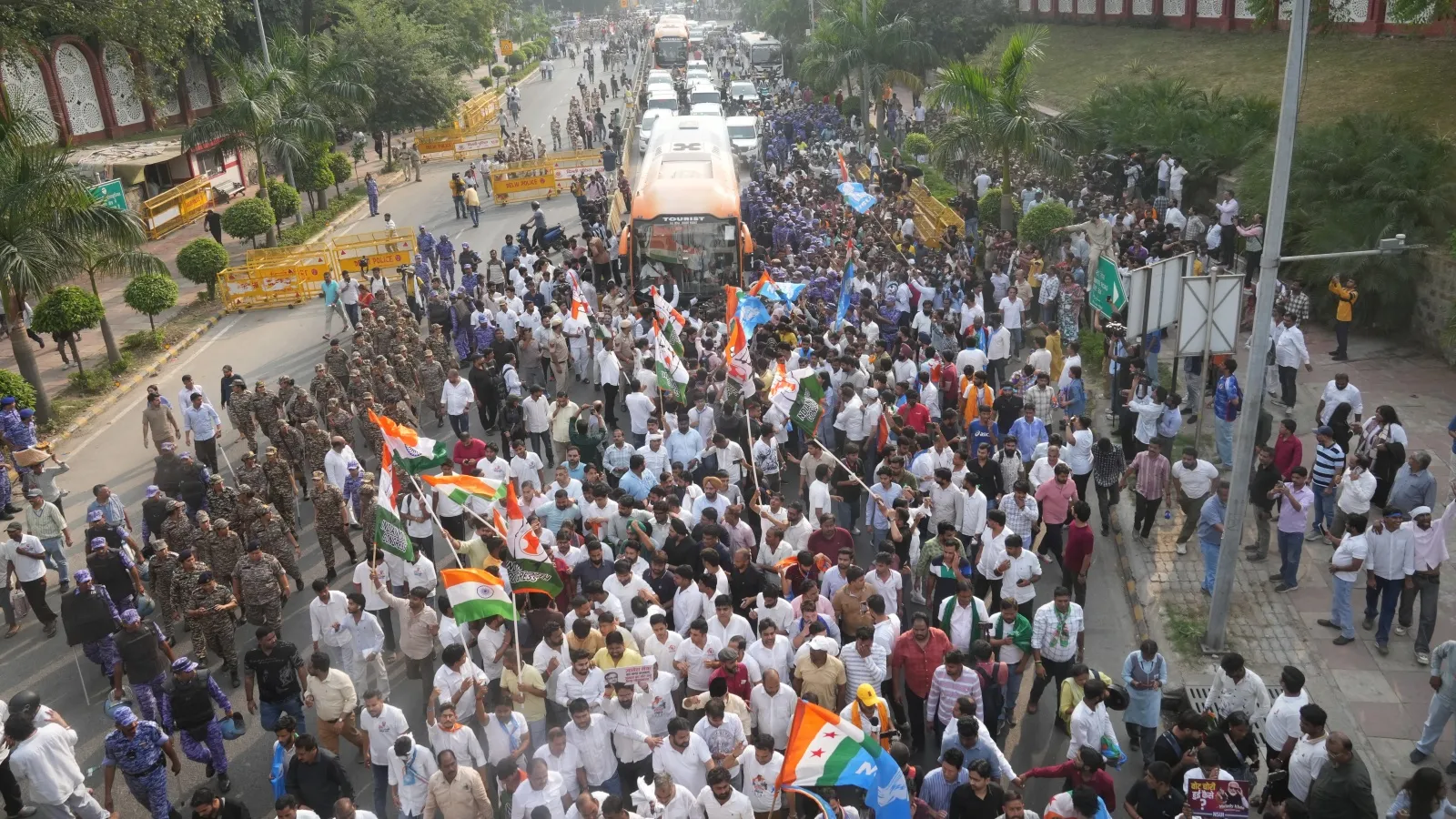
The INDIA bloc’s third day of protests moved to Rajghat, Mahatma Gandhi’s memorial. Leaders including Rahul Gandhi and Mallikarjun Kharge staged a peaceful sit-in and said the campaign would continue on Friday. They accuse Chief Election Commissioner Gyanesh Kumar of involvement in alleged “vote chori” and want him to resign. The opposition first assembled at Moets restaurant in Connaught Place, where Kharge hosted lunch. They then travelled by bus to Rajghat. Gandhi said about 300 MPs wanted a peaceful protest, but police stopped them near the Election Commission on October 6 and prevented them from reaching Jantar Mantar on October 7. The next planned step is a march from Parliament complex to Rashtrapati Bhavan. The opposition has requested a meeting with President Droupadi Murmu. If granted, selected leaders will meet her. If refused, INDIA bloc sources said they will march to the Bhavan and protest there instead.
Based on reporting by Indian Express
What happened on the third day of the INDIA bloc’s protest, and why are its leaders planning to march to Rashtrapati Bhavan?
The INDIA bloc’s third day of protests moved to Rajghat, Mahatma Gandhi’s memorial. Leaders including Rahul Gandhi and Mallikarjun Kharge staged a peaceful sit-in and said the campaign would continue on Friday. They accuse Chief Election Commissioner Gyanesh Kumar of involvement in alleged “vote chori” and want him to resign.
The opposition first assembled at Moets restaurant in Connaught Place, where Kharge hosted lunch. They then travelled by bus to Rajghat. Gandhi said about 300 MPs wanted a peaceful protest, but police stopped them near the Election Commission on October 6 and prevented them from reaching Jantar Mantar on October 7.
The next planned step is a march from Parliament complex to Rashtrapati Bhavan. The opposition has requested a meeting with President Droupadi Murmu. If granted, selected leaders will meet her. If refused, INDIA bloc sources said they will march to the Bhavan and protest there instead.
What is the INDIA bloc, and which major opposition parties and leaders are taking part in it?
The INDIA bloc is a coalition of opposition parties. In this protest, it is acting jointly against Chief Election Commissioner Gyanesh Kumar and the allegations of “vote chori.” The alliance matters because it brings several parliamentary parties together around one institutional demand.
Congress is represented by Rahul Gandhi, Mallikarjun Kharge, Priyanka Gandhi Vadra and K C Venugopal. Other named participants include TMC’s Mamata Banerjee and Abhishek Banerjee, RJD’s Tejashwi Yadav and Sudhakar Singh, SP’s Rajeev Rai, NCP(SP)’s Supriya Sule, and Shiv Sena (UBT)’s Sanjay Raut. CPI(M) and CPI MPs also joined.
The group is not limited to national party leaders. Himachal Pradesh Chief Minister Sukhvinder Singh Sukhu and Telangana Chief Minister A Revanth Reddy attended, along with many MPs. The article presents the bloc as a broad opposition front coordinating protests, a possible presidential meeting and further action in Parliament.
How large and sustained has the protest been—about how many MPs are involved, and for how many days have they demonstrated?
The protest was large enough for Rahul Gandhi to say that around 300 MPs wanted to hold a peaceful sit-in. The article does not provide an independently verified attendance figure, but it records participation by MPs from several INDIA bloc parties and two chief ministers.
The demonstrations lasted three consecutive days. On October 6, the first day, the group marched from Parliament’s Makar Dwar toward the Election Commission of India. On the second day, October 7, it headed from Janpath toward Jantar Mantar. On the third day, October 8, leaders travelled from Connaught Place to Rajghat.
The protest was therefore both sizable and sustained. Leaders said they would continue on Friday, October 9, with a possible march from Parliament complex to Rashtrapati Bhavan. The next step depends partly on whether the President’s office grants their requested meeting.
What does India’s Chief Election Commissioner do, and why would opposition parties demand the CEC’s resignation?
India’s Chief Election Commissioner is the senior member of the Election Commission of India. In general, the Commission supervises the electoral process, including election administration, schedules, polling arrangements and counting oversight. This role matters because public trust depends on elections being run impartially.
The article reports that INDIA bloc leaders are demanding Gyanesh Kumar’s resignation. They allege “vote chori” and say the BJP government is taking away citizens’ voting rights. Rahul Gandhi also accused Kumar, Prime Minister Narendra Modi, Home Minister Amit Shah and RSS chief Mohan Bhagwat of a criminal conspiracy. These are political allegations reported in the article.
A resignation demand is not itself a legal finding. Establishing misconduct would require credible evidence, formal investigation and appropriate constitutional or legal proceedings. The article does not describe any completed investigation, ruling or official finding against Kumar. It records the opposition’s claims and continuing protests.
What do the protesters mean by “vote chori,” and what kind of evidence or legal process would be needed to establish that votes were improperly affected?
In this article, “vote chori” is a political phrase used by INDIA bloc leaders for alleged interference with citizens’ voting rights. They say the BJP government is “snatching” that right and accuse the Election Commission’s leadership of helping undermine elections. The article does not define a particular technical method or identify individual ballots.
To establish such a claim, investigators would need concrete, verifiable material. Depending on the allegation, that could include electoral records, polling-station documents, digital or paper audit trails, witness testimony, procedural records and evidence of unlawful changes. Claims would need to be linked to specific constituencies, voters or election steps rather than broad political statements.
The normal path would involve complaints to election authorities, an independent investigation and, where appropriate, judicial review. Courts or legally empowered bodies would assess evidence and hear responses from those accused. The article mentions no such finding. It describes protests and allegations, not proof that votes were improperly affected.
What could happen next if the President grants the opposition leaders a meeting, or if her office refuses their request?
The opposition has asked President Droupadi Murmu for a meeting with INDIA alliance leaders. K C Venugopal said the first request was sent on October 2, and a later request naming leaders was submitted on October 5. The alliance asked for an appointment on October 7, 8 or 9, but said it had received no response by Thursday.
If the President’s office grants the appointment, opposition MPs will march to Rashtrapati Bhavan, while a selected group meets the President. The proposed delegation includes Rahul Gandhi, Mallikarjun Kharge, Mamata Banerjee, Tejashwi Yadav, Rajeev Rai, Supriya Sule and Sanjay Raut, among others.
If the request is refused, an INDIA bloc source said the MPs will still march to the Bhavan and protest there. Leaders also indicated that protests would continue on Friday. The immediate outcome is therefore either a formal meeting alongside a march or a direct protest without the requested audience.
Why is an independent election system essential to a constitutional democracy, and what institutions are meant to protect the integrity of elections in India?
An independent election system is essential because citizens must believe their votes are counted fairly. Without that confidence, election results can be challenged as politically controlled, and constitutional government loses legitimacy. Independence also helps ensure that governing parties cannot use state institutions to entrench themselves.
India’s Election Commission is the central constitutional institution for conducting and supervising elections. Its independence is supported by constitutional rules, election laws, administrative procedures, polling safeguards and judicial review. Courts can examine legal disputes, while Parliament makes election laws and scrutinises the government. These institutions are meant to check one another.
The article shows why those protections matter. INDIA bloc leaders accuse the Chief Election Commissioner of “vote chori” and demand his resignation, while the article records no completed investigation or legal finding. The immediate issue is political protest, but the wider implication is public trust. Transparent evidence and lawful review would be needed to resolve the dispute.
Key Facts:
📌 The INDIA bloc held its third protest day at Rajghat.
📌 About 300 MPs reportedly wanted to stage a peaceful sit-in.
📌 Leaders may march to Rashtrapati Bhavan on Friday.
📌 The INDIA bloc combines several opposition parties.
📌 Rahul Gandhi and Mallikarjun Kharge led the delegation.
📌 TMC, RJD, SP, NCP(SP), Shiv Sena (UBT), CPI(M) and CPI participated.
📌 Rahul Gandhi said around 300 MPs wanted a peaceful sit-in.