News · International Relations
Germany news: UK's Burnham visits Berlin for talks with Merz
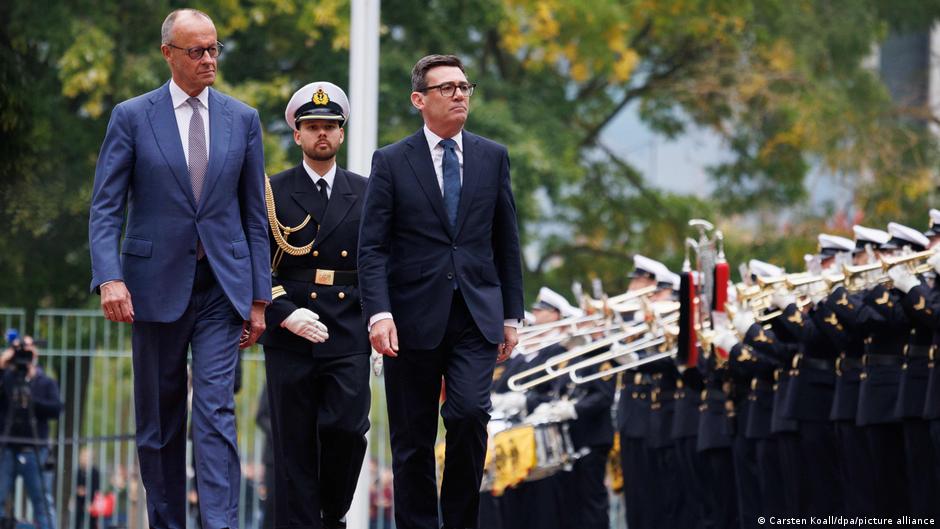
Andy Burnham and Friedrich Merz are the two politicians linked to the Berlin talks. The article calls Burnham the “UK leader” but does not give his formal office. Established public knowledge identifies Burnham as the mayor of Greater Manchester. Friedrich Merz is Germany’s chancellor. Their roles are important because the meeting involved the governments of the United Kingdom and Germany. Merz represents Germany’s federal government. Burnham’s role, as presented in the article, connects him to the UK side of the new Kensington Treaty. The two men also held one-on-one talks in Berlin. The article provides no further biography or explanation of Burnham’s authority in the treaty process. It does state that the Kensington Treaty came into force during his visit. That makes the meeting politically significant, but the source does not specify whether Burnham signed, negotiated, or formally approved the agreement.
Based on reporting by DW News
Who are Andy Burnham and Friedrich Merz, and what official positions do they hold?
Andy Burnham and Friedrich Merz are the two politicians linked to the Berlin talks. The article calls Burnham the “UK leader” but does not give his formal office. Established public knowledge identifies Burnham as the mayor of Greater Manchester. Friedrich Merz is Germany’s chancellor.
Their roles are important because the meeting involved the governments of the United Kingdom and Germany. Merz represents Germany’s federal government. Burnham’s role, as presented in the article, connects him to the UK side of the new Kensington Treaty. The two men also held one-on-one talks in Berlin.
The article provides no further biography or explanation of Burnham’s authority in the treaty process. It does state that the Kensington Treaty came into force during his visit. That makes the meeting politically significant, but the source does not specify whether Burnham signed, negotiated, or formally approved the agreement.
What is the Kensington Treaty, and what does it mean for relations between the United Kingdom and Germany?
A treaty is a formal agreement between countries. In this case, the Kensington Treaty is presented as an agreement between the United Kingdom and Germany. Its entry into force means the treaty’s commitments became legally or politically operative at the stated time, subject to the treaty’s own terms.
The article gives only one concrete detail: the treaty came into force while Burnham was visiting Berlin. It also reports that Burnham and Chancellor Friedrich Merz held one-on-one talks. However, it does not list the treaty’s provisions, institutions, funding, or areas of cooperation. Those missing details matter because they determine how substantial the agreement is.
The confirmed meaning is therefore limited. The treaty marks a formal moment in UK-German relations and provided a backdrop for high-level talks. Its practical effect cannot be described more precisely using this source. The article does not say whether it changes trade, defense, migration, technology, or diplomatic procedures.
What did Burnham and Merz do in Berlin, and why was the treaty’s entry into force important during the visit?
Burnham’s Berlin visit combined personal diplomacy with a formal treaty milestone. The article says he and Chancellor Friedrich Merz held one-on-one talks. It also says the Kensington Treaty between the United Kingdom and Germany came into force during the trip. These events placed bilateral relations at the center of the visit.
The key mechanism is timing. A treaty’s entry into force means its agreed commitments begin operating according to its terms. The meeting offered the two leaders a direct opportunity to discuss relations while that agreement became active. The article does not say whether they signed documents, announced new projects, or discussed specific policy areas.
The importance is therefore clear but limited by the available information. The visit connected high-level talks with a new formal framework for cooperation. Future consequences would depend on the treaty’s actual clauses and implementation. Those details are not included in the article, so its effects on security, trade, or technology cannot be confirmed.
How broad is the treaty’s cooperation—how many major areas such as defense, trade, diplomacy, or technology does it cover?
The treaty’s breadth cannot be measured from the supplied article. No number of cooperation areas is provided. The text mentions the agreement, Burnham’s visit, and his talks with Friedrich Merz, but it does not identify provisions on defense, trade, diplomacy, technology, energy, or other sectors.
That missing list is essential for answering a scale question. A treaty covering one narrow issue would have a different reach from a framework spanning several major policy areas. The article supplies no contents, annexes, budget, implementation body, or timetable. It therefore cannot support a reliable count.
The confirmed fact is that the treaty entered into force during the Berlin visit. Any claim that it covers a particular number of areas would go beyond the source. To establish its scope, readers would need the treaty text or an official summary. Based on this article alone, the number of major cooperation areas is unknown.
What practical consequences could the treaty have for UK-German security cooperation and their ability to respond to threats?
Security consequences depend on the treaty’s wording and implementation. A bilateral agreement can establish information sharing, joint planning, military cooperation, or consultation procedures. However, the article does not say that the Kensington Treaty contains any of these measures. It only confirms that the agreement came into force between the United Kingdom and Germany.
The concrete event was Burnham’s visit to Berlin and his one-on-one talks with Chancellor Friedrich Merz. Those talks may provide political direction, but the article does not report decisions about intelligence, armed forces, cyber threats, procurement, or emergency response. No new capability or operational mechanism is described.
The treaty could matter for responding to threats if its provisions improve coordination. That is a general consequence of security agreements, not a confirmed result here. The current evidence supports only a narrower conclusion: the UK and Germany activated a formal agreement while their leaders met. Its real security impact requires the missing treaty text and evidence of implementation.
Why might the United Kingdom and Germany want a closer partnership after Brexit, even though Britain is no longer a member of the European Union?
After Brexit, the United Kingdom remained outside the European Union while Germany remained an EU member. That separation can make direct partnerships useful for managing shared concerns. Bilateral agreements may provide a focused channel for cooperation without restoring the UK’s membership of EU institutions. This is general context, not a point made in the article.
A direct UK-German partnership can also allow both governments to set priorities that suit their relationship. Depending on the agreement, those priorities might include security, diplomacy, trade, research, or technology. The supplied text does not identify any such Kensington Treaty provisions, so none can be attributed to it confidently.
The article confirms that the treaty came into force during Burnham’s Berlin visit and that he met Friedrich Merz. Those facts show a formal relationship being emphasized after Brexit, but they do not explain why. The likely strategic value of closer cooperation is therefore contextual, while the treaty’s actual purpose remains unspecified in this source.
How do bilateral treaties work, and how are they different from broader institutions such as the European Union or NATO?
Bilateral treaties are agreements made by two countries. They set commitments for those parties and usually operate under terms they negotiate themselves. Broader institutions, such as the European Union or NATO, involve multiple members, standing bodies, and wider rules. Their decisions and obligations come from shared frameworks rather than one country-to-country arrangement.
The Kensington Treaty fits the bilateral category because the article describes it as being between the United Kingdom and Germany. It came into force during Andy Burnham’s visit to Berlin, when he also held one-on-one talks with Friedrich Merz. The source does not state whether the treaty creates committees, dispute procedures, funding, or enforcement arrangements.
The distinction matters because a bilateral treaty can target a narrower relationship, while a wider institution coordinates many countries and policy areas. Still, the article does not say how the Kensington Treaty interacts with the EU or NATO. Any detailed comparison of its authority or obligations would require the treaty text.
Key Facts:
📌 Friedrich Merz is Germany’s chancellor.
📌 The article identifies Andy Burnham as the UK leader.
📌 Burnham and Merz held one-on-one talks in Berlin.
📌 The Kensington Treaty came into force during Burnham’s Berlin visit.
📌 It is presented as a UK-German agreement.
📌 The article does not list the treaty’s provisions.
📌 Burnham visited Berlin for talks with Friedrich Merz.