News · Defence & Security
Lithuania Deploys Army to Kaliningrad Border After Belarus-Latvia Breach
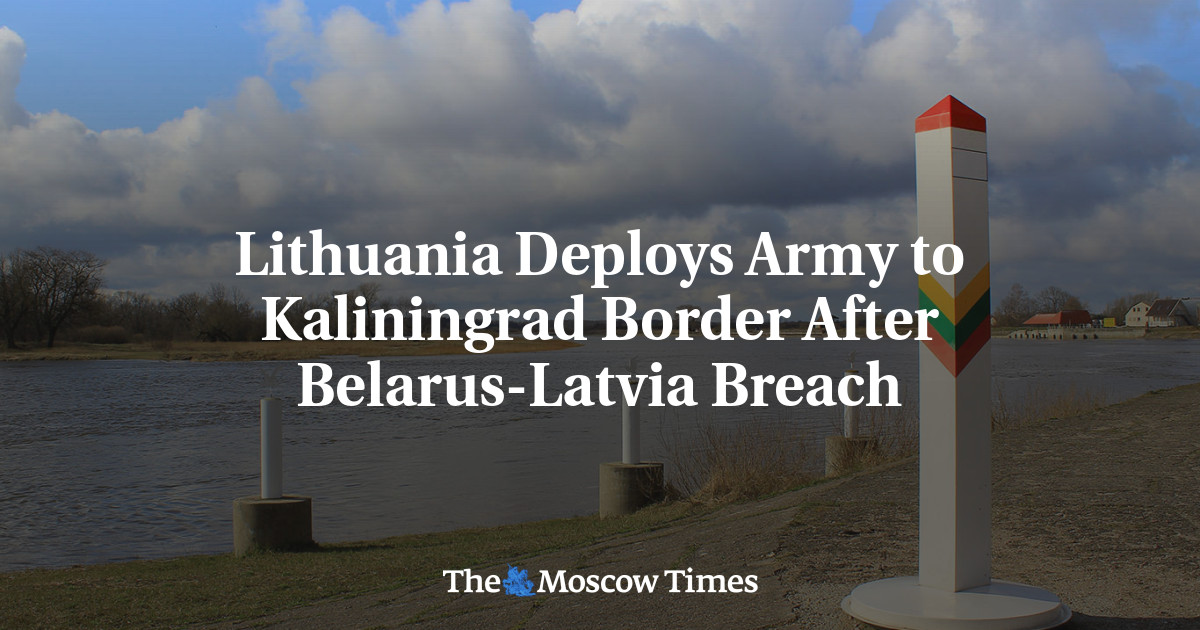
Lithuania is sending about 100 soldiers to help guard its border with Russia’s Kaliningrad exclave. The mission is planned for the next two weeks. Officials describe it as a preventive move, not a response to reported fighting along that border. The soldiers will reinforce border security after concerns about possible Russian military mobilization and renewed hybrid threats. Defense Minister Robertas Kauna said the order was being carried out immediately. Interior Minister Martynas Katelynas linked the decision to a security breach on the Latvia-Belarus border. Lithuanian officials stressed that the Kaliningrad border remains calm. They also reported zero illegal crossings from neighboring Belarus for five consecutive days. The temporary deployment is meant to increase vigilance while authorities assess regional risks. The article does not say whether the two-week mission will be extended.
Based on reporting by Moscow Times
What exactly is Lithuania deploying, where, and for how long?
Lithuania is sending about 100 soldiers to help guard its border with Russia’s Kaliningrad exclave. The mission is planned for the next two weeks. Officials describe it as a preventive move, not a response to reported fighting along that border.
The soldiers will reinforce border security after concerns about possible Russian military mobilization and renewed hybrid threats. Defense Minister Robertas Kauna said the order was being carried out immediately. Interior Minister Martynas Katelynas linked the decision to a security breach on the Latvia-Belarus border.
Lithuanian officials stressed that the Kaliningrad border remains calm. They also reported zero illegal crossings from neighboring Belarus for five consecutive days. The temporary deployment is meant to increase vigilance while authorities assess regional risks. The article does not say whether the two-week mission will be extended.
How many soldiers are being sent, and how large is this deployment compared with Lithuania’s overall military?
Around 100 soldiers are being sent to reinforce Lithuania’s border with Kaliningrad. The article does not state the size of Lithuania’s army, armed forces, or available border personnel. Therefore, it does not provide enough information to calculate what percentage this deployment represents.
The number is a temporary border-support force, not necessarily the size of Lithuania’s entire military response. Defense Minister Robertas Kauna said the soldiers would help guard the Lithuanian-Russian border for two weeks. Their mission follows concerns about possible Russian mobilization and hybrid threats.
The deployment’s practical importance depends on how many border posts, patrols, and surveillance teams they support. The article gives no breakdown of their duties or equipment. It also does not say whether additional troops could follow. Its clearest measurable fact is simply the figure of around 100 soldiers.
What is Kaliningrad, and why is Lithuania’s border with this Russian territory strategically important?
Kaliningrad is a Russian territory separated from Russia’s mainland by other countries. The article identifies it as a Russian exclave and says Lithuania is reinforcing the border beside it. This makes the boundary strategically important because Lithuania directly faces Russian territory there.
A border with Kaliningrad gives Lithuania a sensitive area to monitor for military movement, illegal crossings, or other pressure. Lithuania also borders Belarus, which is relevant because officials cited a Latvia-Belarus border breach and reported crossings from Belarus. The article connects these developments to wider regional security concerns.
Lithuania is a NATO member, so activity near its Russian border carries wider alliance significance. However, the article says the Kaliningrad border remains calm. It reports zero illegal crossings from neighboring Belarus for five consecutive days, while Lithuania adds troops as a precaution rather than announcing an active attack.
What happened during the reported breach on the Latvia-Belarus border, and why did it raise security concerns beyond ordinary illegal migration?
Latvian authorities said masked and armed individuals escorted 20 irregular migrants through the Belarus border into Latvia. The operatives reportedly damaged electrical equipment and stole border surveillance cameras. They then retreated into Belarusian territory.
This raised concerns because the incident involved force, concealment, equipment damage, and a retreat across the border. Ordinary illegal migration involves unauthorized movement, but this episode also targeted the systems used to detect and stop crossings. That combination can reduce border visibility and make later movements harder to monitor.
The reported breach helped prompt Lithuania’s preventive deployment, even though it happened on Latvia’s border with Belarus. Lithuanian officials said their own Kaliningrad border remained calm and reported no illegal crossings from Belarus for five days. The incident nevertheless added to fears of renewed hybrid pressure across the region.
What are hybrid threats, and how can migrants, armed operatives, cyberattacks, or damaged border equipment be used as security tools?
Hybrid threats are coordinated actions that exploit a country’s security, political, or social weaknesses without looking like conventional war. They can include manipulated migration, intimidation by armed operatives, disinformation, cyberattacks, or sabotage of infrastructure. Their purpose may be to create confusion, stretch resources, or test a border’s response.
The article gives one reported example: masked and armed people escorted 20 migrants from Belarus into Latvia, damaged electrical equipment, and stole surveillance cameras. Those actions could make border monitoring harder while forcing authorities to respond to both migrants and suspected organized operators.
The article does not report a cyberattack. It does describe physical damage to border equipment, which can have a similar security effect by reducing surveillance. Lithuania’s officials cited renewed hybrid threats as one reason for sending troops. They still said the Kaliningrad border was calm, showing that concern can rise before a direct attack occurs.
Why could a possible military mobilization in Russia concern Lithuania, especially given Lithuania’s membership in NATO and its borders with Russia and Belarus?
A possible military mobilization in Russia could concern Lithuania because Lithuania borders Russian territory at Kaliningrad and also borders Belarus. More personnel or military activity in the region could increase uncertainty and place greater demands on surveillance and border defense.
Lithuania is a NATO member. Under the alliance’s collective-defense principle, an armed attack on one member can become a concern for all members. That does not mean every mobilization would trigger a NATO response, and the article does not report an attack or say that mobilization has begun. Lithuanian officials describe their step as preventive.
The immediate response is limited: around 100 soldiers will help guard the Lithuanian-Russian border for two weeks. Officials say the border is calm, with zero illegal crossings from Belarus for five consecutive days. The deployment reflects caution about possible changes, not evidence that open conflict is underway.
What consequences can a preventive troop deployment have for border security, deterrence, and tensions between Russia, Belarus, Lithuania, and other NATO countries?
A preventive troop deployment can improve border security by adding personnel to patrols, observation points, and emergency responses. It can also deter attempts to cross illegally or damage surveillance systems. Publicly announcing the move signals that Lithuania is watching regional developments closely.
The reported Latvia-Belarus breach shows why authorities are alert. Masked and armed operatives escorted 20 migrants, damaged electrical equipment, and stole cameras before returning to Belarus. Lithuania’s soldiers are being sent to its border with Kaliningrad, not to the Latvian incident itself, but officials connect both events to wider security concerns.
The move may also increase tension if Russia or Belarus views it as hostile. The Kremlin already called Lithuania’s preliminary vote on hosting foreign nuclear weapons a dangerous escalation. Still, Lithuanian officials say the Kaliningrad border remains calm. The deployment is temporary and preventive, with no announced extension or wider military action.
Key Facts:
📌 Around 100 soldiers will reinforce Lithuania’s border with Kaliningrad.
📌 The deployment is planned for two weeks.
📌 Officials describe the move as preventive.
📌 Around 100 soldiers are being deployed.
📌 The mission is scheduled to last two weeks.
📌 The article gives no total military figure for comparison.
📌 Kaliningrad is a Russian exclave.