News · Politics & Governance
US freezes green card route for Microsoft, Infosys, Tata; Vance says ‘visa fraud’
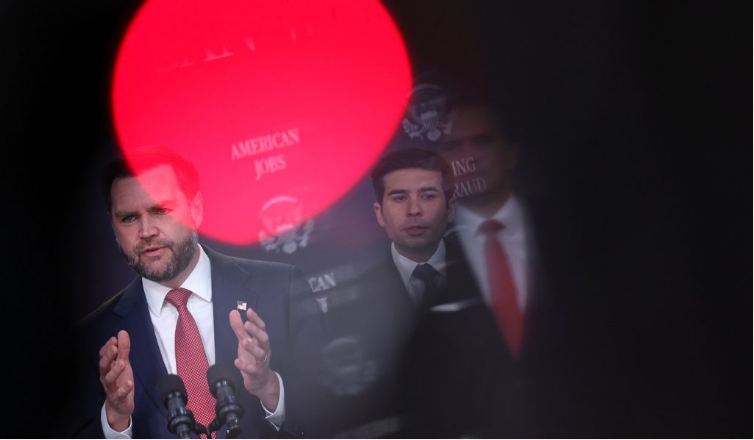
The US suspended some major employers from using the Permanent Labour Certification Programme, or PERM. PERM is the route companies use to sponsor foreign workers for employment-based green cards. The move matters because it can interrupt permanent-residence plans for thousands of skilled workers, especially Indian technology professionals. Labour secretary Keith Sonderling named Cognizant, Infosys, Tata, Wipro, HCL and Capgemini. He also said the decision covered Adobe and other major Indian technology companies. Microsoft featured prominently because Vice President J.D. Vance cited its layoffs while discussing the administration’s concerns about H-1B hiring. The suspension is linked to an investigation into alleged visa fraud and claims that foreign-worker programmes displace Americans. The article does not give an end date. It says restrictions are understood to remain while the politically sensitive allegations are investigated, leaving affected employers unable to sponsor workers through PERM.
Based on reporting by Kathmandu Post Nepal
What did the US government suspend, and which companies were affected?
The US suspended some major employers from using the Permanent Labour Certification Programme, or PERM. PERM is the route companies use to sponsor foreign workers for employment-based green cards. The move matters because it can interrupt permanent-residence plans for thousands of skilled workers, especially Indian technology professionals.
Labour secretary Keith Sonderling named Cognizant, Infosys, Tata, Wipro, HCL and Capgemini. He also said the decision covered Adobe and other major Indian technology companies. Microsoft featured prominently because Vice President J.D. Vance cited its layoffs while discussing the administration’s concerns about H-1B hiring.
The suspension is linked to an investigation into alleged visa fraud and claims that foreign-worker programmes displace Americans. The article does not give an end date. It says restrictions are understood to remain while the politically sensitive allegations are investigated, leaving affected employers unable to sponsor workers through PERM.
What is the PERM programme, and how does it help a foreign worker obtain a US green card?
PERM stands for the Permanent Labour Certification Programme. It is a process available to US companies that want to sponsor foreign workers for employment-based green cards. Its central purpose is to test whether hiring the foreign worker would undermine opportunities for qualified American workers.
Under the process described in the article, the employer must attest that no suitable American candidate is available for the position. If the labour certification is obtained, it supports the employer’s green-card sponsorship of the foreign worker. The certification is therefore an employer-based step toward permanent residence, not the green card itself.
The suspension matters because named companies can no longer use this route while the US investigates alleged visa fraud. Existing workers may still have other immigration options, but the article does not describe them. It clearly states that the affected employers cannot sponsor green cards through PERM during the restriction.
How many foreign-worker visa approvals and permanent labour certifications did the named outsourcing companies receive, according to the US labour secretary?
According to labour secretary Keith Sonderling, six named outsourcing companies received over 230,000 H-1B visa approvals and more than 100,000 permanent labour certifications. The companies were Cognizant, Infosys, Tata, Wipro, HCL and Capgemini. These figures show the large scale of their participation in US employment-based immigration.
Sonderling said the six firms had requested almost three million foreign workers since 2009. He presented the visa approvals and labour certifications as evidence that the companies’ hiring practices affected the American labour market. He characterised the roles associated with those visas as jobs taken from American workers.
The figures are government claims presented at the press conference, not an independent assessment in the article. They help explain why the administration targeted large outsourcing firms rather than treating the issue as a small number of individual cases. The suspension now prevents the named employers from using PERM to sponsor green cards while allegations are investigated.
What happens to foreign workers when their employers can no longer use PERM to sponsor them for permanent residence?
When an employer cannot use PERM, it loses the specific route described in the article for sponsoring a foreign worker’s green card. The worker may therefore be unable to advance through that employer’s employment-based permanent-residence process. The immediate restriction falls on the employer, but its practical effect reaches workers whose applications depend on that sponsorship.
For example, a worker at Infosys or Tata could continue to be identified with an H-1B visa, yet the company could not obtain the labour certification needed for its PERM-based green-card sponsorship. The article distinguishes the programmes: H-1B approvals and permanent labour certifications are separate figures, while PERM is the green-card route.
The article does not specify whether individual applications will be cancelled, delayed, or transferred. It says the suspension is understood to apply while the US investigates alleged visa fraud. The likely near-term reality, based on the stated rule, is that affected employers cannot begin or continue PERM sponsorship through this route.
What is an H-1B visa, and how is it different from the PERM process?
An H-1B visa is a US work-visa programme for skilled foreign workers, as shown by the article’s discussion of tech employees and H-1B approvals. It allows employers to hire qualifying foreign workers for jobs in the United States. The article connects the programme to technology companies and alleged misuse, but it does not provide every eligibility rule.
PERM is different. It is the Permanent Labour Certification Programme, through which a US company can sponsor a foreign worker for a green card. The employer must attest that no suitable American candidate is available. Thus, H-1B is associated with the worker’s employment visa, while PERM is associated with the employer’s permanent-residence sponsorship.
The distinction matters in the current crackdown. Sonderling cited more than 230,000 H-1B approvals and over 100,000 permanent labour certifications for six companies. Suspending PERM blocks green-card sponsorship, but the article does not say that every existing H-1B visa is automatically cancelled.
Why is the Trump administration connecting foreign-worker visas with layoffs, outsourcing, and alleged discrimination against American workers?
The Trump administration is framing foreign-worker visas as a labour-market issue. Officials argue that employers should hire American workers when qualified people are available. They connect outsourcing and visa use with layoffs, saying foreign-worker programmes can shift jobs away from workers already in the United States.
Microsoft became the clearest example at the press conference. Vance cited 6,000 Microsoft layoffs in 2025 and said the company added 6,300 H-1B workers. Sonderling then named large outsourcing companies and said their visas represented jobs taken from Americans. Attorney General Todd Blanche called the policy a response to discrimination against American workers.
The article also notes that AI-linked layoffs are affecting technology, banking, finance and online marketplaces. It does not establish that every reported layoff was caused by visas or outsourcing. The administration has suspended PERM access while investigating alleged visa fraud, making immigration enforcement part of wider domestic job politics.
How does the US employment-based immigration system balance employers’ need for specialised skills with the goal of protecting workers already in the country?
The employment-based system balances two goals. Employers can seek specialised foreign workers when they say the skills are needed. At the same time, the process is meant to protect workers already in the United States from being displaced when a suitable American candidate is available.
The article’s clearest mechanism is PERM. Before sponsoring a foreign worker for a green card, a company must attest that no suitable American candidate is available for the job. H-1B visas provide another channel for foreign-worker hiring, but the article does not describe a comparable detailed test for that programme. Officials say alleged abuse has weakened the intended balance.
The administration is responding by suspending PERM access for major technology and outsourcing firms and investigating alleged visa fraud. That may strengthen scrutiny of employers, but it also limits their permanent-residence sponsorship. The article does not outline reforms beyond the suspension or predict how the investigation will end.
Key Facts:
📌 The US suspended PERM access for six named major outsourcing companies.
📌 Named firms include Infosys, Tata, Wipro, HCL, Cognizant and Capgemini.
📌 Adobe and Microsoft were also discussed in the wider crackdown.
📌 PERM is the Permanent Labour Certification Programme.
📌 Employers must attest that no suitable American candidate is available.
📌 PERM is a route for sponsoring foreign workers for green cards.
📌 The companies received over 230,000 H-1B approvals.