News · Politics & Governance
In graphics: Police’s ‘fail-safe plan’ to block CJP’s Jantar Mantar protest
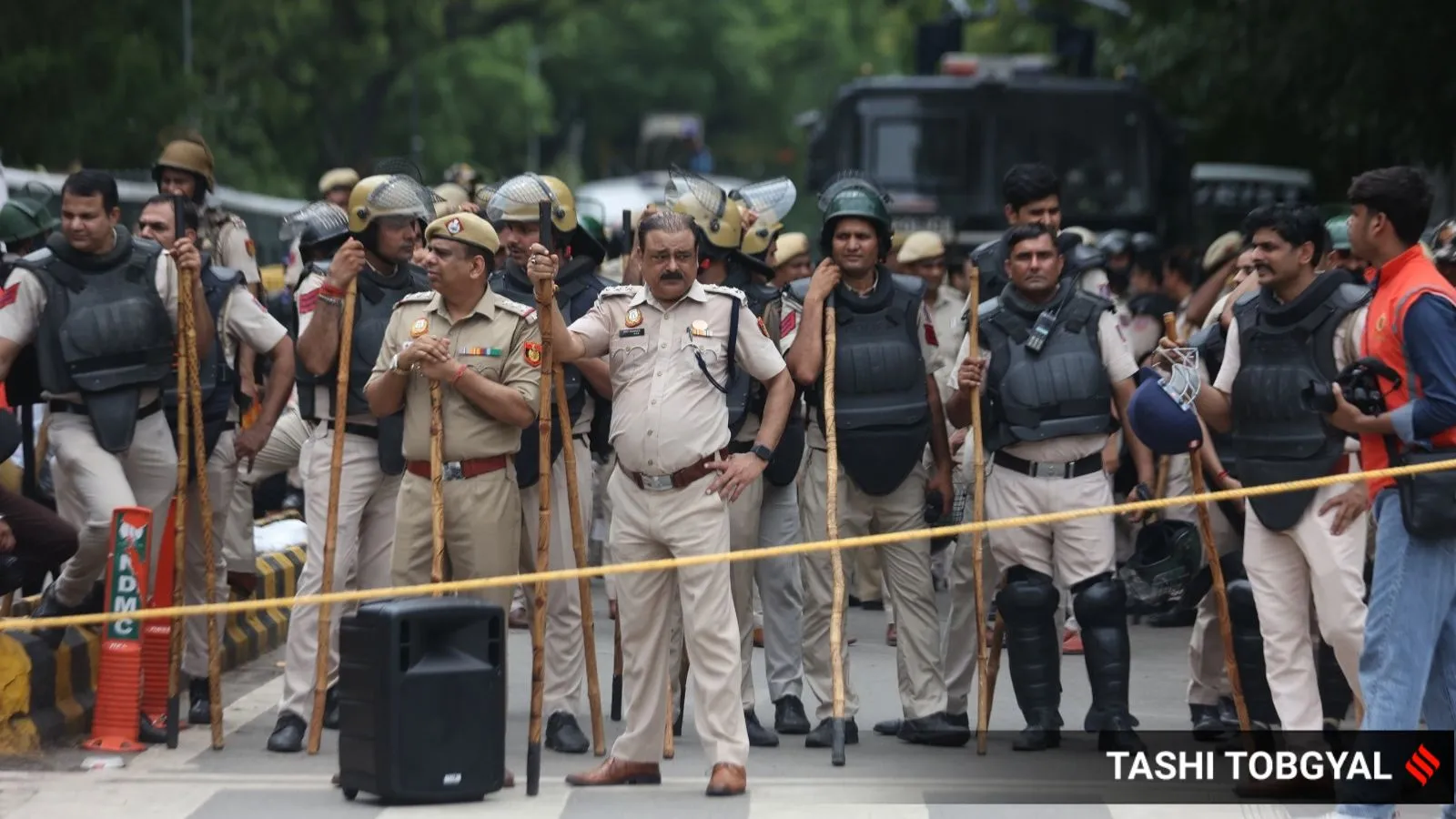
Delhi Police prepared a four-layer plan to prevent the Cockroach Janta Party-led protest from reaching Jantar Mantar. It includes transport disruptions, checks at Delhi’s borders, restrictions around Central Delhi and a heavy deployment at the site. Police cited prohibitory orders under Section 163 of the BNSS and did not grant permission for the demonstration. All trains to and from New Delhi and Hazrat Nizamuddin were cancelled from 4 am to 2 pm on October 10. The article’s graphic lists 57 metro stations closed from Friday night, while its introduction refers to 60. Hotels were asked to restrict new bookings, liquor shops were ordered shut, and app-cab movement towards Lutyens’ Delhi could be regulated. Districts were told to stop suspected protesters before they reached New Delhi. Police planned 37 blocking points and detention centres across all 15 districts. At Jantar Mantar, central forces, women police and body-worn devices were planned. Internet restrictions remained possible, depending on the security situation.
Based on reporting by Indian Express
What restrictions did Delhi Police announce or prepare to prevent the protest at Jantar Mantar?
Delhi Police prepared a four-layer plan to prevent the Cockroach Janta Party-led protest from reaching Jantar Mantar. It includes transport disruptions, checks at Delhi’s borders, restrictions around Central Delhi and a heavy deployment at the site. Police cited prohibitory orders under Section 163 of the BNSS and did not grant permission for the demonstration.
All trains to and from New Delhi and Hazrat Nizamuddin were cancelled from 4 am to 2 pm on October 10. The article’s graphic lists 57 metro stations closed from Friday night, while its introduction refers to 60. Hotels were asked to restrict new bookings, liquor shops were ordered shut, and app-cab movement towards Lutyens’ Delhi could be regulated.
Districts were told to stop suspected protesters before they reached New Delhi. Police planned 37 blocking points and detention centres across all 15 districts. At Jantar Mantar, central forces, women police and body-worn devices were planned. Internet restrictions remained possible, depending on the security situation.
What is Section 163 of the Bharatiya Nagarik Suraksha Sanhita, and how can it be used to restrict public gatherings?
Section 163 of the Bharatiya Nagarik Suraksha Sanhita, or BNSS, is an emergency public-order provision. It allows an authorised magistrate to issue a written order when immediate action is needed to prevent obstruction, danger, disturbance of public tranquillity, a riot or an affray. It replaced the widely known Section 144 of the previous criminal-procedure law.
An order can direct people to avoid certain acts or places. It may also restrict an assembly when authorities believe a gathering could create a specific public-order risk. Such orders are normally temporary and must state the reasons and area covered. In this case, Delhi Police said prohibitory orders under Section 163 supported its refusal to permit the protest.
The power is not unlimited. Any restriction must have legal authority and should be necessary, proportionate and connected to public safety. Courts can review excessive or arbitrary orders. The article does not provide the precise text, duration or territorial limits of the order used here.
How large is the security operation, and how many trains, metro stations, police personnel, and central-force personnel are involved?
The security operation was designed as a citywide dragnet rather than a single-site deployment. About 5,000 Delhi Police personnel were already deployed in New Delhi district, and officers said that number could rise to 15,000. The Home Ministry made 221 Central Armed Police Forces companies, around 23,000 personnel, available from October 8 to 12.
The transport measures were also large. All trains to and from New Delhi and Hazrat Nizamuddin were cancelled from 4 am to 2 pm on October 10. Certain Mail and Express trains were cancelled at their source, including two Rajdhani services. The graphic lists 57 metro stations closed from Friday night, although the introduction describes the figure as 60.
The article does not state how many individual trains were cancelled. It gives time windows and categories instead. The scale shows that authorities planned to control arrival routes, city movement and the protest zone together, with further deployments possible if conditions changed.
How could the restrictions affect commuters, visitors, hotels, journalists, and people trying to reach the protest site?
The measures could disrupt nearly every stage of a journey to the protest. Rail passengers using New Delhi or Hazrat Nizamuddin faced cancellations from 4 am to 2 pm, while 57 metro stations were listed as closed from Friday night. App cabs could be regulated on roads into Lutyens’ Delhi, and police planned heightened checks at Delhi’s borders.
Visitors could also face fewer accommodation options. Hotels, guest houses and other properties in and around Central Delhi were asked to close or restrict fresh bookings, and Paharganj owners were briefed. Liquor shops across Delhi were ordered shut on October 9 and 10. Suspected protesters could be stopped at borders or within their own districts and sent to detention centres.
Near the site, journalists were asked to display valid press cards at barricades. People filming or livestreaming could face action if they obstructed police operations or breached restrictions. Internet curbs were also possible where detainees were held and potentially in parts of New Delhi and Central Delhi.
What are the Special Intensive Revision of voter rolls and the allegations that the protesters are raising?
A Special Intensive Revision, or SIR, is a detailed exercise to verify and update voter rolls. Election authorities may examine existing entries, identify duplicates or ineligible records, add eligible voters and correct details. The purpose is to maintain an accurate electoral register, though the process can become politically contentious when voters fear wrongful deletion or exclusion.
The protest described in the article is directed against Chief Election Commissioner Gyanesh Kumar and alleged irregularities in the SIR. The Cockroach Janta Party and AISA planned the demonstration at Jantar Mantar, but Delhi Police did not grant permission. The article identifies the allegation only in broad terms and gives no examples of disputed names, deletions or procedures.
That missing detail matters. The security plan is clearly described, but the underlying voter-roll claims are not examined in depth. The immediate issue is therefore the proposed protest and the police response, while the specific evidence behind the allegations remains outside the article’s account.
Why are Delhi Police, the Union Home Ministry, district administrations, and Central Armed Police Forces all involved in managing the protest?
Different authorities are involved because the plan covers transport, borders, districts, the protest site and possible detention. Delhi Police is the lead agency in New Delhi district. It refused permission, set the security plan, coordinated checks and prepared barricades, deployments and restrictions. The Home Ministry supports that operation by making Central Armed Police Forces available.
District administrations and police units have a preventive role outside the protest zone. Officers told districts to stop would-be protesters within their own jurisdictions and detain people who refused to turn back. The plan assigns the 37 blocking points to separate districts or units, preventing two units from being placed at the same location.
Central forces provide additional manpower for a citywide operation. The Home Ministry made 221 companies, around 23,000 personnel, available from October 8 to 12, including five all-women companies. The article presents this as reinforcement for Delhi Police, not as a separate protest authority. The arrangement could change with the security situation.
What legal and democratic principles determine when authorities may limit the right to assemble and protest in order to maintain public order?
India’s Constitution protects peaceful assembly without arms under Article 19(1)(b). That right is subject to reasonable restrictions in the interests of public order under Article 19(3). Authorities may therefore regulate a protest’s place, timing, route or conditions when they can connect the measure to a real and sufficiently serious risk, rather than simply opposing the message.
The legal framework also requires proper authority and procedure. Orders should be clear, time-bound and geographically limited where possible. Restrictions should be necessary and proportionate, meaning officials should use no more force or reach than the identified risk requires. Non-discrimination matters too: rules should not target people solely because of their political viewpoint. Detention and internet restrictions require additional legal justification.
The article reports that Delhi Police cited Section 163 of the BNSS and expected congestion and public-order concerns. It does not provide the order’s full reasoning or terms. Whether the restrictions are lawful would depend on those details, their implementation and any judicial review, not merely on the existence of a protest.
Key Facts:
📌 All trains to and from two major Delhi stations were cancelled for ten hours.
📌 Police planned 37 blocking points across New Delhi district.
📌 Hotels were asked to restrict fresh bookings around Central Delhi.
📌 Delhi Police cited Section 163 when refusing permission for the protest.
📌 Section 163 concerns urgent action to prevent public-order disturbances.
📌 The article does not state the order’s precise duration or territorial limits.
📌 About 5,000 Delhi Police personnel were deployed in New Delhi district.