News · Politics & Governance
Vijay sees endorsement, Stalin calls it downfall: In Tamil Nadu, same bypoll results, different readings
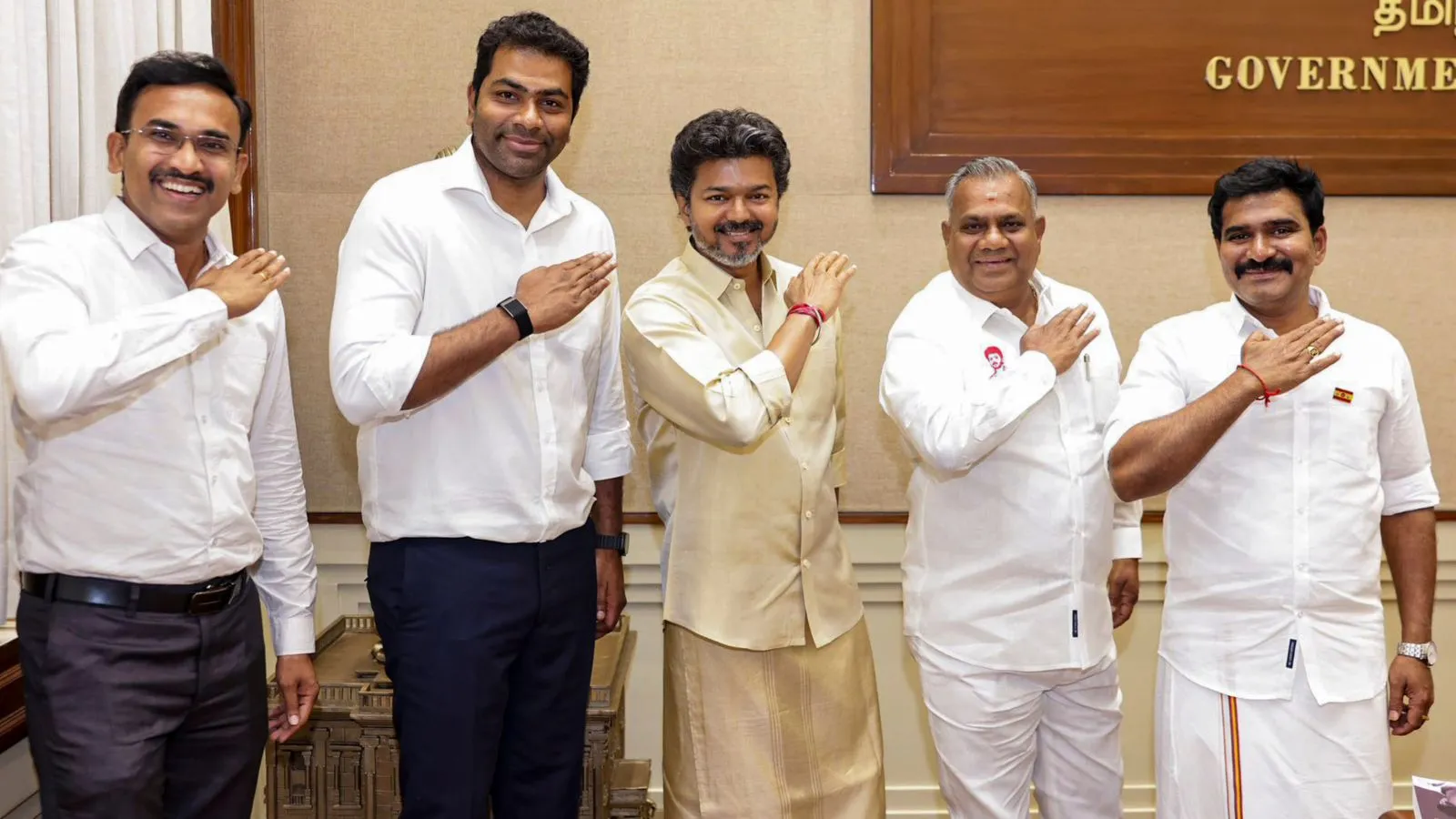
Tamilaga Vettri Kazhagam, or TVK, won both Tamil Nadu Assembly by-elections held in Madurantakam and Dharapuram. The results returned two former AIADMK legislators to the Assembly under their new party banner. They also gave Chief Minister C Joseph Vijay’s four-month-old government an early electoral victory. In Madurantakam, TVK’s Maragatham Kumaravel received 74,048 votes. She defeated DMK’s E Paranthaman, who polled 54,008 votes, by 20,040 votes. AIADMK’s Kanitha Sampath finished third with 47,450 votes. In Dharapuram, TVK’s P Sathyabama won 66,841 votes, beating DMK’s Suganya by 9,471 votes. The results produced different political interpretations. Vijay called them a victory for the people and said they were achieved without paying voters. DMK president M K Stalin called the outcome an interim victory for betrayal and said the downfall of fake image politics had begun. Four more constituencies remain vacant after similar resignations.
Based on reporting by Indian Express
What happened in the Madurantakam and Dharapuram Assembly by-elections?
Tamilaga Vettri Kazhagam, or TVK, won both Tamil Nadu Assembly by-elections held in Madurantakam and Dharapuram. The results returned two former AIADMK legislators to the Assembly under their new party banner. They also gave Chief Minister C Joseph Vijay’s four-month-old government an early electoral victory.
In Madurantakam, TVK’s Maragatham Kumaravel received 74,048 votes. She defeated DMK’s E Paranthaman, who polled 54,008 votes, by 20,040 votes. AIADMK’s Kanitha Sampath finished third with 47,450 votes. In Dharapuram, TVK’s P Sathyabama won 66,841 votes, beating DMK’s Suganya by 9,471 votes.
The results produced different political interpretations. Vijay called them a victory for the people and said they were achieved without paying voters. DMK president M K Stalin called the outcome an interim victory for betrayal and said the downfall of fake image politics had begun. Four more constituencies remain vacant after similar resignations.
What is an Assembly by-election, and why were these two elections held only five months after the previous election?
An Assembly by-election is a fresh election held to fill a vacant seat in a state’s legislative Assembly. It is different from a full Assembly election, which fills all or most seats at once. A by-election is needed when a sitting legislator leaves office before the next regular election, such as through resignation.
These two seats became vacant because Maragatham Kumaravel and P Sathyabama had first won them on AIADMK tickets in April. Both then resigned as legislators and joined TVK. Their resignations meant voters had to choose representatives again, even though the previous election had taken place only about five months earlier.
The timing made the contests politically important. The same people were seeking to return to the same constituencies, but under a different party banner. Their victories showed that voters returned them to the Assembly after their change of allegiance. The result also added two legislators to Vijay’s ruling party and raised questions about further movement from AIADMK to TVK.
How large were TVK’s victories in the two constituencies, and how many votes did the main candidates receive?
TVK’s victories were clear in both constituencies, but the margins differed sharply. In Madurantakam, Maragatham Kumaravel won by 20,040 votes. In Dharapuram, P Sathyabama won by 9,471 votes. The first contest was therefore more than twice as wide in margin as the second.
Kumaravel received 74,048 votes in Madurantakam. DMK candidate E Paranthaman received 54,008, while AIADMK’s Kanitha Sampath finished third with 47,450. In Dharapuram, Sathyabama polled 66,841 votes. DMK’s Suganya received 57,370, and AIADMK’s K Bhanumathi finished third with 45,280 after leading during the early counting rounds.
These figures show that TVK led the main rival in both seats, despite different levels of competition. The results also placed AIADMK candidates third in both constituencies. That performance matters because the winning candidates had previously represented these seats for AIADMK before switching parties and returning through TVK.
Why was it significant that the winning candidates had previously been elected as AIADMK legislators before joining TVK?
The victories mattered because they tested whether voters would accept elected representatives changing parties soon after winning office. Maragatham Kumaravel and P Sathyabama had both won their constituencies on AIADMK tickets in April. They then resigned as MLAs and joined TVK, forcing new elections barely five months later.
Instead of selecting different representatives, voters returned both women to the Assembly under the TVK banner. Kumaravel won Madurantakam with 74,048 votes, defeating the DMK candidate by 20,040. Sathyabama won Dharapuram with 66,841 votes and defeated DMK’s Suganya by 9,471. Both AIADMK candidates finished third.
That outcome gave TVK two additional legislators, but its significance went further. It suggested that the candidates retained enough support after changing allegiance to win again. At the same time, it left AIADMK facing the unusual result of former legislators defeating candidates from their previous party. Four other constituencies face possible similar contests after AIADMK legislators reportedly resigned and joined TVK.
What evidence did Vijay and Stalin use to describe the same results as, respectively, an endorsement of the government and the beginning of its downfall?
Vijay and Stalin read the same results in opposite ways because they focused on different evidence. Vijay treated TVK’s victories in both constituencies as public approval of his government and party. He said the verdict was achieved without paying voters and described it as a victory for the people, not simply for himself or TVK.
His supporters pointed to the winning margins and the celebrations by ministers and TVK workers. Congress state president Manickam Tagore called the results a certificate from voters for Vijay’s four months in office. VCK leader Thol Thirumavalavan said they endorsed the ruling Secular Social Justice Victory Alliance.
Stalin stressed allegations and vote totals instead. He accused TVK of using government machinery, money, and police power, while criticising Vijay’s intensive campaigning. He argued that parties opposing TVK collectively won more votes than TVK, making the result a vote against the government. TVK rejected the money allegations, while Stalin called the outcome an interim victory for betrayal.
What could these results mean for AIADMK, given that four other constituencies are vacant after legislators reportedly left the party for TVK?
The results could deepen AIADMK’s organisational and political challenge. Two of its legislators resigned, crossed over to TVK, and then defeated AIADMK candidates in the resulting by-elections. That means the party lost not only sitting representatives but also contests in constituencies where those former legislators had previously won for AIADMK.
The pattern may continue. The article says four other constituencies remain vacant after their AIADMK legislators similarly resigned and joined TVK. If fresh elections are held there, TVK could again benefit from candidates who already represented those areas. AIADMK would need to defend seats against former members with established local support.
AIADMK general secretary Edappadi K Palaniswami called the results a temporary setback. He accused TVK of using incumbency advantages and various tactics, but said AIADMK would overcome them. The immediate implication is uncertainty over further movement between the parties. The four vacant constituencies could show whether Friday’s result was isolated or part of a broader shift.
How do India’s state Assembly elections turn votes in individual constituencies into seats, and why can one party win a seat even when several opposing parties together receive more votes?
In India’s state Assembly elections, the state is divided into constituencies, and each constituency elects a representative. In the usual first-past-the-post system, the candidate with the highest number of votes wins that seat. The winner does not need more than half the votes, only more than every individual rival.
For example, suppose Party A’s candidate receives 40,000 votes. Three opposing candidates receive 30,000, 20,000, and 15,000. Together, the opponents have 65,000 votes, but their support is split across three candidates. Party A still wins because its candidate has the single largest total. The same mechanism applies separately in every constituency.
That explains Stalin’s argument about these by-elections. He said votes for parties opposing TVK collectively exceeded TVK’s votes, calling them votes against the government. However, TVK candidates still won because each had more votes than any one rival. This system converts constituency-level pluralities into seats, rather than combining all opposition votes into one total.
Key Facts:
📌 TVK won both the Madurantakam and Dharapuram by-elections.
📌 Maragatham Kumaravel won Madurantakam by 20,040 votes.
📌 P Sathyabama won Dharapuram by 9,471 votes.
📌 By-elections fill Assembly seats that become vacant between regular elections.
📌 Both seats were vacated after their AIADMK legislators joined TVK.
📌 The fresh contests occurred barely five months after April’s election.
📌 TVK won Madurantakam by 20,040 votes.