News · Politics & Governance
Provide evidence you won 2023 poll, Tinubu challenges Obi
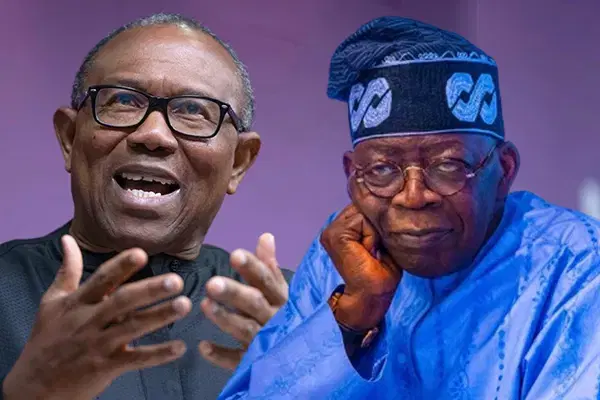
The central dispute is about evidence. President Bola Tinubu’s campaign council is challenging Peter Obi to prove his repeated claim that he won Nigeria’s 2023 presidential election. The council says a claim of victory should rest on verifiable facts, not assertion alone. This matters because official results and legal rulings determine who holds the presidency. The council’s spokesman, Dele Alake, asked Obi to present actual records or data supporting his claim. The challenge followed a BBC interview in which Obi said he won but also acknowledged that he had no evidence. Alake described the position as a disregard for facts and the democratic process. The article does not identify a specific document that Obi could submit. It says Tinubu’s victory was certified by INEC and upheld by the Presidential Election Petition Court and the Supreme Court. The council therefore treats the result as legally settled, while urging Obi to stop making unsupported claims.
Based on reporting by Vanguard Nigeria
What concrete proof is President Tinubu’s campaign council challenging Peter Obi to present?
The central dispute is about evidence. President Bola Tinubu’s campaign council is challenging Peter Obi to prove his repeated claim that he won Nigeria’s 2023 presidential election. The council says a claim of victory should rest on verifiable facts, not assertion alone. This matters because official results and legal rulings determine who holds the presidency.
The council’s spokesman, Dele Alake, asked Obi to present actual records or data supporting his claim. The challenge followed a BBC interview in which Obi said he won but also acknowledged that he had no evidence. Alake described the position as a disregard for facts and the democratic process.
The article does not identify a specific document that Obi could submit. It says Tinubu’s victory was certified by INEC and upheld by the Presidential Election Petition Court and the Supreme Court. The council therefore treats the result as legally settled, while urging Obi to stop making unsupported claims.
What did Peter Obi claim about the 2023 presidential election, and what did he acknowledge about the evidence for that claim?
Peter Obi’s position, as reported in the article, is that he won Nigeria’s 2023 presidential election. His statement directly challenges the officially recognized outcome, which placed him third according to the APC campaign council. The claim matters because it questions the legitimacy of the result and President Bola Tinubu’s mandate.
In a BBC interview, Obi reportedly said, “I won the last election. There’s no evidence, but I won the election.” He also said that everything is not based on evidence. The combination of a firm victory claim and an admission that he lacked proof triggered the campaign council’s response.
The council described Obi’s position as a troubling disregard for facts and the democratic process. It said Tinubu’s victory was certified by INEC and upheld by two courts. The article gives no new evidence from Obi, so the immediate reality is a political dispute over a result the council considers legally settled.
What is INEC, and what role does it play in declaring Nigeria’s election results?
INEC stands for the Independent National Electoral Commission. It is Nigeria’s official electoral management body. Its role is to organize national elections, count and compile results, and declare or certify the official outcome under the country’s election framework. That formal declaration gives the result institutional standing.
In the article, INEC certified President Bola Tinubu’s victory in the 2023 presidential election. The Presidential Election Petition Court and the Supreme Court later upheld that outcome. These steps illustrate the usual chain described in the report: the electoral commission makes the official determination, while courts review legal challenges.
INEC’s declaration does not prevent candidates from contesting a result through lawful procedures. However, once the relevant courts have ruled, the result carries legal finality within the process described. The article presents Tinubu’s victory as settled legally and constitutionally, while the campaign council criticizes continued claims that lack supporting evidence.
How many major official or legal institutions cited in the article supported Tinubu’s declared victory?
The article identifies three official or legal institutions connected to Tinubu’s victory. They are the Independent National Electoral Commission, the Presidential Election Petition Court, and the Supreme Court. Counting these bodies matters because each represents a different stage in establishing and reviewing an election result.
INEC certified Tinubu’s victory after the 2023 presidential election. The Presidential Election Petition Court then upheld the outcome, and the Supreme Court also upheld it. The article therefore describes a result that passed through the electoral commission and two levels of judicial review.
The campaign council uses these three institutional actions to argue that the election is settled legally and constitutionally. This does not mean every political argument has disappeared. It means the article identifies no remaining successful legal challenge to the declared result, while Obi continues to claim victory without providing evidence.
What kinds of election records or data could a candidate use to challenge an officially declared result?
To challenge an officially declared result, a candidate generally needs records that can be checked against the electoral process. Useful material may include polling-station result forms, collation sheets, voter registers, turnout figures, accreditation records, and documented reports of irregularities. The goal is to connect a claimed problem to specific votes or locations.
For example, a candidate might compare signed polling-station forms with figures entered at higher collation levels. If the numbers differ, those forms could support a formal challenge. Other evidence, such as observer reports or legally admissible records, could help show whether the difference affected the overall result. The exact requirements depend on the country’s legal process.
The article does not say that Obi presented any of these materials. It reports that he claimed victory while acknowledging he had no evidence. The APC campaign council therefore asked for concrete proof, while pointing to INEC certification and court rulings upholding Tinubu’s victory.
What happens when a presidential candidate disputes an election result after the electoral commission and courts have ruled on it?
When an election commission declares a result, candidates may challenge it through the available legal process. Courts then examine the claims and evidence. If the courts uphold the result, the declared winner retains the legal mandate under that process. Continued disagreement may remain politically important, but it does not itself overturn the official outcome.
Here, INEC certified Tinubu’s victory. The Presidential Election Petition Court and the Supreme Court subsequently upheld it. The APC campaign council uses those decisions to reject Peter Obi’s continuing claim that he won. It says the result is no longer an unresolved legal question.
The article says Obi continues making the claim without evidence and describes this as posturing and shenanigans. It does not report a new legal case or further official review. The immediate consequence is therefore political confrontation, not a change in the presidency. Tinubu, the council says, remains focused on economic, educational, and infrastructure reforms.
Why do electoral commissions, courts, and constitutional procedures matter for transferring political power in a democracy?
Electoral commissions, courts, and constitutional procedures matter because they provide recognized rules for choosing and replacing leaders. Electoral commissions establish the official result. Courts offer a lawful way to challenge alleged problems. Constitutional procedures help ensure that power changes through institutions, not pressure, personal claims, or force. This supports public confidence and political stability.
The article gives a specific sequence. INEC certified President Tinubu’s victory in the 2023 presidential election. The Presidential Election Petition Court and the Supreme Court later upheld that victory. The APC campaign council says these steps confirm the result as legally and constitutionally settled.
That process also explains the council’s demand for evidence from Peter Obi. A candidate who disputes the outcome must connect the claim to verifiable records and recognized procedures. The article says Obi has continued to claim victory while admitting he has no evidence. It portrays Tinubu as continuing his executive mandate through economic, educational, and infrastructure reforms.
Key Facts:
📌 The council demanded concrete proof that Obi won the 2023 presidential election.
📌 Dele Alake called for verifiable records or data.
📌 The council said official records contradict Obi’s claim.
📌 Obi claimed he won the 2023 presidential election.
📌 He acknowledged that he had no evidence for the claim.
📌 The council said Obi placed third in the poll.
📌 INEC means Independent National Electoral Commission.