News · International Relations
Sheinbaum meets with US business leaders and ambassador amid controversy over US-backed police academy
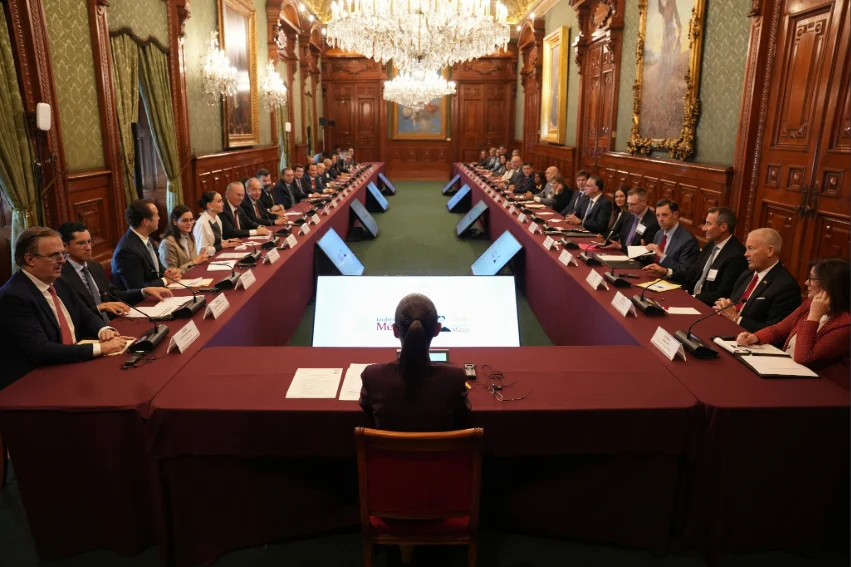
Sheinbaum’s meeting with U.S. business leaders centered on Mexico’s investment climate and deeper North American economic ties. She discussed companies’ concerns, the controversial new revenue law, trade requests, and ways to promote investment. The meeting also included updates on Plan México, her strategy for economic development, industrialization, and regional growth. Several investment agreements were finalized but will be announced later. Security was deliberately kept separate. U.S. Ambassador Ronald Johnson attended, but Sheinbaum said she would discuss her concerns with him at a later date. Those concerns followed criticism of an International Police Training Academy launched in Querétaro without apparent federal authorization. She has argued that state governments cannot independently create international security arrangements. Sheinbaum said Johnson agreed to meet Foreign Affairs Minister Roberto Velasco soon. They are expected to discuss the academy and other security and border issues. The separation shows Mexico is pursuing economic cooperation while insisting security cooperation follow federal law and Mexican authority.
Based on reporting by Mexico News Daily
What did President Claudia Sheinbaum discuss with U.S. business leaders, and why did she postpone security discussions with Ambassador Ronald Johnson?
Sheinbaum’s meeting with U.S. business leaders centered on Mexico’s investment climate and deeper North American economic ties. She discussed companies’ concerns, the controversial new revenue law, trade requests, and ways to promote investment. The meeting also included updates on Plan México, her strategy for economic development, industrialization, and regional growth. Several investment agreements were finalized but will be announced later.
Security was deliberately kept separate. U.S. Ambassador Ronald Johnson attended, but Sheinbaum said she would discuss her concerns with him at a later date. Those concerns followed criticism of an International Police Training Academy launched in Querétaro without apparent federal authorization. She has argued that state governments cannot independently create international security arrangements.
Sheinbaum said Johnson agreed to meet Foreign Affairs Minister Roberto Velasco soon. They are expected to discuss the academy and other security and border issues. The separation shows Mexico is pursuing economic cooperation while insisting security cooperation follow federal law and Mexican authority.
What is the International Police Training Academy in Querétaro, and why has its authorization become controversial?
The International Police Training Academy is a police-training project in Querétaro involving international cooperation. The article gives no further description of its curriculum, size, or operating structure. Its importance comes from the legal question surrounding who may authorize such a project. Mexico is not rejecting international cooperation outright, but President Claudia Sheinbaum says it must follow Mexican law.
The controversy began after U.S. Ambassador Ronald Johnson and Governor Mauricio Kuri attended a groundbreaking ceremony on Oct. 2. Critics said the project apparently had not obtained the required federal authorization. Sheinbaum repeatedly stated that state governments cannot establish international security arrangements or launch such academies without federal and Foreign Ministry approval.
The dispute remains unresolved in the article. Johnson agreed to meet Foreign Affairs Minister Roberto Velasco to discuss the academy and other security matters. The episode has become a test of whether international security projects respect Mexico’s federal framework, transparency requirements, and demand for cooperation with dignity rather than subordination.
Which Mexican authorities are legally responsible for approving international security cooperation, and why can’t a state government act alone?
The article identifies Mexico’s federal authorities and Foreign Ministry as the required authorities for international security cooperation. President Claudia Sheinbaum said state governments cannot forge international security agreements or launch international police academies without federal and Foreign Ministry authorization. Security Minister Omar García Harfuch likewise said bilateral cooperation must follow Mexican law.
The Querétaro academy illustrates the issue. Governor Mauricio Kuri and U.S. Ambassador Ronald Johnson attended its groundbreaking ceremony on Oct. 2. Critics then questioned whether the project had received the required federal authorization. Sheinbaum publicly challenged the project several times, while stressing that Mexico is not fundamentally opposed to international cooperation.
The federal role matters because international security arrangements involve Mexico’s national legal framework and relations with another country. Allowing a state to act independently could bypass that framework. Sheinbaum is demanding cooperation with dignity and transparency, not subordination. Johnson has agreed to meet Foreign Affairs Minister Roberto Velasco to address the dispute.
What is the USMCA, and how does it organize trade and economic relations among Mexico, the United States, and Canada?
The United States-Mexico-Canada Agreement, or USMCA, organizes the trade relationship among Mexico, the United States, and Canada. It provides the framework under which the three economies conduct regional commerce and review their economic ties. The article presents it as more than a trade rulebook: AmCham says it should deepen regional integration and preserve competitiveness.
The agreement matters during the current review of Mexico-U.S. trade relations. AmCham president Óscar del Cueto said the USMCA could help Mexico benefit if the United States enters a new stage of growth and industrialization while China loses dynamism. That could encourage investment and more connected production across North America.
The article does not list specific USMCA rules, tariffs, or deadlines. It does show the agreement’s broader purpose in this discussion: supporting economic integration, investment, and competitiveness among the three partners. Mexico’s meeting with U.S. business leaders connected those goals to Plan México and possible new investment agreements.
How many countries participate in the USMCA, and how large and economically important is the North American market it connects?
The USMCA connects three countries: Mexico, the United States, and Canada. Together, they make up the North American market. The source does not provide a population or gross domestic product figure, but widely established estimates place the region at roughly 500 million people and among the world’s largest economic areas. Its importance comes from the scale and closeness of its economies.
The article links that market to regional integration, competitiveness, and investment. AmCham says the USMCA should help preserve the competitiveness of all three economies. Óscar del Cueto also sees an opportunity for Mexico if the United States enters a new industrial growth phase and China loses dynamism.
That combination could make North America more attractive for production and investment. Sheinbaum’s Plan México is presented as a strategy for economic development, industrialization, and regional growth. The meeting’s investment discussions therefore fit into a wider effort to strengthen economic connections across the three-country market.
What could happen to diplomatic trust, security cooperation, and investment if international agreements bypass Mexico’s federal legal process?
If an international security agreement bypasses Mexico’s federal legal process, trust between Mexican authorities and foreign partners could suffer. Mexico’s government could view the arrangement as interference or subordination rather than cooperation. The article shows that this concern is already politically sensitive: Sheinbaum demanded cooperation with dignity and transparency and insisted that federal frameworks not be bypassed.
The Querétaro academy provides the concrete example. A state government and U.S. ambassador participated in a groundbreaking ceremony, while critics questioned whether federal authorization had been obtained. Security Minister Omar García Harfuch responded that bilateral cooperation is subject to Mexican law. The mechanism is straightforward: without the required approvals, a project can face criticism, delay, or renegotiation.
The wider effects are possible, not certain. Security cooperation could become slower and more cautious. Diplomatic confidence could decline. Investors might also seek clearer legal assurances, although the article does not report investment losses. Sheinbaum is keeping economic cooperation active while arranging new talks on security and border matters.
What is nearshoring, and why can companies’ decisions to move production closer to the U.S. strengthen economic integration in North America?
Nearshoring is the practice of moving production or supply-chain operations closer to the market they serve. In this case, it means locating more production in Mexico or elsewhere in North America rather than farther away. The article does not define the term, but it presents nearshoring as a possible major investment trend for Mexico.
The mechanism is geographic and economic. Closer production can connect companies across Mexico, the United States, and Canada through shared manufacturing, trade, and investment. Óscar del Cueto said Mexico could benefit if the United States enters a new stage of growth and industrialization while China loses dynamism. Those conditions could encourage companies to reconsider where they produce goods.
Del Cueto predicted that nearshoring could again become a hot topic next year. Sheinbaum’s Plan México also aims at economic development, industrialization, and regional growth. If investment agreements and trade cooperation advance, nearshoring could strengthen North American productive integration, though the article reports no guaranteed outcomes.
Key Facts:
📌 The meeting addressed investment, trade, Mexico’s revenue law, and Plan México.
📌 Sheinbaum postponed security discussions with Ambassador Ronald Johnson.
📌 Several investment agreements were finalized but will be announced later.
📌 The academy held a groundbreaking ceremony in Querétaro on Oct. 2.
📌 Critics questioned whether the project obtained federal authorization.
📌 Sheinbaum said Foreign Ministry approval was also required.
📌 Federal and Foreign Ministry authorization is required.