News · Space
Astronomers detect ancient hydrogen signal that could help map the Universe
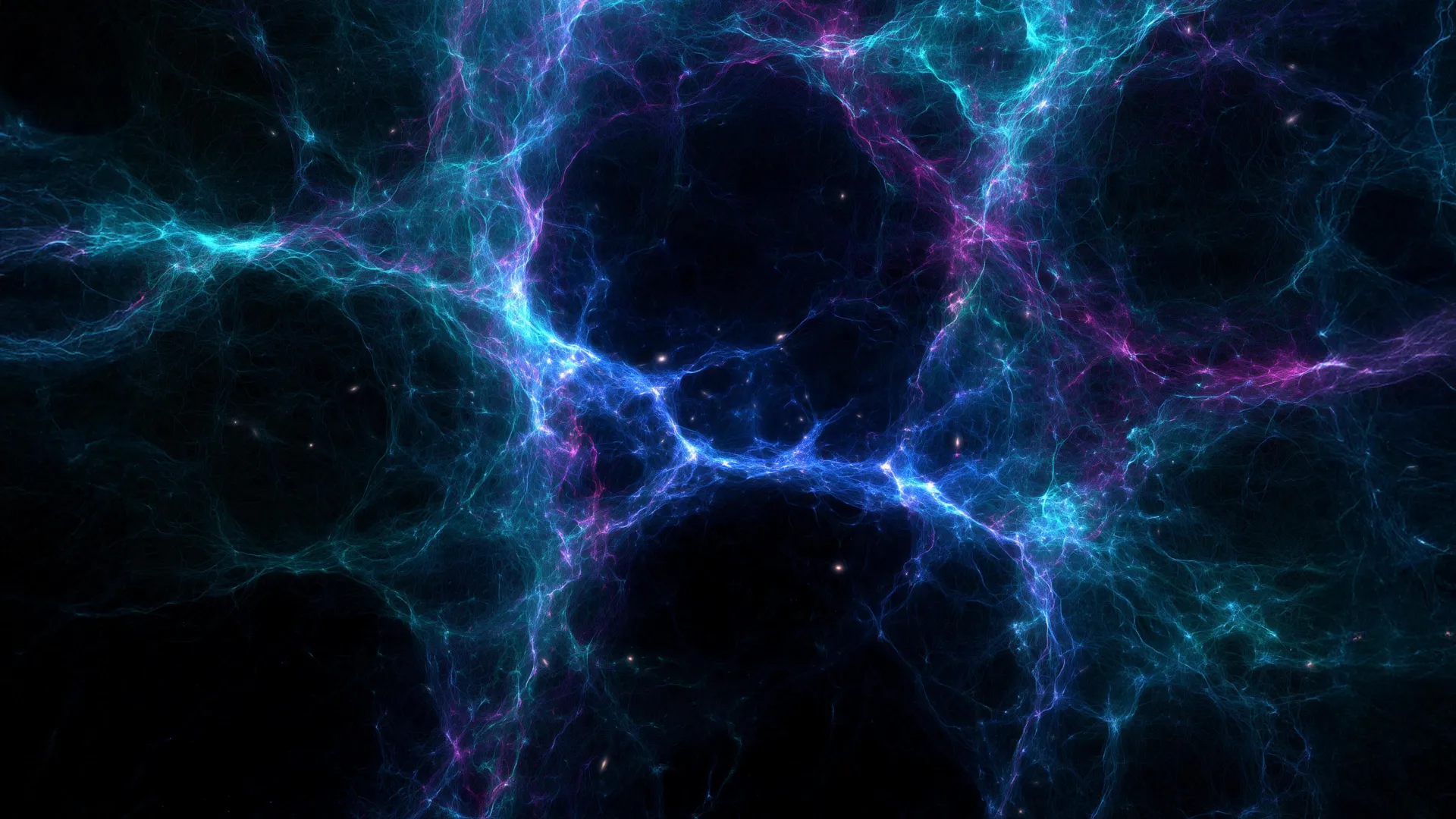
Astronomers detected an exceptionally faint radio signal from hydrogen using South Africa’s MeerKAT telescope. The signal came from billions of light-years away. This matters because hydrogen is spread throughout galaxies, so its radio glow can reveal where galaxies and matter exist across space. Rather than observing galaxies one at a time, the researchers measured their combined hydrogen emission across a huge region. The faint signal is like a blended whisper from many distant sources. Separating that whisper from stronger radio noise requires a sensitive telescope and careful analysis. The detection is an important demonstration, not yet a complete cosmic map. It shows that this method works on very large scales. With improved observations, astronomers may use it to build much larger three-dimensional maps of the Universe and study how matter is distributed and has changed over time.
Based on reporting by ScienceDaily
What did astronomers detect with the MeerKAT telescope?
Astronomers detected an exceptionally faint radio signal from hydrogen using South Africa’s MeerKAT telescope. The signal came from billions of light-years away. This matters because hydrogen is spread throughout galaxies, so its radio glow can reveal where galaxies and matter exist across space.
Rather than observing galaxies one at a time, the researchers measured their combined hydrogen emission across a huge region. The faint signal is like a blended whisper from many distant sources. Separating that whisper from stronger radio noise requires a sensitive telescope and careful analysis.
The detection is an important demonstration, not yet a complete cosmic map. It shows that this method works on very large scales. With improved observations, astronomers may use it to build much larger three-dimensional maps of the Universe and study how matter is distributed and has changed over time.
What is a hydrogen radio signal, and how can hydrogen produce radio waves?
A hydrogen radio signal is radio light emitted by hydrogen atoms. Astronomers often use neutral hydrogen’s distinctive 21-centimeter wavelength, also called the 1420-megahertz line. Because hydrogen is common in and around galaxies, this signal can act as a tracer of cosmic structure.
The signal comes from a tiny energy change inside a neutral hydrogen atom. The proton and electron each have spin. When their combined spin arrangement changes from a higher-energy state to a lower-energy state, the atom emits a radio photon. Each photon is weak, but enormous numbers of atoms can produce a measurable signal.
The article focuses on detecting this emission from extremely distant galaxies. Its success shows that astronomers can measure hydrogen collectively, even when individual galaxies are too faint or crowded to study separately. This approach can support wider surveys of the Universe.
How far away was the detected signal, and why is detecting such a faint signal difficult?
The detected hydrogen signal came from billions of light-years away. That means the radio waves began their journey when the Universe was much younger. Detecting them gives astronomers information about both distant galaxies and the earlier Universe.
The signal is difficult to measure because hydrogen emission from each distant galaxy is extremely faint by the time it reaches Earth. Individual signals can also overlap across the sky. Human-made transmissions, radio interference, and emissions from objects within our own Galaxy can be much stronger than the target signal.
MeerKAT’s detection shows that careful observations can recover this hidden, collective glow. The telescope does not need to make every galaxy appear as a bright separate point. Instead, researchers identify the statistical or combined hydrogen signal across a wide area, then use it to study large-scale cosmic structure.
How does measuring the combined hydrogen glow reveal galaxies that astronomers cannot easily observe one at a time?
Many distant galaxies are too faint, too small, or too crowded to observe individually. Yet each may contain hydrogen that emits the same recognizable radio signal. Measuring that shared signal lets astronomers detect the population as a whole rather than requiring a clear image of every galaxy.
For example, imagine many quiet voices speaking together. One voice may be impossible to hear, but the combined sound can become measurable. In hydrogen mapping, researchers collect radio data over a large region and look for the characteristic emission from many galaxies. Their signals add together, while unrelated noise can be reduced through analysis.
This method reveals structure that ordinary galaxy-by-galaxy surveys can miss. It does not necessarily identify each galaxy’s exact appearance. Instead, it measures where groups of galaxies and their hydrogen are concentrated, providing a broad view of matter across enormous cosmic distances.
How could this technique help astronomers create much larger three-dimensional maps of the Universe?
A three-dimensional map needs positions across the sky and a distance for each region. Hydrogen radio observations provide both kinds of information. The telescope records where the signal comes from, while its observed frequency helps indicate how far away the emitting material is.
Instead of cataloging galaxies one by one, astronomers divide the radio data into many sky areas and frequency ranges. Each range corresponds to hydrogen observed at a different cosmic distance because the expanding Universe shifts its radio frequency. Combining these measurements creates a three-dimensional intensity map of hydrogen and, therefore, the galaxies it traces.
The MeerKAT detection demonstrates that this strategy can recover a faint collective signal. Future surveys could cover much larger volumes than detailed individual-galaxy searches. Those maps would help researchers investigate how matter is distributed and how cosmic structure developed across time.
Why is hydrogen useful for tracing where galaxies and matter are spread across space?
Hydrogen is the most abundant element in the Universe and is found throughout galaxies, including in gas that may be difficult to see with ordinary telescopes. Its radio emission can travel across immense distances and carries information about the gas producing it. That makes hydrogen a valuable tracer of cosmic structure.
A galaxy may contain stars that are faint, obscured, or difficult to separate from neighboring objects. Hydrogen can still reveal the galaxy’s presence through its radio emission. When astronomers measure many galaxies together, their hydrogen glow outlines denser and emptier regions across space. These patterns reflect the large-scale distribution of matter.
The article’s MeerKAT result confirms that this tracer can be detected collectively from billions of light-years away. Hydrogen measurements will not replace every galaxy survey, but they can cover broad regions efficiently. That could make much larger maps of cosmic structure possible.
How do radio telescopes use light’s travel time and frequency changes to measure distance and reconstruct the expanding Universe?
Radio telescopes collect light, although radio light has much longer wavelengths than visible light. Light takes time to travel, so observing a distant source means seeing it as it was in the past. Greater distance generally means a longer look-back time and an older view of the Universe.
The expansion of space stretches light during its journey. This lowers the observed frequency and increases the wavelength, producing a redshift. By measuring how far a hydrogen radio line moved from its known frequency, astronomers estimate the source’s cosmic distance using an expansion model. The telescope’s direction supplies the source’s position on the sky.
Together, sky position and redshift create three-dimensional, time-layered maps. The map shows where hydrogen was located at different eras, not merely where it is today. The MeerKAT detection demonstrates that this approach can work even with extremely faint, combined signals.
Key Facts:
📌 - MeerKAT detected an exceptionally faint hydrogen radio signal.
📌 - The signal came from billions of light-years away.
📌 - It combined hydrogen glow from many galaxies.
📌 - Neutral hydrogen produces a distinctive 21-centimeter radio line.
📌 - A spin-state change releases each radio photon.
📌 - Hydrogen’s abundance makes it a useful cosmic tracer.
📌 - The signal traveled billions of light-years to Earth.