News · Science & Technology
Physicists zoom into the birth of cosmic rainstorms with new CERN study
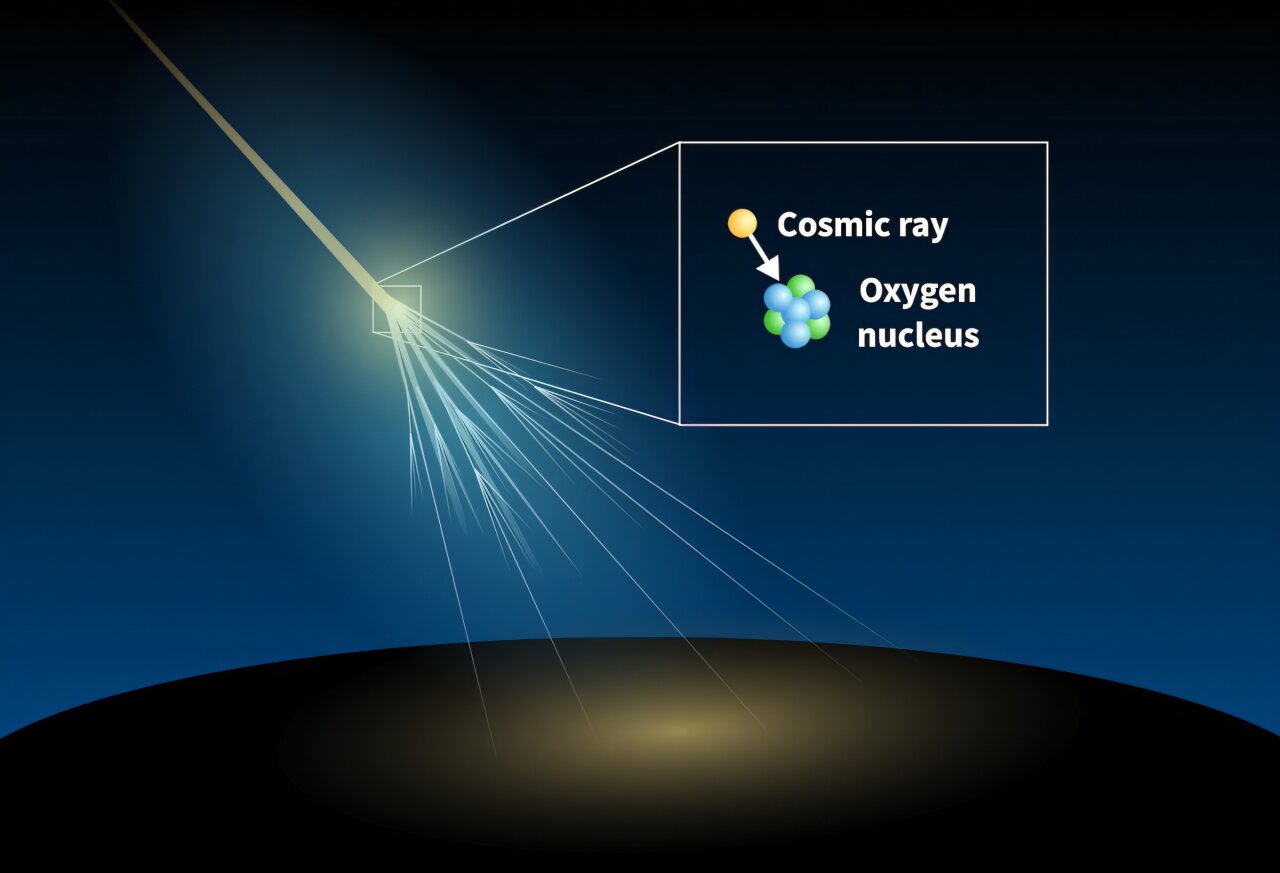
The supplied article does not identify a CERN study, its methods, or its results. Therefore, it cannot establish exactly what researchers investigated about the shower’s beginning. It does describe the opening event: a cosmic ray reaches Earth and strikes an atom high in the atmosphere. That impact breaks the atom apart and starts a shower of secondary particles. The article does not name the particle types, energies, or timing that a study might measure. This beginning matters because the first collision controls how the shower develops and what detectors may observe near the ground. However, details about CERN’s specific question must come from another source; they are not in this passage. From the article alone, the safest answer is that the study’s exact focus is unknown, while the general subject is how an atmospheric collision begins a particle shower.
Based on reporting by Phys.org
What did the new CERN study investigate about the beginning of cosmic-ray particle showers?
The supplied article does not identify a CERN study, its methods, or its results. Therefore, it cannot establish exactly what researchers investigated about the shower’s beginning.
It does describe the opening event: a cosmic ray reaches Earth and strikes an atom high in the atmosphere. That impact breaks the atom apart and starts a shower of secondary particles. The article does not name the particle types, energies, or timing that a study might measure.
This beginning matters because the first collision controls how the shower develops and what detectors may observe near the ground. However, details about CERN’s specific question must come from another source; they are not in this passage. From the article alone, the safest answer is that the study’s exact focus is unknown, while the general subject is how an atmospheric collision begins a particle shower.
What are cosmic rays, and where do they come from?
Cosmic rays are high-energy particles traveling through space. The article calls them a powerful type of interstellar matter. When they reach Earth, they arrive from above and continually enter the atmosphere. Their energy lets them trigger reactions that ordinary low-energy particles cannot.
The passage does not specify their exact sources. In established science, cosmic rays include particles from the Sun and from energetic events elsewhere in our galaxy and beyond. Many are protons or atomic nuclei. They move through space before colliding with atoms in the air.
That origin explains why cosmic rays are found throughout Earth’s atmosphere rather than only near one location. The article says they constantly strike atmospheric atoms, producing showers that rain toward the ground. So cosmic rays begin as energetic space particles, while the particles detected at Earth’s surface are often their products.
How many cosmic-ray particles pass through an average person's body, and how often?
The article gives a striking frequency but not a numerical count. It says particles zip through your body nearly at the speed of light every second. Thus, the safest answer is that cosmic-ray-related particles pass through a person continuously, with particles arriving during every second.
The passage does not say whether “particles” means one, several, or a larger measured number per second. It also does not provide a body-size average, a location, or a detector-based estimate. Those details would be needed to calculate an exact rate for an average person.
What is clear is the constant exposure. Cosmic rays strike atoms high in the atmosphere, creating showers whose secondary particles rain toward the ground. Some can pass through people. The article emphasizes their speed and nonstop arrival, not a precise personal particle count, so an exact number cannot be stated from this source.
What happens when a high-energy cosmic ray strikes an atom in Earth's atmosphere?
When a high-energy cosmic ray strikes an atom high in Earth’s atmosphere, the impact can break the atom apart. The collision transfers enough energy to create or release additional particles. Instead of one incoming particle continuing alone, the event produces many moving particles.
The article describes this as a shower: cosmic rays strike atmospheric atoms, and the impacts break them apart into particles that rain down. In a more detailed physical picture, the incoming particle hits an atomic nucleus or another atmospheric target. The resulting secondary particles may collide again, decay, or continue downward.
This matters because the ground receives evidence of the original space particle indirectly. Detectors or living bodies may encounter secondary particles rather than the first cosmic ray. The atmosphere therefore turns a single energetic collision into a broad stream of particles, spreading the event over distance as it moves toward Earth’s surface.
Why does one cosmic-ray collision create a cascade, or shower, of many particles?
A cosmic-ray collision creates a cascade because the incoming particle carries very high energy. When it hits an atmospheric atom, that energy can break the atom apart and produce secondary particles. The original event therefore creates more than one moving object.
Those secondary particles can keep the process going. Some strike other atoms, while others decay into different particles. Each new interaction can add more particles, spreading the energy through a widening shower. This is the key mechanism behind the article’s description of impacts producing a “shower” that rains toward the ground.
The cascade matters because a single cosmic ray can become easier to detect through its many products. It also explains why particles can be present at ground level even though the first collision occurs high above Earth. The atmosphere changes one energetic arrival into a large, developing chain of interactions.
Which particles are produced in these showers, and which ones can reach the ground?
The passage does not list the particles produced in a shower. It only says that cosmic-ray impacts break atmospheric atoms apart and create a shower of particles that rains toward the ground. Therefore, the exact particle inventory cannot be taken from this article alone.
In established particle physics, air showers can include pions and other short-lived particles, plus muons, electrons, photons, and neutrons. Some are produced high in the atmosphere and disappear through decay or absorption. Muons are especially important because many survive the trip to ground level. Neutrinos can also travel through Earth, though the passage does not mention them.
So, the article supports a general answer: secondary particles are produced, and some reach the ground. It does not identify which ones. Detailed experiments are needed to separate the shower’s different particles and measure how many survive the atmosphere.
How does Earth's atmosphere shield living things from cosmic radiation while still allowing some particles to reach us?
Earth’s atmosphere shields living things by placing a deep layer of air above the surface. Cosmic rays collide with atmospheric atoms before reaching us. Those impacts break particles apart and spread their energy through a shower, reducing the energy of the original radiation as it travels downward.
For example, one incoming cosmic ray can trigger many secondary particles high in the sky. Some particles are absorbed, lose energy, or decay before reaching the ground. Others, including many muons, are penetrating enough to continue downward. This matches the article’s image of particles raining from atmospheric showers to the surface.
The protection is therefore strong but incomplete. The atmosphere blocks or weakens much of the original cosmic radiation, rather than stopping every particle. Some secondary particles still pass through people every second, as the article states. At higher altitudes, less atmosphere lies overhead, so exposure generally increases; at ground level, the remaining radiation is much more reduced.
Key Facts:
📌 The article does not identify the CERN study’s exact research question.
📌 A cosmic-ray collision starts the atmospheric particle shower.
📌 The passage gives no study methods, results, or measured particle details.
📌 Cosmic rays are high-energy particles traveling through space.
📌 They constantly enter and strike atoms in Earth’s atmosphere.
📌 The article does not specify their exact astronomical sources.
📌 Particles pass through your body every second.