News · Politics & Governance
Parliament street shuts down for much of the day; opposition parties step up protest against CEC Gyanesh Kumar, leaders held
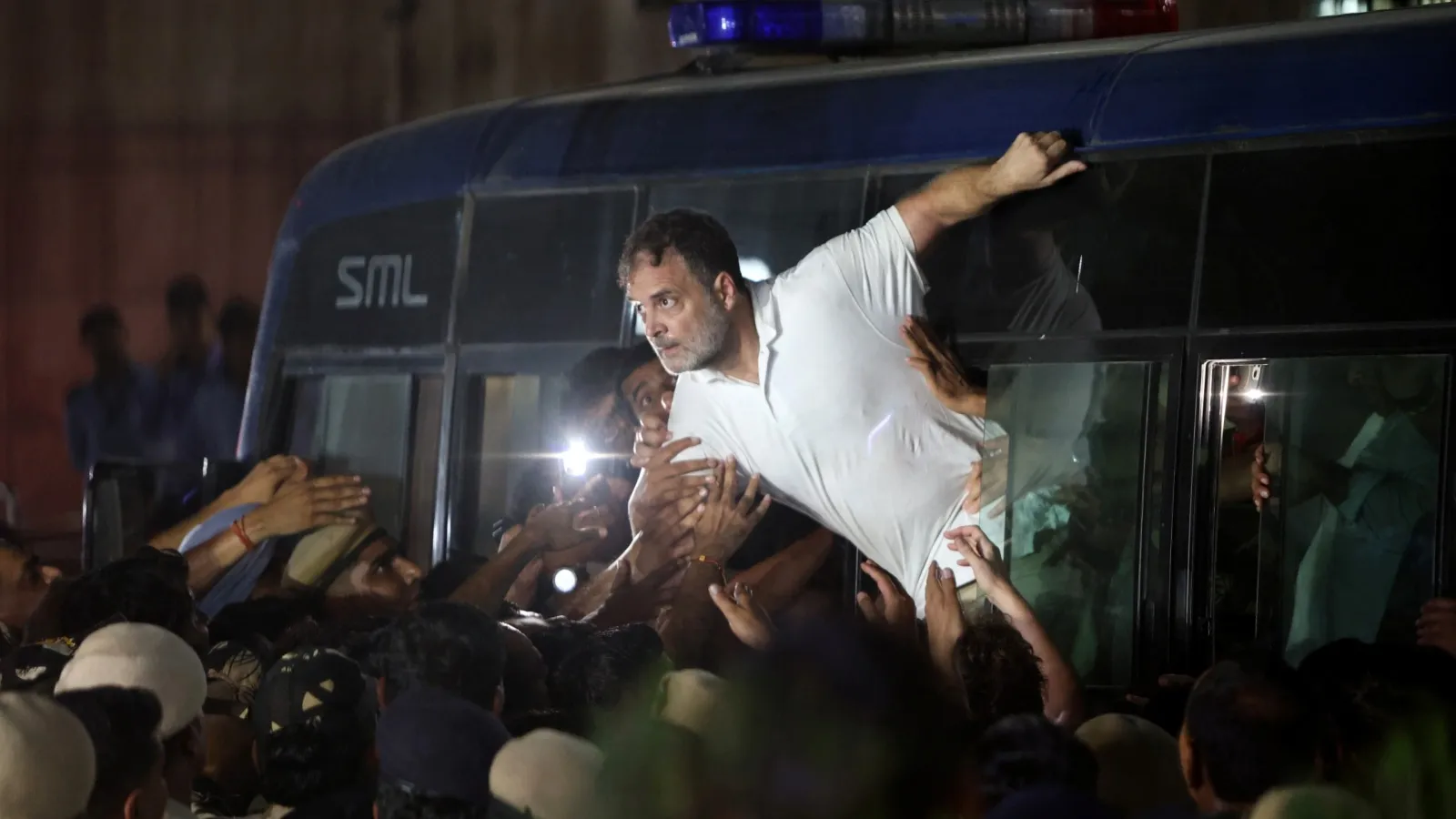
The protest began as INDIA bloc MPs marched from Parliament toward Nirvachan Sadan, the Election Commission headquarters. They demanded Chief Election Commissioner Gyanesh Kumar’s resignation. Rahul Gandhi said he wanted to tell Kumar that he had committed “vote chori,” an allegation about electoral-roll changes. Police stopped the march near Akashvani Bhavan, next to the Commission. Gandhi climbed over barricades, while he, Priyanka Gandhi Vadra, and Congress MPs entered the complex and held a sit-in. Police had heavily barricaded roads leading to Nirvachan Sadan. The barriers prevented the crowd from reaching the headquarters and contained the protest. The standoff lasted about eight hours. Police eventually detained Gandhi, Vadra, and other leaders, taking them to a police facility. The action disrupted movement around the area for much of the day. It also showed how the dispute over the special intensive revision had moved from parliamentary criticism to a direct street confrontation.
Based on reporting by Indian Express
What happened during the opposition’s protest outside the Election Commission headquarters, and why was Parliament Street shut for much of the day?
The protest began as INDIA bloc MPs marched from Parliament toward Nirvachan Sadan, the Election Commission headquarters. They demanded Chief Election Commissioner Gyanesh Kumar’s resignation. Rahul Gandhi said he wanted to tell Kumar that he had committed “vote chori,” an allegation about electoral-roll changes.
Police stopped the march near Akashvani Bhavan, next to the Commission. Gandhi climbed over barricades, while he, Priyanka Gandhi Vadra, and Congress MPs entered the complex and held a sit-in. Police had heavily barricaded roads leading to Nirvachan Sadan. The barriers prevented the crowd from reaching the headquarters and contained the protest.
The standoff lasted about eight hours. Police eventually detained Gandhi, Vadra, and other leaders, taking them to a police facility. The action disrupted movement around the area for much of the day. It also showed how the dispute over the special intensive revision had moved from parliamentary criticism to a direct street confrontation.
What is a special intensive revision of electoral rolls, and why does it involve adding or removing voters’ names?
A special intensive revision, or SIR, is a detailed review of electoral rolls. Its purpose is to verify that listed voters are eligible and that important details are accurate. Unlike a routine update, an intensive revision can involve broad checking of existing entries and fresh claims for inclusion. The article names the SIR but does not explain its exact procedure.
Names may be added when eligible citizens reach voting age, move into an area, or were previously left out. Names may be removed when people die, move away, appear more than once, or cannot meet eligibility requirements. The key mechanism is verification of voter records before the roll is finalised.
This process matters because electoral rolls determine who can cast a ballot. Accurate revision can prevent duplicate or ineligible voting while restoring legitimate voters. Poorly handled revision can wrongly exclude citizens. That is why the opposition’s allegations and the Commission’s procedures have become politically significant.
How long did the standoff last, and how many formal objections by other Election Commissioners were cited in the investigation?
The confrontation continued for roughly eight hours, from the afternoon protest and sit-in until police detained the leaders in the evening. Rahul Gandhi, Priyanka Gandhi Vadra, and other opposition figures were later taken toward the Kingsway Camp police facility. Their detention marked the immediate end of the physical standoff, not the political dispute.
The article also cites an investigation by The Indian Express. It reported that Election Commissioners Sukhbir Singh Sandhu and Vivek Joshi had objected on record 14 times in 10 months to steps taken under Chief Election Commissioner Gyanesh Kumar. The reported objections included concerns about being kept in the dark, adding voters, and deleting names.
Those figures became a central reason for the opposition’s demand that Kumar resign. They do not, by themselves, establish that electoral changes were unlawful. They do show that disagreements inside the Commission were formally recorded. The dispute is therefore about both the voter-roll process and the institution’s internal decision-making.
Who is the Chief Election Commissioner, what is the Election Commission’s role, and why are protesters demanding Gyanesh Kumar’s resignation?
Gyanesh Kumar is the Chief Election Commissioner, the senior member of India’s Election Commission. The Commission is a constitutional body responsible for supervising elections to Parliament, state legislatures, and the offices of President and Vice-President. It also oversees electoral rolls and election procedures. The article identifies Kumar as the protest’s main target.
The protesters accuse the Commission of “vote chori,” meaning they allege that electoral-roll decisions could unfairly add or remove voters. Their demand intensified after The Indian Express reported 14 recorded objections by Election Commissioners Sukhbir Singh Sandhu and Vivek Joshi. The objections reportedly concerned information-sharing and voter additions and deletions.
These are political allegations, not findings established by the article as legal fact. The protest sought Kumar’s resignation and a meeting with the Commission. The controversy now places pressure on the Commission to explain its revision process, internal disagreements, and safeguards for eligible voters.
What immediate consequences did the protest have for the leaders, the roads around Parliament, and relations among INDIA bloc parties?
The immediate result was detention. Rahul Gandhi, Priyanka Gandhi Vadra, and several Congress and opposition leaders were taken to police facilities after the sit-in and negotiations ended. Roads leading to Nirvachan Sadan stayed heavily barricaded, restricting access and traffic around the Election Commission. Vadra was eventually allowed through a gate after climbing it amid a crowd.
The protest also strained opposition coordination. Congress leader K. C. Venugopal reportedly told INDIA bloc parties that the leadership had acted suddenly and regretted the mistrust caused by not informing allies. Some allies felt the Gandhi siblings had dominated the protest by sitting separately at Akashvani Bhavan.
A Left MP said allies would not have agreed to seek an Election Commission meeting while demanding the CEC’s resignation. The TMC joined later after Congress calls. Meanwhile, the BJD unexpectedly sent two MPs, while the DMK was absent. The episode therefore produced both visible unity and behind-the-scenes disagreement.
How can changes to electoral rolls affect who is able to vote and the fairness of an election?
Electoral rolls are the official lists used to determine who may vote. If an eligible citizen’s name is missing, that person may be unable to cast a ballot even if otherwise qualified. If an ineligible, duplicate, or deceased person remains listed, the roll may become less accurate. The article’s dispute matters because the SIR could affect these entries.
The mechanism is administrative but powerful. Officials verify voter details, accept claims for inclusion, and process objections or deletion proposals. A name can be added after eligibility is established, or removed after evidence shows ineligibility, duplication, or relocation. Notice and an opportunity to challenge decisions are important safeguards in such processes.
Accurate rolls support equal participation and public confidence. Errors can disproportionately affect mobile residents, first-time voters, or people with weak documentation. The article does not establish that particular voters were wrongly removed. It does show why alleged additions and deletions, and the Commission’s explanations, have become central to the fairness debate.
How is the Election Commission of India intended to remain independent from the government and accountable to voters, political parties, and the courts?
The Election Commission of India is an autonomous constitutional authority under Article 324. It supervises elections and electoral rolls, while the government provides administrative cooperation. Its independence is intended to stop the ruling party from controlling who votes or how elections are conducted. The article focuses on the protest and does not describe these constitutional safeguards.
The Commission is headed by a Chief Election Commissioner and other Election Commissioners. Appointments are made by the President under the governing legal framework. The CEC has stronger removal protection: removal follows a process similar to that for a Supreme Court judge, while other Election Commissioners have related protection against arbitrary removal. Courts can review unlawful decisions.
Accountability also comes through public reasons, published rolls, objections, party scrutiny, legislative oversight, and judicial challenges. Voters can respond politically to perceived failures. Independence does not mean immunity from criticism. The reported internal objections and the protest underline the continuing need for transparent procedures and credible explanations.
Key Facts:
📌 Rahul Gandhi and Priyanka Gandhi Vadra were detained after an eight-hour standoff.
📌 Protesters held a sit-in inside the Akashvani Bhavan complex.
📌 Police barricaded roads leading to Nirvachan Sadan.
📌 SIR means a detailed review of electoral-roll entries.
📌 Eligible citizens may be added to the rolls.
📌 Ineligible, duplicate, or deceased entries may be removed.
📌 The standoff lasted about eight hours.