News · Social Issues
Thousands of protesters trap Polish bishop in church amid anger over dismissal of local priest
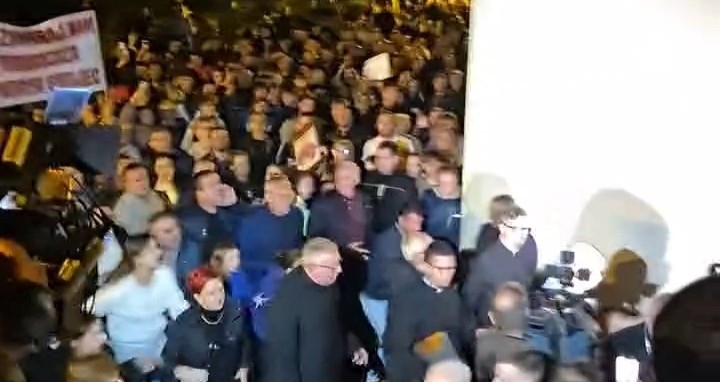
Thousands of people gathered at the church in Grojec after the diocese removed their popular priest, Józef Zborek, following almost 30 years of service. The protest showed how strongly local loyalty could clash with centralized church authority. Before the bishop’s arrival, protesters surrounded the building with signs supporting Zborek. Some entered and disrupted the Eucharist. Pindel and other priests withdrew to the sacristy, where protesters continued shouting. Videos reportedly showed some people physically attacking the bishop before others pulled them away. Police brought specialist negotiators, but efforts to calm the crowd failed. Pindel said the dismissal had been confirmed by the Vatican and was final. Because protesters blocked the exits, officers escorted him from the church after midnight. The diocese later said the crowd had threatened priests’ health and lives.
Based on reporting by Notes from Poland
What happened when protesters gathered around the church in Grojec, and why was the bishop eventually escorted out by police?
Thousands of people gathered at the church in Grojec after the diocese removed their popular priest, Józef Zborek, following almost 30 years of service. The protest showed how strongly local loyalty could clash with centralized church authority.
Before the bishop’s arrival, protesters surrounded the building with signs supporting Zborek. Some entered and disrupted the Eucharist. Pindel and other priests withdrew to the sacristy, where protesters continued shouting. Videos reportedly showed some people physically attacking the bishop before others pulled them away.
Police brought specialist negotiators, but efforts to calm the crowd failed. Pindel said the dismissal had been confirmed by the Vatican and was final. Because protesters blocked the exits, officers escorted him from the church after midnight. The diocese later said the crowd had threatened priests’ health and lives.
How many people took part in the protest, and how large was the crowd compared with Grojec’s population?
Local reports estimated that about 3,000 people gathered in Grojec on Sunday evening. The municipality has an official population of around 3,200. Even allowing for an approximate protest estimate, the crowd was exceptionally large for a village community.
The comparison is striking: 3,000 divided by 3,200 is about 94%. The article does not establish that every participant lived in Grojec, since it describes parishioners and people who attended the church. Still, the figures show that the dispute reached far beyond a small group of activists.
This scale helps explain why the bishop could not simply leave after the service. Thousands surrounded the church, and protesters blocked its exits. Police negotiators were called, but officers eventually escorted the bishop away. The turnout demonstrated the priest’s unusual popularity and the depth of local anger over his dismissal.
What is canon law, and how was it used to remove the local priest and uphold that decision?
Canon law is the body of rules governing the Catholic Church’s organization, responsibilities, discipline, and procedures. It matters here because the priest’s removal was handled through church proceedings rather than a Polish civil court. The diocese said the process found serious, proven irregularities in his duties.
The article says Zborek was able to defend himself and repeatedly appeal the decision. He took the case to the Vatican, but the decision was upheld. The bishop then removed him from his parish position on Saturday. Church officials also said only Zborek could disclose the specific reasons, because of canon-law rules.
The public therefore knows the outcome but not the alleged conduct itself. The diocese described the process as complete and final. That secrecy intensified local frustration, because parishioners supported Zborek but could not assess the undisclosed allegations. The episode shows how internal church law can produce binding decisions within a parish.
Who has authority over a parish priest in the Catholic Church, and what roles did the bishop and the Vatican play in this case?
In Catholic structure, a parish priest serves under the authority of the diocese, normally led by a bishop. The bishop oversees parish assignments and can take disciplinary action under canon law. This arrangement gives the wider church authority over local clergy, even when parishioners feel strong personal loyalty to one priest.
In Grojec, Bishop Roman Pindel visited the parish after Zborek’s removal and tried to explain the decision. The diocese said Zborek had been found responsible for serious, proven irregularities. Zborek appealed repeatedly, eventually taking the case to the Vatican, which upheld the decision.
The bishop therefore carried out the local removal, while the Vatican served as the higher reviewing authority described in the article. Pindel told protesters that the decision was final. The confrontation showed the tension between formal hierarchy and a community that believed its longtime priest should remain. It did not change the church’s stated outcome.
What consequences can a priest’s dismissal have for parishioners who depend on him for services such as baptisms, first communion, weddings, and funerals?
A parish priest often becomes the person families rely on for baptisms, first communion preparation, weddings, funerals, and pastoral guidance. Removing him can therefore feel personal and practical, not merely administrative. Parishioners may lose a trusted relationship and need to work with a replacement priest.
The article says Zborek accepted children other priests had turned away for first communion and had no problem baptising children born outside marriage. One local theory also claimed he did not charge parishioners for sacraments, though this was not confirmed as the reason for dismissal. These practices help explain his strong support.
The article does not say that baptisms, weddings, funerals, or other services stopped. Those services would ordinarily remain available through the parish or another priest, though arrangements could change. The immediate documented consequence was disruption and anger. Longer term, the diocese must rebuild trust while applying its final decision.
What formal avenues of appeal were available to the priest, and how do internal church appeals differ from appeals in a civil court?
The article says Zborek repeatedly challenged the decision to remove him and eventually took the case to the Vatican. It does not list every procedural stage or identify a specific tribunal. The confirmed formal avenue was an internal church appeal that reached the Vatican.
Church appeals examine a matter under canon law and are decided by authorized ecclesiastical bodies. In this case, the diocese said Zborek had received a full process, could defend himself, and could appeal. The Vatican ultimately upheld the removal, so the bishop treated the decision as final.
A civil-court appeal belongs to a country’s public legal system and can concern enforceable state law, legal rights, evidence, and judicial remedies. An internal church appeal instead addresses the church’s own offices, rules, and disciplinary decisions. The article does not say whether any civil court case occurred. It reports only that the church process ended without reversing the dismissal.
How do large religious institutions balance centralized authority and local communities’ loyalty to an individual leader?
Large religious institutions need centralized authority to keep doctrine, discipline, and leadership decisions consistent across many communities. They also depend on local congregations, which attend services, support clergy, and build relationships with particular leaders. Stability requires both levels to function together.
Grojec provides a clear example. The diocese said Zborek’s removal followed a complete canon-law process, and the Vatican upheld it. Yet around 3,000 people reportedly protested because they valued his nearly 30 years of local service. Some said he welcomed children other priests had rejected and did not charge for sacraments, though the latter was only a local theory.
The outcome shows that formal authority can prevail without ending local resentment. The diocese asked parishioners to accept the decision in faith and unity, but rebuilding trust may take time. Future leadership will need to explain what can be disclosed, support parish services, and address the community’s sense of loss.
Key Facts:
📌 About 3,000 people surrounded the church in Grojec.
📌 Some protesters disrupted the Eucharist and physically attacked the bishop.
📌 Police escorted Bishop Pindel away around 1 a.m.
📌 Local media estimated around 3,000 protesters.
📌 Grojec’s municipality has about 3,200 official residents.
📌 The reported crowd equaled roughly 94% of that population.
📌 Canon law governs the Catholic Church’s internal procedures and discipline.