News · Defence & Security
Yemen's Houthis claim strikes on Aden, Riyadh airports
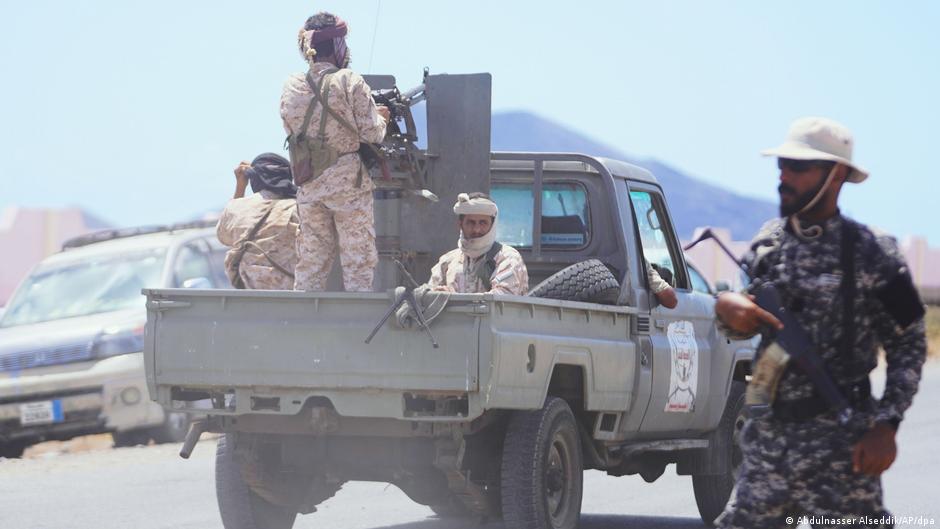
The Houthis claimed a broad strike campaign against aviation targets in Yemen and Saudi Arabia. They said they attacked Aden International Airport, King Khalid International Airport in Riyadh, Abha International Airport, and an air base in Khamis Mushait. These claims mattered because they extended the fighting beyond Yemen’s front lines and toward civilian air travel. Aden’s incident had outside reporting. Yemen’s Transport Ministry said a missile landed near the runway, while a Cairo flight diverted to Jeddah and aircraft were moved away. The Saudi-led coalition separately said it intercepted and destroyed a ballistic missile north of Riyadh, tracing its launch to Sanaa. That confirms an incoming missile, but not necessarily every claimed target. The Riyadh airport attack had no immediate confirmation. Saudi authorities also did not immediately confirm the Abha claim. The article says it was unclear whether the Khamis Mushait claim matched the missile intercepted near that area, so several Houthi claims remained unverified.
Based on reporting by DW News
Which attacks did the Houthis claim, and which incidents were independently reported or confirmed by other sources?
The Houthis claimed a broad strike campaign against aviation targets in Yemen and Saudi Arabia. They said they attacked Aden International Airport, King Khalid International Airport in Riyadh, Abha International Airport, and an air base in Khamis Mushait. These claims mattered because they extended the fighting beyond Yemen’s front lines and toward civilian air travel.
Aden’s incident had outside reporting. Yemen’s Transport Ministry said a missile landed near the runway, while a Cairo flight diverted to Jeddah and aircraft were moved away. The Saudi-led coalition separately said it intercepted and destroyed a ballistic missile north of Riyadh, tracing its launch to Sanaa. That confirms an incoming missile, but not necessarily every claimed target.
The Riyadh airport attack had no immediate confirmation. Saudi authorities also did not immediately confirm the Abha claim. The article says it was unclear whether the Khamis Mushait claim matched the missile intercepted near that area, so several Houthi claims remained unverified.
What are ballistic missiles and explosive-laden drones, and how do they differ as weapons?
A ballistic missile is a weapon that receives powerful acceleration at launch, then travels much of its route along a high, curved path before descending toward its target. It can cover long distances quickly and carry a conventional explosive warhead. Its predictable flight path still allows advanced defenses to track and intercept it.
An explosive-laden drone is an unmanned aircraft packed with explosives. It is guided remotely or programmed to fly toward a target and crash into it. Unlike a ballistic missile, it uses aircraft-like flight for much or all of its journey. Drones are often slower, but they can fly low, change direction, and arrive in groups.
The article says the Houthis used both weapons against Aden and claimed drone attacks on Saudi airports. The difference affects defense. Missiles demand rapid detection and interception, while drones may challenge radar systems because of their smaller size and lower flight.
How many airports and military sites were named as targets, and how many incoming missiles were reported as intercepted?
The article names three airports as targets: Aden International Airport in Yemen, King Khalid International Airport in Riyadh, and Abha International Airport in Saudi Arabia. It also names an air base in Khamis Mushait. That makes four aviation-related sites, including three civilian airports and one military facility.
The reported interception count is one incoming ballistic missile. The Saudi-led coalition said it intercepted and destroyed that missile north of Riyadh. It tracked the launch to a site in Houthi-controlled Sanaa. This is a report from the coalition, not a claim that every incoming weapon was stopped.
The Houthis claimed attacks using multiple missiles and drones. However, the article does not provide a total number of weapons launched or intercepted. It also says the Khamis Mushait claim might or might not relate to a missile intercepted near that area. Thus, the confirmed count in the article is one interception.
What happened to civilian flights and aircraft at Aden International Airport because of the nearby missile strike?
The nearby missile strike disrupted civilian aviation at Aden International Airport. It landed near the runway only minutes before a flight from Cairo was scheduled to land. The timing created an immediate danger for passengers, crew, and airport workers, even though the article does not report a direct hit on the terminal or an aircraft.
The Cairo flight was diverted to Jeddah instead of landing in Aden. Airport staff also moved two planes that were already on the runway away from the threatened area. These actions reduced the chance that another strike would damage aircraft or injure people on the ground.
The episode shows how even a near miss can interrupt air travel. The Transport Ministry said officials feared further attacks, so normal airport operations could not continue safely. The article does not say how long the disruption lasted or whether the airport closed permanently, but it clearly affected an arriving flight and aircraft on the ground.
Why is Aden International Airport important to Yemen, and why might an airport be a strategic target during a war?
Aden International Airport matters because the article identifies it as Yemen’s main international gateway outside Houthi control. That makes it an important link for passengers, aid, trade, officials, and forces aligned with the government. Disrupting it can isolate areas held by the Saudi-backed government and create wider economic and humanitarian problems.
The reported strike shows the practical effect. A missile landed near the runway just before a Cairo flight was due to arrive. The flight diverted to Jeddah, and two aircraft on the runway were moved away. The airport’s location and connections therefore became a vulnerability during fighting.
Airports can also be strategic because they support surveillance, transport, and military logistics, even when they serve civilians. Attacking or threatening one can pressure an opponent without capturing territory. In this case, the article does not establish the Houthis’ specific motive, but the strike came during intensified fighting and a government counteroffensive along the Red Sea coast.
Why are the Houthis fighting Yemen's Saudi-backed government, and why is Saudi Arabia leading a coalition against them?
The article presents the immediate conflict as a struggle between Houthi insurgents and Saudi-backed Yemeni government forces. It says government troops launched a counteroffensive after the Houthis gained territory along the Red Sea coast. More broadly, the Houthis are a Zaydi Shia movement that rebelled against Yemen’s central government, seized Sanaa in 2014, and challenged the political order.
Saudi Arabia began leading a coalition in 2015 after President Abd-Rabbu Mansour Hadi’s government requested military help. Saudi leaders viewed the Houthi advance as a threat on their southern border and feared growing Iranian influence, although Iran’s level of control over the Houthis is disputed. The coalition has provided air support and backed government forces.
The article shows that this conflict remains active. Government forces reportedly retook areas near the Bab el-Mandeb Strait and Mocha, while Houthi attacks reached airports in Yemen and Saudi Arabia. Continued territorial shifts raise the risk of further missile and drone strikes.
What is the Bab el-Mandeb Strait, and why does control of this narrow waterway matter for regional power and global shipping?
The Bab el-Mandeb Strait is the narrow sea passage between Yemen on the Arabian Peninsula and Djibouti and Eritrea in Africa. It connects the Red Sea to the Gulf of Aden and the wider Indian Ocean. Ships using the Suez Canal route pass through this gateway when traveling between Europe and Asia.
Its geography gives the strait unusual strategic value. A force controlling or threatening nearby territory can potentially monitor shipping, disrupt commercial traffic, or pressure rivals. The article says government forces drove the Houthis out of areas around Bab el-Mandeb and the port city of Mocha. That shows the waterway is tied directly to the ground war.
Control does not automatically mean total control of global shipping. Naval forces and international patrols also matter. Still, fighting near the strait can raise insurance costs, delay ships, and threaten energy and trade routes. Any escalation there could therefore affect countries far beyond Yemen and Saudi Arabia.
Key Facts:
📌 Houthis claimed attacks on three airports and one air base.
📌 Aden’s missile strike was reported by Yemen’s Transport Ministry.
📌 Saudi Arabia confirmed one missile interception, not every claimed attack.
📌 Ballistic missiles travel mainly on high, arcing trajectories.
📌 Explosive-laden drones are unmanned aircraft designed to crash into targets.
📌 Missiles are generally faster; drones can fly lower and maneuver.
📌 Three airports were named: Aden, King Khalid, and Abha.